Seems like this blog cracked the 1,000 visitors and 2,000 views thresholds. Still feels weird writing English numbers with what looks like the German decimal comma, though.
Wehrten wir nicht den Anfängen?
Hatten wir nicht gehofft, dass alles einmal besser werden würde? Haben wir nicht Holocaust Education und Erziehung zum mündigen Staatsbürger im Schulsystem großgeschrieben? Haben wir nicht dafür gesorgt, dass alle ein Interesse am Funktionieren unserer Demokratie haben? Haben wir nicht alles getan, was menschenmöglich ist um der unmenschlichen braunen Woge Einhalt zu gebieten?
Nein, haben wir nicht. Wir haben in den letzten Jahrzehnten viel versäumt – von der Bekämpfung der Politikverdrossenheit, über die zunehmend unmenschliche Bürokratisierung der sozialen Hilfe bis zum Unwillen sich mit der Tatsache, dass wir in einer multikulturellen Gesellschaft leben, auseinanderzusetzen. Nun kommt die Retourkutsche der rechten Hassprediger, die – aufbauend auf realen und vermeintlichen sozialen Ungerechtigkeiten und volkstümelnden Verschwörungstheorien – ein Süppchen kochen, das mit dem sozialen Miteinander – auch unter “Deutschen” verschiedener Schichten – rein gar nichts mehr zu tun hat.
Die AfD – ersetzen Sie das je nach Wutlevel und gegenwärtigem Artikulationsvermögen durch Alternative für Deppen, Dumme oder Demagogen – kann eines gut und das ist Menschen das Gefühl zu geben, dass es okay ist andere zu hassen. Nein, rechtsradikal würde man dadurch noch lange nicht. Die bösen Medien, die naive Bundeskanzlerin und die frauenfeindlichen Flüchtlinge – das seien doch alles Dinge, die man hassen kann – ja als guter Deutscher hassen muss. Und eine Erlaubnis zum Hassen befreit. Man muss sich nicht mehr verstellen. Man kann endlich gegen all diese Asylanten, Homos, Gutmenschen und FrauenrechtlerInnen wettern und bekommt dabei Rückenwind von “normalen” Bürgen – von Leuten, die auch von öffentlich-rechtlichen Sender nicht als rechtsradikal bezeichnet werden. Das fühlt sich gut an. Man muss sich endlich nicht mehr verstellen.
Das hat sich auch schon in den 20ern gut gemacht. Vieles heute erinnert an die Weimarer Zeit. Es fehlt lediglich das öffentlichkeitswirksame Aussprechen antisemitischer Parolen durch hohe AfD-Funktionäre. Da ich ja einmal einigen hochkarätigen Professoren Rede und Antwort zur ersten deutschen Demokratie stehen musste, hier ein paar erschreckende Parallelen:
Die Weltwirtschaftskrise wurde nach der Finanzkrise immer wieder beschworen. Es schien eine Weile so, als ob wir aber diese neue Krise ohne größeren Schaden für die Demokratie überwinden könnten. Aber genau diese Krise war es, die mit all ihren Folge, inklusive der “Euro-Rettung” die AfD den Einzug in die öffentliche Arena erlaubt hat. So, wie es einst auch der NSDAP gelungen war von einer kleinen Splitterpartei zu einer die Reichspolitik erschütternden Kraft zu werden.
Tatsächliche weist die Hochrechnung für Sachsen-Anhalt eine geradezu frappierende Ähnlichkeit zur Reichstagswahl von 1930 auf:

Quelle: de.wikipedia.org

Quelle: tagesschau.de
Abgesehen davon, dass SPD und Zentrum / CDU ihre Anteile vertauscht haben, ergibt das tatsächlich ein sehr ähnliches Bild. Die Fünf-Prozent-Hürde hält die NPD aber noch zurück und allgemein gibt es natürlich weniger Stimmen für kleinere Parteien. Trotzdem nicht gerade ein rosiger Vergleich. Die AfD schneidet sogar noch besser ab als die Original-Nazis.
Wir haben, zum Glück, keine vergleichbare Massenarbeitslosigkeit wie 1930, aber im Gegensatz zu früheren Jahrzehnten existiert eine starke soziale Verunsicherung, die viele Menschen den radikalen Rattenfängern in die Arme treibt. Die große Zahl von Flüchtlingen, die keine andere Lösung mehr sehen als ihre Heimat zu verlassen, braucht den Vergleich mit den in der Zwischenkriegszeit herrschenden Problemen (Minderheitenrechte, Reparationen, psychologische Effekt der Niederlage im 1. Weltkrieg) nicht zu scheuen.
Und genau diese Menschen werden zu einem Feindbild hochstilisiert, wie es damals die jüdischen Deutschen waren. Jeder Vorfall, bei dem es zu Übergriffen von Seiten der Flüchtlinge kommt, wird aufgegriffen – egal ob real oder fiktiv, während die Brandanschläge unter den Teppich gekehrt und fast schon als alltäglich betrachtet werden. Ohne real-existierende Probleme wegreden zu wollen, kann man doch mit Fug und Recht davon sprechen, dass die Hetze am rechten Rand stark in Richtung von Ritualmord-Vorwürfen geht. Die Berichterstattung nach den Kölner Ausschreitungen ist ein gutes Beispiel dafür.
Auch zeigt hier sehr hässlich das Frauenbild der AfD: Als Opfer “wildgewordener Nordafrikaner” verteidigt man sie gerne. Dafür müssen sie aber zu den Herd gekettete Dienstmägden werden, die ohne einen Mann an ihrer Seite ihre Daseinsberechtigung verlieren. “Die Würde der Frauen ist unantastbar” respektive “Traditionelle Geschlechterrollen verteidigen” heißt das im AfD-Jargon. Hoffen wir, dass dies nicht eines Tages in einem neuen Mutterkreuz und BdM endet.
Verteidigen tut die AfD auch gerne unsere Polizei. Zu solchen Bestrebungen hier eloquent der unnachahmliche Georg Kreisler. Noch können wir uns mehr oder minder auf die Polizisten und Polizistinnen verlassen, doch die AfD rekrutiert, wie seinerzeit die NSDAP, gerne unter den Mitbürgern in grün. Auf der AfD-Wahlliste zum Stadtrat waren – auch in Mannheim – fünf Polizeikommissare. Da Justitia bekanntermaßen auf dem rechten Auge etwas kurzsichtig ist, sollte das einem schon zu denken geben. Zum Glück versteht sich Frau Petry sehr gut darauf auch Polizisten zu brüskieren. Morddrohungen aus dem AfD-Umfeld wurden bislang trotzdem noch nicht strafrechtlich geahndet.
Die Idee den regierenden Parteien einen Denkzettel zu verpassen kam natürlich auch schon in der Weimarer Republik auf. Genauso wie Hasspropaganda, die besonders in verwundbaren Wahlkreisen verteilt wurde:

Quelle: Mein Briefkasten
Dass dreiste Lügen Erfolg haben können, zeigt der Sieg des Direktkandidaten der AfD in Mannheim Nord, des seinerzeit (2006) letzten roten Wahlkreises des Landes. Es reichen durchaus 0,8% mehr um zu gewinnen und ich fresse einen Besen, der vor dem Haus des AfD-Kandidaten gekehrt hat, dass dieses Schandblatt etwas damit zu hatte.
Was die AfD auch gerne tut, ist zu behaupten, dass unsere demokratischen, rechtsstaatlichen und sozialstaatlichen Organe versagt haben. Da hat sie ebenfalls gute Vorläufer aus der Weimarer Zeit – von der DNVP, über den Stahlhelm bis zu Strassers und Hitlers Mannschaft.
Wo stehen wir damit? Müssen wir uns dem brauen Mob ergeben? Nein! Es ist zwar zu spät für “Wehret den Anfängen”, aber durch entschlossenes Entgegentreten könnte der Geist wieder zurück in die Flasche gebannt werden – Ja, am besten mit einem schönen Salomonssiegel drauf – das wäre was!
Was jetzt Not tut, ist klar zu sagen, was die AfD ist: rechtsradikal. Jeder, der sie wählt, wählt eine rechtsradikale, antidemokratische, freiheits- und friedensfeindliche Partei, die gegen Gleichstellung und gegen jede Art des friedlichen Zusammenlebens verschiedenster Menschen ist. Die Politik muss den Mund aufmachen und die Presse ebenso. Nicht mehr “Die AfD ist ja keine rechtsradikale Partei”, sondern endlich die Maske von der Fratze und laut gesagt, wer der Feind ist. Mit solchen Gruppierungen darf es keine Verhandlungen, kein Arrangieren und um Himmels Willen kein demokratisches “Einrahmen” in Koalitionen geben.
Um es nochmals zu sagen: Das Gefährliche an dieser Art des Kryptofaschismus ist, dass sie imstande ist durch Ihre vorgebliches Stehen auf dem Boden der Demokratie die Massen zu mobilisieren. Wo bei den schwarz-weiß-roten Fahnenschwingern der NPD die Warnung des historische Beispiels nicht zu übersehen ist, gibt sich die AfD – in schickem Blau – so als ob sie damit nichts zu tun hätte. Man muss aber nur ihr (erst am Wahltag beschlossenes!) Parteiprogramm lesen um zu sehen, aus welcher Wurzel sie sich nährt.
Wie schon Reichskanzler Wirth 1922 müssen wir auch heute wieder mutig sprechen:
“Da steht der Feind, der sein Gift in die Wunden eines Volkes träufelt. – Da steht der Feind – und darüber ist kein Zweifel: dieser Feind steht rechts!”
Oder müssen wir es erst zum politischen Mord kommen lassen, bevor wir so weit gehen wie der – zugegebenermaßen auch nicht sehr erfolgreiche – Kanzler des Zentrums?

Eine rare ehrliche Aussage der AfD.
Review: GURPS After the End 1 – Wastelanders
As all my other reviews this one will be rated according to meat (rules, stats, game mechanics), cheese (setting, characters, story), sauce (form, writing, style, art) and generic nutritional substance (universal nature, adaptability). At the end you find a weighted average of those components and a value score that also takes into account price per page.
Not at all surprising given RPK’s recent ask-me-anything session, this week’s release kicked off a new quick-start line with GURPS After the End. The big question is, of course, how it compares to the already existing ones. I’ve never had a chance to delve into Monster Hunters, but AtE doesn’t need to hide from either the Dungeon Fantasy or the Action series.

Facts
Author: Jason Levine (“Reverend Pee Kitty / PK”)
Date of Publication: 03/03/2016
Format: PDF-only (Warehouse 23-only)
Page Count: 36 (1 title page, 1 contents page, 2 index/ad pages)
Price: $7.99 (PDF), $ 0.25 per page of content; Score of 4/10
Preview: http://www.warehouse23.com/products/gurps-after-the-end-1-wastelanders
Review
The book follows the existing framework for a quick-start line. It mainly gives us the “Player’s Guide” with a one-page intro, character templates (15 pages), cheat sheets for traits and skills (5 pages), equipment (7 pages) and a few extras. In this case the extras mutations and new rules for Long-Term Fatigue, cinematic Radiation exposure – half a page each – and Mutations (a 3-page chapter).
The page numbers alone show that templates are the most important part of the book, but there’s more than that and it definitely includes more information on world-building and related topics than either DF or Action. The new mechanics are also unusual for a character guide, but of course they are needed to streamline some rules that also impact character creation.
On the whole, this is still mostly a book for players with some added details that will mainly be of interest to GMs – and not all of them at that.
No additional books past the Basic Set are needed, but Bio-, High- and Ultra-Tech along with Psionic Powers certainly add depth to the setting.
Meat
The templates as such are not nothing absolutely new. Yet pretty much every template gets more detailed packages to help differentiate characters made with it. The exception is the Nomad, who will be defined by their choice of vehicle. The packages are mostly about slightly different roles, not just weapon choices like in DF. The customisation notes are likewise extensive (more than 1/3 of a page each) and tied to the packages. The advice given there is very solid and helps keeping players used to more resource-rich environments grounded. Common mistakes with trait and skill choices are mentioned as well as good equipment buy strategies. These also include tips for which templates can stand in for others in a pinch with correct trait selection.
What isn’t immediately obvious to the novice GM is the fact that that the templates are very much regular heroic level instead the larger-than-life ones in Action and Dungeon Fantasy protagonists. Fitting for the setting this gives characters more scope for personal growth. It also means that you won’t find traits like Weapon Master, Gunslinger
or Trained by a Master on any of the templates, which incidentally leads to less of a gap
between combat-oriented and support characters.
The biggest change to Dungeon Fantasy is certainly that social traits are included in the templates, which is – of course – crucial for the setting. Wealth doesn’t exist as a concept, though – well, nobody is going to miss these rules much. And maybe RPK will come up with some ingenious mechanics for the accumulation of stuff in the upcoming “GM’s Guide”.
The lenses presented here are not tied to character background like in Action. They act more like Power-ups or the lenses in DF: Denizens – Barbarians in giving characters a special shtick like “Fast” or “Hardy”. They do all have the same 50 point price tag, though.
The cheat sheet is nothing special, but it is a crucial piece of information for the novice GM. It lists what does and doesn’t go in a wasteland setting and also gives you tips on how to handle those boring background skills that might exist reasonably.
This chapter also includes the Long-Term Fatigue and Radiation Threshold Point (RP) rules. The former offer an easy way to remember that you’re not only fatigued, but dehydrated, sleep-deprived, starved etc., but aren’t what Douglas H. Cole did in “The Last Gasp” (PYR/3.44) – but given that this is a framework that should appeal to newbies that is a good thing. Even veterans might snatch the rules for another setting, but don’t expect any wonders. RPs are a cinematic way to treat radiation that fits in very well with most postapocalyptic portrayals and avoids unfunny outcomes like “dies painfully over weeks” without making radiation a non-issue. They’re basically a hit-point-equivalent mechanic and can be bought up and down from a base value.
As mentioned, mutations get their own chapter and the system itself is pretty slick. All mutations are accompanied by a Freakishness value, which apart from making it obvious for others that you are a mutant and giving you a reaction penalty also necessitates rolls on a side-effect table, when you reach certain thresholds. The nice thing about that table is that the disadvantages won’t generally ruin your character concept (though Berserk and Callous might in some cases). The mutations themselves run from subtle to freakish, while decidingly leaning to the latter.
The last chapter deals with gear and gives some world background. The “economic” TL of the world is 4 and all the prices are figured from that using the standard rules for higher TL gear. What’s disappointing is that we are basically told to stop using TL modifiers for skill use. I had somehow expected an ingenious compromise between realism and cinematic usability.
The equipment list is not quite as colourful as in DF: Adventurers, but provides most of the basics that aren’t in Basic: Characters. I’ve missed cross-country bicyles and expected a couple of out-there PA motor vehicles, but alas there aren’t any. What is there are a table for problems with scavenged vehicles and very detailed rules for fuel replacement mechanisms. That last page is where old GURPS Vehicle stereotypes will rear their ugly heads in the unconverted. It is good stuff, but it might put off the less technical-minded.
Meat score: 8 (that rat jerky ain’t irradiated)
Cheese
Given the examples one could expect AtE1 to do poorly in this regard. That’s not the case. Granted, it does contain only a small amount of world-building and non-rules oriented material, but what’s there is certainly nice enough.
The “How did it all end?” box spells out different end-of-the-world scenarios and encourages GMs to mix and match to create something unique. It also talks about how distant in the past the end should be set. You can’t have proper a post-apocalypse if everybody is still sad about missing the end of Game of Thrones.
The customisation notes for the templates talk a lot about how they will fit into the world, much more so than in Dungeon Fantasy and still more than in Action (which uses the modern world anyway). Even the traits in the templates give some world information, though often these aren’t further explained (like Secret: Organ-legger) and the GM has to work them out for themselves. There are interesting bit-pieces like trader becoming the last DJ, but they’re far and few between.
The outlined barter economy based on rifle cartridges makes sense. You wouldn’t want to invest ins something as perishable as cigarettes and who needs bottle caps anyway?
All the notes about what still is and what isn’t useful give the GM something to work with when designing treasure hoards. Even the rules for fuel-substitutes are good as inspiration for world-building – or for deciding that everything runs on mystical petrol.
Cheese score: 6 (Brahmin milkshakes for everyone!)
Sauce
As always Jason Levine’s style is readable and pleasant, without quite reaching Dr. Kromm’s tongue-in-cheekiness. It is one of the funnier RPK books though – even the author section seems more hilarious than usual.
The illustrations are again the weak part. Even though none are bad, the resulting theme is pretty incongruous. The title page is a good indication of what to expect.
The only real beef I have is that I would have wanted a clearer indication of Freakishness level for the mutation section. Yes, Freakishness is treated as a regular disadvantage, but it wouldn’t have hurt to have that spelled out near the front of each mutation.
Sauce score: 5 (Sure, that’s soy sauce!)
Generic Nutritional Substance
How generic can a book be that deals with civilisation after the end of the world? Pretty dang generic actually. All the new rules work for any setting that might touch on the subjects of survival, radiation and mutation (which could be from demonic powers just as easily).
All the world-building information is relatively generic too. Yes, something went terribly, terribly wrong, but that’s not that specific. It could happen in a fantasy world too, though the guns are, of course, a problem. The templates chapter has a handy box called “Inappropriate Skills” that helps you determine when some of the listed skills are inappropriate because of setting contents.
Generic Nutritional Substance score: 7,5 (Man, generic rat paste is the best!)
Summary
GURPS After the End 1 – Wastelanders is a good product for beginners (GMs and players alike) that benefits from the fact that there aren’t so many postapocalyptic settings out there and that GURPS really shines at simulating realistic survival. It’s not quite as easy to use as the first volume in the Dungeon Fantasy or Action series, but that has a lot to do with the subject matter. There’s a much broader range of images that come up, when one thinks of the wasteland.
Let’s hope there are two or more of these coming this year and we’ll all be set to ride the fury road!
Total score: 7.275 (best in 2016 so far, beating out Epic Treasures by the tiniest of margins)
Total score is composed of a weighted average of Meat (50%), Cheese (15%), Sauce (20%) and Generic Nutritional Substance (15%). This is a meat-oriented book. A “cheesy” setting- or drama-orientied book would turn the percentages for cheese and meat around.
Value score: 5.1375 (it’s always the low page count that gets this one down)
Value Score is composed of the average of Total and Price.
GURPS is a registered trademark of Steve Jackson Games, and the art here is copyrighted by Steve Jackson Games. All rights are reserved by SJ Games. This material is used here in accordance with the SJ Games online policy.
Review: GURPS Dungeon Fantasy Treasures 2 – Epic Treasures
As all my other reviews this one will be rated according to meat (rules, stats, game mechanics), cheese (setting, characters, story), sauce (form, writing, style, art) and generic nutritional substance (universal nature, adaptability). At the end you find a weighted average of those components and a value score that also takes into account price per page.
This week saw the release of another Dungeon Fantasy title and as Dr. Kromm’s blog suggested it’s another Matt Riggsby one. Dungeon Fantasy Treasures 2: Epic Treasures turns the Treasures sub-line into regular thing that actually needs the number in the title.

Facts
Author: Matt Riggsby (a.k.a. Turhan’s Bey Company on the fora)
Date of Publication: 04/02/2016
Format: PDF-only (Warehouse 23-only)
Page Count: 13 (1 title page, 1 content page, 1 index page)
Price: $4.99 (PDF), $ 0.38 per page of content; Score of 3/10
Preview: http://www.warehouse23.com/products/gurps-dungeon-fantasy-treasures-2-epic-treasures
Review
In contrast to the first volume in the series this one is a bona fide gear catalogue. There are rules to make solid gold and platinum weapons and armour (spoiler: they suck), but apart from that everything is a unique epic treasure. The book itself feels a lot like the item section from the Other Game’s Dungeon Master’s Guide with everything generic removed. Older gamers might also remember the Encyclopedia Magica from the same game. There is however one glaring difference: Epic Treasures is too damn short! At ten pages of actual content it’s even shorter than Power Items (which was at least of appropriate length for the subject matter).
This will not impact any scores except the Value Score, but I dearly hope the length is due to Matt Riggsby is holding back highly-specialised treasure troves for future supplements.
Required reading for this includes the usual DF 1-3, but also DF 6: Artifacts and DF 8: Treasure Tables, funnily enough DF Treasures 1 is not exactly needed.
Meat
As a gear catalogue the book is rather meaty, but in DF that is still rules light. We don’t get any behind-the-scenes deconstruction of the item’s traits, but that’s sort of the point. These are unique treasures. They don’t even get a price tag, though most come with a fully power-items-compliant Energy Reserve.
Most interesting rules-wise are platinum and gold weapons and armour. I’d like to see something like that done to the faulty rules for silver weapons presented in the Basic Set, but the rules given here are easy enough to reverse-engineer. The same goes for the energy costs for high-powered weapon enchantments that only need a dollar cost in DF.
The items themselves range from the very powerful/almost imbalanced (Whirlwind Swords, Spell Magnifier, Omnigates), over the powerfully specialised like armour that effectively gives you an elemental meta trait, to classic plot devices (Dungeon Torpedo, Nightmare Phaeton, Forest Clarion, Raiser of Mountains). There are two or three that are rather boring (both mechanically and power-wise), but things like the Universal Tool and the Cornucopia are the exception.
On the whole that comes out to a rather tasty meat snack. Not quite the top of the heap, but pretty good
Meat score: 8 (high-class ham)
Cheese
As in the last supplement in this line Riggsby surprises us with a pretty atmospheric book by DF standards. Most of the items have an interesting touch to them. They don’t quite come with a backstory, but most certainly evoke a feeling of well the epic. Except a few silly ones like the Centarmor (yeah, exactly what you’re thinking off) all these items are a fitting reward for an epic adventure – not only in power, but also in style.
Additionally, the introduction has a very good explanation of what makes an item epic that is pretty helpful for campaign-building.
Cheese score: 6.5 (the stuff you just like on your pizza)
Sauce
The art ranges from pretty good to serviceable without anything awful hidden in the pages. The only annoying thing is the repetition of the title image on the very next page. That’s unnecessary.
I already said a bit about the evocative nature of the items in the last section and Matt Riggby’s language certainly is good for that. There are few obvious jokes, but I really like the shout-out to DSA/Realms of Arkania with the Blades of Destiny (including invading hordes and a picture of a Viking).
Sauce score: 6.5 (Tomato is good with anything)
Generic Nutritional Substance
There’s no denying that this book is geared towards the Sword and Sorcery crowd, though many items will also work in an urban fantasy setting they do seem most appropriate for something where dungeons at least remain a possibility. That does not mean pure DF, though.
Generic Nutritional Substance score: 6.5 (filling)
Summary
A pretty good dang good gear catalogue that only suffers from its short length. Gamers on a budget might want to get something with a better value.
Total score: 7.25 (not quite epic, but helping you get there)
Total score is composed of a weighted average of Meat (40%), Cheese (25%), Sauce (20%) and Generic Nutritional Substance (15%). This is a meat-oriented book. A “cheesy” setting- or drama-orientied book would turn the percentages for cheese and meat around.
Value score: 5.125 (only slighty below the preceding volume)
Value Score is composed of the average of Total and Price.
GURPS is a registered trademark of Steve Jackson Games, and the art here is copyrighted by Steve Jackson Games. All rights are reserved by SJ Games. This material is used here in accordance with the SJ Games online policy.
Review: GURPS Dungeon Fantasy 18 – Power Items
As all my other reviews this one will be rated according to meat (rules, stats, game mechanics), cheese (setting, characters, story), sauce (form, writing, style, art) and generic nutritional substance (universal nature, adaptability). At the end you find a weighted average of those components and a value score that also takes into account price per page.
The Dungeon Fantasy series is growing at a rapid pace at the moment. Hard on the heels of Matt Riggsby’s extremely useful Guilds and very cool Glittering Prizes comes Sean Punch’s Power Items. Makes one really nostalgic for those sales figures good old e23.sjgames.com used to show us.

Now, any title by the good doctor raises great expectations, but in this case the subject matter is rather specific. Power items were introduced in a small box in DF 1 and to me they always were just a way to provide simplified powerstones without all the hassle that comes with the GURPS Magic version.
Facts
Author: Sean Punch (a.k.a. Dr. Kromm)
Date of Publication: 2015/01/07
Format: PDF-only (Warehouse 23-only)
Page Count: 14 (1 title page, 1 contents page, 1 index / ad page)
Price: $4.99 (PDF), $ 0.36 per page of content; Score of 3/10
Preview: http://www.warehouse23.com/products/gurps-dungeon-fantasy-18-power-items
Review
Now, the book is one of the smallest GURPS releases in recent times, coming in at 14 pages (7 less than Kromm’s Icky Goo). That certainly hurts the price-per-page, but then I don’t think double the size would have been better here. The book is one of those that are kind of too long for a Pyramid, but kind of short for a standalone book.
Of those 14 pages only 11 are true content. After a one-page introduction that is actually a pretty good summary of the concept, we get a good 3 pages for determining the value of power items complete with ready-to-use tables and detailed price formulae. The next three pages describe the different types: caster, psionic, heroic, scholary and endurance items. The next two pages deal with actually using (and recharging, replacing etc.) the items in question. One page page for power item-related character power-ups and one page on controlling all that power round off the book.
Meat
Apart from some minor setting-related toggles, this book is pretty much all rules – most of them new. Heroic and scholarly items are, as far as I can tell, new and the rules for all the other items have been expanded considerably.
If you want to play DF by the book, the part on determining value is extremely useful. Even if not, it does add a neat “item-modding” system in an almost full-page box that really screams Diablo. Who didn’t want to fiddle around with gems in sword hilts since the late nineties?
The chapter on the different types of Power Items serves two purposes: Clearing up ambiguities that existed in the previous rules (strung out over several books and mostly contained in small boxes) and giving non-caster, non-psi characters more access to power items. The first will be of certain use for defending against rules-lawyering munchkins (not unheard of in DF), while the diminishes the uniqueness of caster/psi items. All in all, good and useful.
“Using Power Items” involves a lot of clarifications too, but these serve to make power items a bit more involved than just “cash fatigue points”, so that’s good.
The character power-ups are new and seem reasonably expensive. We get a way to get more power items, a perk for better power items (reworked from the Dark One perk), one to make an item recharge like a powerstone and Recharger advantage that only NPCs will be attracted to.
Basically the only thing that isn’t treated in detail is the relationship between powerstones and power items, but that’s probably a conscious design decision. We’re talking DF here. The material is well-thought out, balanced to offer more niche protection and extensive, but you probably won’t find huge surprise in there.
Meat score: 7 (good, sturdy workmanship)
Cheese
There’s next to no worldbuilding information in this volume, not even in the form of dwarven limericks. Very limited information about what kind of folks come after you if you start running a recharging business, doesn’t make a world book. But then, this isn’t about worldbuilding.
Cheese score: 2 (some Emmentaler shavings)
Sauce
Except for the cover (seriously guys, use ornamentation!) there are only two pictures in the book, but those aren’t so bad. Vampire dude’s sun-protection ring sure is shiny and who doesn’t like gemstones. The cover art is atrociously cobbled together though. Kromm’s writing is very good, but isn’t quite as funny as in Icky Goo and other places and all the clarifications on how the items work drag on a bit. Editing is top-notch as usual.
Sauce score: 4.5 (still a passing grade)
Generic Nutritional Substance
Ay, there’s the rub. While you can certainly transfer the concept of power items to other settings (or other fantasy campaigns), it is very much written with DF in mind. And that’s the full Monty DF with prescriptive templates and guild training costs. While I don’t doubt that there are quite a few groups out there, playing it like that, many more use the DF line as a quarry for ideas. And power items are not necessarily the most-pilfered bits.
Generic Nutritional Substance score: 2 (Almost painfully specific)
Summary
I admit that I’m not the target audience for this – having never used power items myself. The book has helped me visualise a place for them in a DF campaign. I might even include them in the occasional fantasy campaign, but the whole “power bling” vibe is still a bit too DF for me. I did enjoy reading the book, but it’ll probably be a long time before I dust this one off.
It’s not a bad book, but I find myself thinking: “Is the main use of this resolving arguments with combative munchkins?”
Total score: 5 (average)
Total score is composed of a weighted average of Meat (50%), Cheese (15%), Sauce (20%) and Generic Nutritional Substance (15%). This is a meat-oriented book. A “cheesy” setting- or drama-orientied book would turn the percentages for cheese and meat around.
Value score: 4 (hampered by the short length)
Value Score is composed of the average of Total and Price.
GURPS is a registered trademark of Steve Jackson Games, and the art here is copyrighted by Steve Jackson Games. All rights are reserved by SJ Games. This material is used here in accordance with the SJ Games online policy.
2015 – (Re)Commencing to Blog
When I started this blog in June last year, I did it for two reasons: To promote GURPS, especially new books, through reviews and articles and to structure my own ideas better. From my livejournal experience I didn’t expect much of an audience outside the GURPS forumites and the occasional Google search for reviews. Now, either things have changed greatly in the last decade or my interpretation of the traffic data is completely deficient, but in 2015 alone I got more than 600 and more than 1200 views. Even discounting a third as bots, that’s far more than I would have expected.
What hasn’t changed is that hardly anybody ever comments, but that I expected. I’ve got one subscriber on wordpress (Hallo dknxohq!) and two comments so far. Now that’s still pretty good if you assume only one visitor in a thousand ever gives feedback. And I did have some external feedback on Twitter and on the forums, mainly from RPK, Turhan’s Bey Company and Archangel Beth. That’s pretty good, considering that there’s hardly any GURPS blogger living on wordpress. I really should have gone to blogspot, but I refuse to have anything more to do with Google than I have to.
So, what did people interest in 2015? In one word: reviews. With the Thaumatology – Sorcery review leading the parade at more than 300 views, I can be pretty sure that’s what people want. Even the most popular rules article has only one tenth of that (though that’s getting close to the less popular reviews).
Some rules articles only have 2 or 3 views at all. Now that doesn’t mean that I didn’t get any use out of them, because they did help me to finally focus on some topics that I only treated in passing before. Now, I’d love to get some feedback on my Language article, Technique pricing and thoughts on Afflictions, but I guess I should push my blog a bit more on the forums.
The articles on The Dark Eye roleplaying system got relatively disappointing views numbers in the lower double-digits, but that might be due to most of them being written in English. I should really ask SJGames about translating GURPS rule terminology. I got a comment anyway – thanks, Dunkelzahn.
Resolutions
This also brings me to my blogging resolutions for the new year. In 2016, I’m going to try to review each new GURPS release – with the possible exception of Monster Hunters and Action instalments, which I haven’t really followed and don’t feel competent to judge.
I know, I’m bad at self-promotion, but I’m going to try and do a bit more in this regard too: Opening a blog thread on the GURPS forums, tweeting each new article (without forgetting the hashtag), maybe spending a bit more time on the forums and being a little more assertive about linking to my stuff.
Then there’s the mentioned translation: If SJGames gives me the go-ahead, I’ll make that sure that I publish at least one DSA article a quarter, though these might be German-only in this case.
I’ll also post a number of maps I made over the years and see if somebody can’t find a use for them in their game.
If everything goes well, I might even post a some campaign transcripts, probably from DSA’s Phileasson Saga.
Review: GURPS Dungeon Fantasy 17: Guilds
As all my other reviews this one will be rated according to meat (rules, stats, game mechanics), cheese (setting, characters, story), sauce (form, writing, style, art) and generic nutritional substance (universal nature, adaptability). At the end you find a weighted average of those components and a value score that also takes into account price per page.
Matt Riggsby seems to be on a roll, when it comes to Dungeon Fantasy. A month after kicking off the Treasure subseries, he brings us GURPS Dungeon Fantasy 17: Guilds just before Christmas (Is it just me or would that release have been better for Treasures? Well the vagaries of publishing, I guess).
 Now, I am on record for saying Riggsby’s last book was less DF than what we’re used to. This doesn’t quite apply to this title, even though it does have applications outside of Dungeon Fantasy. Before I elaborate further let me say that the book builds on the social rules for DF that Dr. Kromm introduced in “Traits for Town” (Pyramid 3.58: Urban Fantasy II). In fact, pretty much the whole of the article is reproduced – not counting the “Professional Discounts” box, but that one has been expanded for each discussed guild. So if you thought about buying Pyramid 58 just for this article, you can just buy Riggsby’s book instead. If you already bought it, don’t begrudge SJGames the slight recycling.
Facts
Author: Matt Riggsby (a.k.a. Turhan’s Bey Company on the fora)
Date of Publication: 2015/12/10
Format: PDF-only (Warehouse 23-only)
Page Count: 31 (1 title page, 1 content page, 1 index page, 1 page ad)
Price: $7.99 (PDF), $ 0.26 per page of content; Score of 4/10
Preview: http://www.warehouse23.com/products/gurps-dungeon-fantasy-17-guilds
Review
As a DF product kind of dealing with setting details, Guilds is a square peg in a round hole, but much less so than Treasures. Yes, it deals with worldbuilding too, but it does so in a style that is decidedly dungeon-fantasyesque. Nevertheless, the book is pretty much balanced between rules and setting tips.
The book is split in two chapters and an appendix of rank titles. The first chapter reproduces Kromm’s rules, which is important as this reintroduces social traits into Dungeon Fantasy. Then Riggsby takes us by the hand and shows us easy-to-use ways of using organisations in DF. He makes heavy use of the Pulling Rank rules first introduced in the Action series and expanded by the good doctor and Riggsby himself. There is also some historical background information, but that amounts only to two paragraphs.
The second chapter details fifteen types of organisation (along with a couple of variants) for use in your campaigns. Each of those takes up one and a quarter page or so and they tie into DF templates a lot. The three questions “Who are they?”, “What do they want?” and “What can they provide?” are answered in some detail for each. Be warned though that these are very much types, not ready-to-use sample organisations akin to the magical styles in Dungeon Magic. The appendix of rank titles is just that: titles for each of the organisation types.
Meat
So, why would you want to add in all these fiddly social bits into a beer-and-pretzel game like DF? Simple: to give the players more options for customising their characters. The cleric who holds high rank a congregation will play differently from the one who’s someone in a noble court and the one who rubs shoulders with university-types. Organisations also provide ample plot hooks, but that’s a setting (and therefore cheese) thing.
The basics here are Kromm’s rules, but everything concerning guilds comes from Riggsby. The assistance rules from Pulling Rank et. al are nicely streamlined to fit a DF setting and not bog down play. All the different types of assistance are detailed complete with samples. The guild entries show at a glance what each can easily provide and what not.
Ease of use is a big thing here. We get a complete listing of DF professions with sources, a a complete overview of social traits, a sorting of professions in each guild (who are the masters, rank & file, hired help?) and a rank range for each organisation. Especially nice is that guilds don’t always use Administration for the assistance rolls. Intimidation or Streetwise might work just as well. There’s a lot of simple stuff like adding rank to contest skill rolls or wealth level to sell loot that might also work well outside of DF, even if they are a bit gamist.
Add to that some odds and ends (rules for technical jargon, cants and slangs are neat) and you’ve described most of the book’s rules. There’s nothing in here that doesn’t work, although there are no complete revelations for those who already know the Pyramid article.
Meat score: 8.5 (extra half-point for streamlining)
Cheese
As this is a balanced kind of book, setting matters just as much and although we don’t get any cute worked examples, this book can be a great help, especially for the beginner GM who just starts exploring their world. Riggsby explains why leaving the dungeon from time to time is a good idea. He shows how each of the guild types can provide hooks for further adventures and how advancement in rank can serve as a means to achieve the game’s ultimate goal: get better bling and cooler powers.
We do learn a little bit about historical guilds and communication problems that made large organisations impossible in the middle ages, but that information is relatively sparse. Don’t buy the book for its real-world data. The rank names are, unfortunately, mostly boring. Apart from one or two odd men out most of the tables have nothing interesting to them. The Congregation table is at least an odd mixture of religions, but only the Hermetic Cabal titles are truly close to old D&D weirdness. Who wouldn’t love to be called “Hidden Instrument of the Verities”?
As it stands Guilds is a good stepping stone to a more nuanced style of play and might lead people who cut their teeth on that other game and DF to actual worldbuilding. It’s only a first step, though, and it is a bit constrained by its length. Personally I would have liked a Dungeon Magic approach better with detailed worked examples added to the generic types. Even a half-page sample for each type would have been nice. Maybe we can still get this as a follow-up? Pretty please?
Cheese score: 7 (good framework in need of filling)
Sauce
There’s a very limited amount of pictures in the book, but most are appropriate if unspectacular. I like the ornamental title pages, as I’ve said before, but it’s nothing special. There are some jokes in Kromm’s text that make you laugh out loud, Riggsby’s jokes are more wry and less frequent, but they are well-executed and his writing is fluent and easy to read. There’s one cut-and-paste error, but apart from that the editing is good. The only surprise concerning the sauce was a pull quote from Pope Francis. The pope in Dungeon Fantasy – now that’s an association you’ll have a hard time severing.
Sauce score: 7 (okay art, nice jokes, good writing and editing)
Generic Nutritional Substance
The information, while DF-centric, is useful for any kind of fantasy campaign and might be even used for some that take place in higher-tech settings. By their very nature most of the guilds are, however, tied to a setting where there’s some pretty rigorous diversion of labour. In campaigns where there’s none of that, the write-ups will be much less useful.
Generic Nutritional Substance score: 7 (generic enough)
Summary
Dungeon Fantasy: Guilds is no must-have title for those who strictly adhere to the genre’s core values, but for those who want to stray a bit farther afield it is more than useful. More than some DF titles it is a toolkit, though – albeit a toolkit that takes the novice GM’s hand and leads them into that fearsome land of social roleplaying.
Total score: 7.4875 (a really good book, especially for less experienced GMs)
Total score is composed of a weighted average of Meat (32.5%), Cheese (32.5%), Sauce (20%) and Generic Nutritional Substance (15%). This is a balanced book
Value score: 5.74375 (cost-to-length ratio is always hard to beat)
Value Score is composed of the average of Total and Price.
GURPS is a registered trademark of Steve Jackson Games, and the art here is copyrighted by Steve Jackson Games. All rights are reserved by SJ Games. This material is used here in accordance with the SJ Games online policy.
Review: GURPS Aliens: Sparrials
As all my other reviews this one will be rated according to meat (rules, stats, game mechanics), cheese (setting, characters, story), sauce (form, writing, style, art) and generic nutritional substance (universal nature, adaptability). At the end you find a weighted average of those components and a value score that also takes into account price per page.
Elizabeth McCoy’s GURPS Aliens: Sparrials, is I think, her first independent offering for GURPS in a while. That is if I know how to use the search function on Warehouse 23 (Hint for all those who are confused: She’s listed as both Beth McCoy and Elizabeth McCoy). It’s not what I thought of when I saw the hints, but it isn’t all that unexpected. The Aliens entry has been on the e23 wishlist for quite some time. And Sparrials are shoe-in to kick-start the line. 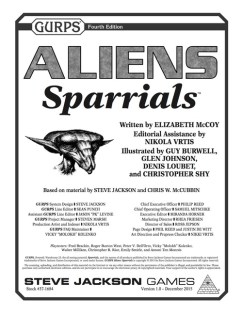
You might ask what’s so special about the little squirrel-monkeys if you only skimmed the four pages in the original GURPS Aliens (which are pretty much reproduced completely in this volume by the way). Sparrials are pretty much as adaptable as humans in an SF setting (lacking only strength) and include iconic characters like Serron of Irregular Webcomic fame. Okay, maybe Serron is the only fictional Sparrial ever, but they are pretty cool anyway. (Edit: the author informs me that there is at least one more fictional Sparrial – although minor)
For those of you who haven’t encountered them in the German translation of the 3rd Edition version of Space, here the short version: Sparrials are limber aliens with interesting dominance mechanics, compulsive kleptomania and the ability to smell (among other things) lies.
Facts
Author: Elizabeth McCoy (a.k.a. Archangel Beth)
Date of Publication: 2015/12/03
Format: PDF-only (Warehouse 23-only)
Page Count: 30 (1 title page, 1 content page, 1 index page, 1 page ad)
Price: $7.99 (PDF), $ 0.27 per page of content; Score of 4/10
Preview: http://www.warehouse23.com/media/SJG37-1684_preview.pdf
Review
The most surprising part about this book is that it’s a setting book that’s almost more meaty than cheesy. Yes, it describes an alien species, but it certainly doesn’t skimp on rule mechanics. We get the updated 4th Edition stats as expected, but we also get hints on what advantages, disadvantages and skills make sense for Sparrial PCs. We get variant races for dropping them into Fantasy, a species-specific martial arts style and preferred psionics and spells. Add to that a sub-chapter on template selection (with a fully-fleshed out pilot one) and a 7-page chapter on gear including pets and spaceships and you’re not going to end up with an all-fluff book.
What’s also surprising is the fact that the whole shebang is 30 pages instead of the 12 or 21 advertised on the wishlist – a wise decision that one can hope will continue to other books in this series and the – hopefully upcoming – Fantasy Folk one. Apart from the usual 4 spare pages we have a 9-page chapter that deals mostly with the game stats for the race, an 8-page chapter that contains much on Sparrial psychology, culture and society and the mentioned 7-page chapter on gear. On the whole, this looks like the sweet spot for any species book this side of elves, dwarves and orcs.
Meat
So, how does all that meat hold up? Very well for the most part. The basic stats make sense, even though both Short Lifespan and Increased Consumption are classic free points disads in many campaigns. The racial strength penalty is also a bonus in most non-military SF campaigns. With their high DX Sparrials are no longer point neutral in 4th Edition, which is probably a good thing. I’m only missing Brachiator for the originally tree-dwelling squirrel monkeys, but it can be bought by exceptional characters (and is largely irrelevant in SF if artificial gravity exists).
There are some neat titbits in there like the rules for albino eyesight riding gear for goat-headed, snake-necked sloths and scent-based attraction. But there’s also some (very) slightly wonky stuff like the ageing thresholds thresholds that don’t mesh with the rules for Short Lifespan and missing rules for Pacifism: Cannot Kill Except in Self-Defence. Overall there’s nothing substantial to complain about and almost anything you’d need to know about Sparrials is in there. There are no sample organisations, but even that makes sense: Sparrials are notoriously hard at coordinating above the family level. They have no large governments or even military forces.
For a minor race described on four pages in a decades-old book, this is an excellent treatment rules-wise. The Sparrial pets and the spaceship tie round things out nicely and the template makes you wish there was an SF equivalent to Dungeon Fantasy.
Meat score: 7 (would steal back from any Sparrial hacker)
Cheese
As shiny as the meaty bits are, such a book still stands and falls with its cheesy content and the McCoy doesn’t disappoint there either. Yes, the book uses most of the old GURPS Aliens content verbatim, but it also adds a lot of new stuff. Especially the kinship society and one-on-one dominance receive a lot of attention, as do child-rearing, culture and relations with aliens. Players shouldn’t have any problems making their Sparrial character fit into an existing group and GMs are given a lot of ideas to integrate the squirrely aliens into their campaigns – that goes even for Banestorm and Dungeon Fantasy. As the Sparrials were quite low-tech before first contact, they don’t need many changes to exist between orcs and elves. With their low ST they might even be somewhat better balanced in a fantasy campaign.
There are no real disappointments for those who want extensive non-rules information about a species. Even the sample character and the adventure seeds are interesting – if reused from the original treatment.
Cheese score: 9 (Sparrials are very competent cooks)
Sauce
There aren’t many pictures in the book and both of those showing actual Sparrials are re-used from GURPS Aliens. There’s one that might show a Sparrial dwelling, but I’m not sure what it signifies. There is a generic spaceship picture in Christopher Shy’s gorgeous style, but it’s incongruous with the other art and appears twice on consecutive pages only clipped and skewed differently. All in all a quite disappointing showing.
Writing is good, but some of the direct speech in the prose text is a bit jarring. Those were taken verbatim from the original and the age shows. Some editorial decisions are a bit weird – size modifier considerations come before we know Sparrials actual height – but nothing major.
Sauce score: 5.5 (meh art, mostly good writing and editing)
Generic Nutritional Substance
As every species treatment is necessarily tied to setting, the Sparrials don’t do so well here, but they can reasonably be added to any setting that does contain multiple sapient species this side of grim dark treatments.
Generic Nutritional Substance score: 6.5 (still good for a species book)
Summary
Aliens: Sparrials honestly isn’t something I would have bought if I didn’t have fierce desire to support GURPS and a wallet that doesn’t cringe on these kinds of expenditures any more. I am, however, glad that I did buy it. Sparrials probably won’t show up in any of my campaigns any time soon, but Elizabeth McCoy shows us how to do a species splatbook GURPS-style. If you think your campaign needs more colourful thieves, this is the book for you.
Total score: 7.275 (a steal)
Total score is composed of a weighted average of Meat (32.5%), Cheese (32.5%), Sauce (20%) and Generic Nutritional Substance (15%). This is a balanced book
Value score: 5.6375 (not quite a steal due to length)
Value Score is composed of the average of Total and Price.
GURPS is a registered trademark of Steve Jackson Games, and the art here is copyrighted by Steve Jackson Games. All rights are reserved by SJ Games. This material is used here in accordance with the SJ Games online policy.
Review: GURPS Dungeon Fantasy Treasures 1: Glittering Prizes
As all my other reviews this one will be rated according to meat (rules, stats, game mechanics), cheese (setting, characters, story), sauce (form, writing, style, art) and generic nutritional substance (universal nature, adaptability). At the end you find a weighted average of those components and a value score that also takes into account price per page.
I haven’t even managed to review the last Dungeon Fantasy title and then there’s another one. And the mouthful that is GURPS Dungeon Fantasy Treasures 1 – Glittering Prizes starts its own sub-series too. So now we have five different DF series: the main line, DF: Monsters, DF: Adventure, DF: Denizens and DF: Treasures. And that’s not even counting Magical Styles: Dungeon Magic. It sure would be nice to see each sub-series fleshed out with another two to three issues soon.

Before you start buying this, better heed the preview’s advice: DF 2: Dungeons and DF 8: Treasure Tables are required reading for this. I might add that readers who didn’t like the latter won’t get much use out of this volume either.
Another caveat: This book is very much oriented towards the detail-oriented GM and those who run Dungeon Fantasy as beer-and-pretzels game might feel overwhelmed. However, it’s not only for Dungeon Fantasy GMs. Yes, you need the mentioned books, but if you’re like me and use the DF line as a quarry for ideas and stats, it might be even more useful than for the DF purist.
Facts
Author: Matt Riggsby (a.k.a. Turhan’s Bey Company on the fora)
Date of Publication: 2015/11/12
Format: PDF-only (Warehouse 23-only)
Page Count: 22 (1 title page, 1 content page, 1 index page, 1 page ad)
Price: $5.99 (PDF), $ 0.27 per page of content; Score of 4/10
Preview: http://www.warehouse23.com/products/gurps-dungeon-fantasy-treasures-1-glittering-prizes
Review
As I’ve said the book is brimming with details. It is similar in this regard to Riggsby’s earlier Treasure Tables, but it contains less tables and some of those aren’t even random. What it does contain is details you might have been missing in TT. The first part (the book only has one chapter) uses nine pages with different kind of coins and other tokens of exchange. The second part deals with materials, decorations and cultural details on eight pages. As always contents, introduction and index are present too and a page each.
Meat
While the book is rules-oriented it is less so than you might expect from a DF book. Especially in the “Filthy Lucre” part we learn a lot of historical details the production, adulteration and use of coins. It’s almost enough to make the reader think this was a Low-Tech book. Small wonder as Riggsby has been deeply involved with that series too.
All the rules expand Treasure Tables considerably. Money wasn’t even a consideration in this earlier volume and here the GM finds a lot of ways to make a favourite treasure more interesting than “You find coins worth $10.000”. There are detailed tables on coin worth by weight, coin size by weight and random tables for composition, shape and condition. The decoration tables and even the improbable materials tables from the second part can also be used for coins, of course.
Despite that the tables are not the main thing here. This part is half a GM’s toolkit for designing monetary system for different societies and half a guide on how to use money in game. Even paper money is included for those who can fit it into their fantasy world-view. Magic coins and coin-based weapons aren’t missing either.
As far as low-tech and fantastic money goes, there’s not much to be left desired here. Personally, I could have done without the expansive weight and size tables. Inch measurements are not very enlightening for non-American readers to say the least and a simple excel file with densities and weight formulae would have gone a long way to make them superfluous. But maybe some GMs will appreciate them.
The second part features a detailed table for decorative motifs that completely replaces the one from TT. There’s also information on fasteners and fabrics with some historical details and rules for attacking fasteners, but I would have liked some more detail. I have been working on something similar for a while and it’s kind of sad to see many weaves to be defined only by a cost factor. And frankly, for fashion there can never be enough details.
The part about implausible materials does it better. Almost each of them (whether blood, flower petals or darkness) has a special effect. So your pixie ninja can finally wear a cloak made of moonbeams.
The last part is about building interesting societies for your delvers to identify and plunder. Again we get some historical detail and on top of that three non-human sample societies with their ethnic cool gear.
On the whole, the material is very usable. The book suffers a bit from the fact that Riggsby can’t go all Low-Tech inside the Dungeon Fantasy line. There are more than enough details to satisfy most DF GMs, but one or two more pages to satisfy the Low-Tech crowd would have been anticipated.
Meat score: 6.5 (still shiny)
Cheese
The real surprise is how much world-building information the book contains. The historical details are fun and I only missed a mention of Spartan iron money. Those useless ingots would have been a fun way to ruin any delver’s day. The sample cultures are interesting even without their ethic gear and if there ever is a DF worldbook I’m looking forward to see more about the Glittering City. All that doesn’t mean this is a hugely cheesy book, but for a crunchy book it’s certainly above average.
Cheese score: 5.5
Sauce
Illustrations are far and few between and mostly workmanlike. One looks like it was lifted from an archaeological textbook and I for my part wouldn’t mind seeing more of those. While the title page contains sparkles, it’s a bit boring that the title image was repeated on the very next page.
Matt Riggbys’ style is very readable if a bit technical – which is more than understandable given the subject matter. Editing is as top-notch as we’re used to. Jokes are sadly mostly absent, but I smiled at this line describing the Yellow Mountain helmet level: “Widespread use of the device has led to a myth that dwarves have an inherent ability to measure slopes.” Ring a bell?
Sauce score: 6 (okay art, good writing and editing)
Generic Nutritional Substance
As I’ve been saying, this book can be used for more than just DF or Fantasy. Only the supernatural stuff is inappropriate for realistic campaigns. Coins, details and textiles will be interesting even if you play in a gritty Roman Empire or the Mongol steppes.
Generic Nutritional Substance score: 7 (some fantasy-specific stuff)
Summary
Glittering Prizes is certainly not the most anticipated must-have buy. It’s a bit fiddly for DF and a could use a bit more details for real-world adventures. It could have profited from some excel support – though not as much as Treasure Tables. I’m certainly holding out hope for more volumes in this line. Both enhancements to parts of TT and completely new subject matter would be welcome. And maybe we can get automatic item generation when we hit the tenth volume…
Total score: 6.325 (good, but hampered by some hiccups)
Total score is composed of a weighted average of Meat (50%), Cheese (15%), Sauce (20%) and Generic Nutritional Substance (15%). This is a meat-oriented book. A “cheesy” setting- or drama-orientied book would turn the percentages for cheese and meat around.
Value score: 5.1625 (still average, though among the pricier GURPS PDFs due to its short length)
Value Score is composed of the average of Total and Price.
GURPS is a registered trademark of Steve Jackson Games, and the art here is copyrighted by Steve Jackson Games. All rights are reserved by SJ Games. This material is used here in accordance with the SJ Games online policy.
A Short Note Concerning Reviews
I have just updated my review calculations to better reflect the actual usefulness of the books. Final value before price now consists of 50% meat or cheese depending on the book’s focus, 15% of the other ingredient, 20% sauce and 15% generic nutritional substance. This led to slightly higher values across the board for all existing reviews, but nothing extraordinary. I just wanted to avoid situations where a book is dragged down by too little rules or flavour, when there’s nothing to justify that.
I might use a combined category in the future if something presents itself. The upcoming GURPS Discworld looks like a likely candidate.
 The Blind Mapmaker