The Tribunes of Caradocia

“There are no self-proclaimed villains, only regiments of self-proclaimed saints.”

– Glen Cook, The Black Company

The Tribunes, the heirs of the False Rohins, are among Adosaye’s most principal antagonist. They are the result of the Council of Five’s sorcerous and depraved experiments in creating lieutenants and soul-vessels, and so they are all marked by the dark legacy of their forebears. Aside from this shared general origin, which itself is wrapped in much mystery, the Tribunes have few unifying traits. Some were fashioned much as golems and constructs are; others were powerful mortals subjected to rituals and experiments; others still may have been conjured from great beyonds. Great creativity, malicious as it was, was applied in the creation of the Tribunes. Their powers exceed that of most creatures on Adosaye, for they carry in their being twisted fragments of the Red Soul itself. Walking blasphemies, their predations are a prominent theme of Adosayean history since the Council’s demise; for the Tribunes have dark wills and dark ambitions of their own.

At least three Tribunes maintain notable presences in Caradocia and its environs, and their shadows are long and dark. Much to humanity’s fortune, the Tribunes work poorly together. Plans, schemes and not least egos clash, and they tend to be resentful of their “siblings” more than anything else. Some rivalries between Tribunes are the stuff of legend. Tribunal alliances, even temporary ones, are threats of the greatest magnitude. A coordinated offensive between two Yric the Glaive and the Leveler almost brought Caradocia to its knees.

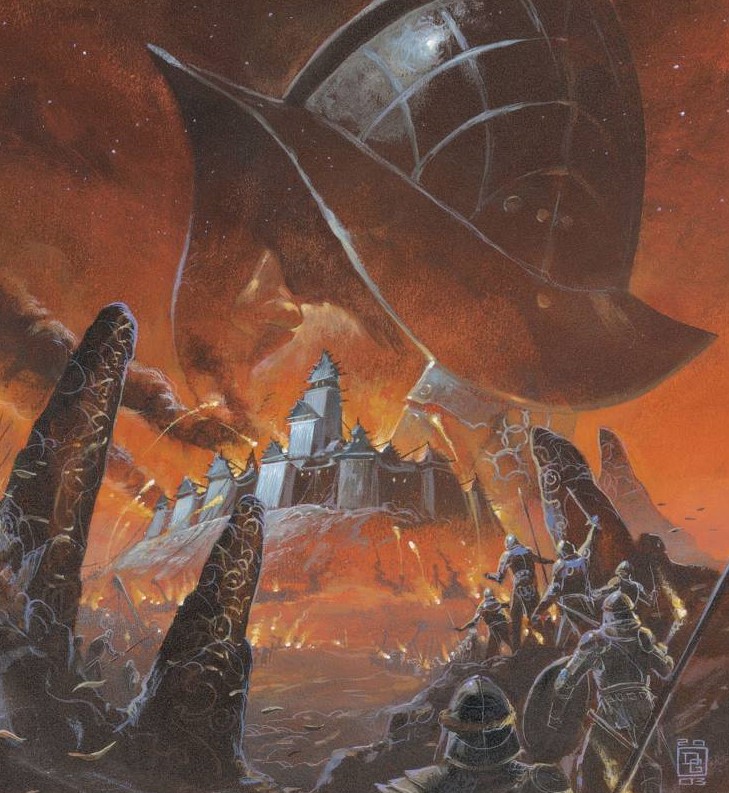
Art by Wayne Reynolds for the Black Company d20 book by Green Ronin Publishing.

Tribunal power has its luster for some mortals. And it is true that the Tribunes have access to lore otherwise forgotten. They are no teachers like them when it comes to dark and blasphemous sorcery and adjacent “arts”. Some mortals even recognize the Tribune’s religious mandate as legitimate and hail them as true prophets and genuine successors to the Red Soul. Such talk is considered offensive, heretical and malignant by most faithful Synodists. Many Tribunes actively cultivate an image of mystique and power; human pawns are part of the Tribunal modus operandi. The exact relationship between the Tribunes and the fragment voices of their creators carried through the Witchstorms is unknown and assumed to be fraught and complicated.

For the past half century, the Tribunes in Caradocia have been mostly quiescent – mostly. The Tribunes are no strangers to schemes and shadow games, after all.

Inspirations and Thoughts

The Ten Who Were Taken from Glen Cook’s The Black Company series; the awnsheghlien of the Birthright campaign setting; the Nazgûl; villains post explicit and implicit in Kevin Crawford’s Godbound TTRPG; bosses and creatures from the Dark Souls series of video games.

Villains! Villains are cool because they create story almost just by being. I like the idea of the scattered, bitter, and powerful heirs of the former Dark Lord(s) still making trouble out there, and it seeds some adventure material both on the political/Company level and the personal level. They represent the option of slightly more fantastical, larger-than-life threats and opponents – or allies of unscrupulous characters. I think that settings with a lot of potential for moral greyness and moral ambiguity benefits from human (or at least, relatable to us humans) villains are almost, almost entirely purely evil. Depending on what mood the campaign swings, the Tribunes can individually be irredeemable Sauron wannabes, or they might turn out to be slightly more complex. We’ll see.

Yric the Glaive

Strategist and general par excellence, Yric the Glaive represents the apex of the Council of Five’s genetic tampering to create a dispassionate corps of bodyguards and lieutenants. When Yric’s helmeted visage overlooked the battlefields of Caradocia, she wrought tremendous destruction – but for now, she is planning and cultivating alliances with the yuan-ti warlords who may despise her, but see great potential in her battlefield skills and strategic insight. Yric is a scourge to northern Caradocia in particular, and seems to have a particular affinity for the Witchstorms. Her pocket domain is well-guarded, but she has at least surface respect for the pleasantries of diplomacy, etiquette and some semblance of decency outside the battlefield. To her detractors, she is a principled but ruthless and dangerous warlord; to those who take a disciple’s view, she is the embodiment of perfected military discipline and an inspiring leader who can remake society into something strong, mighty and orderly.

The ArchEidolon

The ArchEidolon has, as far as the stories tell, little sophistication of mind, but it is a colossus in stature, a veritable walking apocalypse. Most are glad it is currently dormant, supposedly somewhere in the Dawnlands. Those interested in seeking out the ArchEidolon are less interested in serving or allying with it, and more interested in its uses as a weapon. It is known that the ArchEidolon is not unintelligent, and in its dormancy it can still extend and project its will in esoteric ways. But its exact nature remains a mystery. A handful of cultists seek to reawaken it, believing it would usher in some doomsday event alluded to in apocryphal Synodist texts and prophecies.

The Leveler

Said to be a tall hierophant with a head ever sheathed in ruby flames, the Leveler by all accounts, believes that he is truly a righteous prophet and genuine successor to the Red Soul. His cult is one of the most active Tribunal religions, where their dark whispers of power and ancient magical lore ensnares those of little faith. His sorcery focused on the fire, the forge and the fiendish, and he is an accomplished crafter and summoner. Cruelly, he seems to have mastered a less sophisticated version of the Council of Five’s Tribune-creation rituals, and a cadre of twisted wraith-lieutenants do his bidding. Rumor has it that he is in love with a human. The Leveler’s library is supposedly the stuff of legends.

The Knight of Brass

A particularly vicious and mad Tribune, though an indisputably brilliant fighter and Witchstorm adept, the Knight of Brass once ruled a sizeable domain after conquering most of the realm of Bezent, southwest of Caradocia. The locals’ call for help were largely ignored by the Denevs to the south, who were preoccupied with calamities of their own, but an alliance of Caradocian knights, mercenaries and petty nobles pooling their resources (and aided by Synodist champions) launched an assault to counter the Knight of Brass. The Tribune was defeated and destroyed, and the Bezentian March was established – in other words, the liberation would have unforeseen consequences and be a source of future conflicts all on its own.

Worldcrafting: Adosaye

Gearing up for a game of Reign 2e, and a vision is coalescing. Reign, much like GURPS, benefits from a clear vision of the setting before quantifiable crunch is created. The system allows for a tremendous breadth in terms of tone and aesthetics, and like GURPS, it has a distinct creative and mechanical grammar that makes translating ideas to game material a joy. Unlike GURPS, it doesn’t overload and overwhelm my brain though!

A lot of the ideas here were the result of brainstorming and conversations with Hans, who was the player in the Korryus Burning Wheel game – and who will be a player in this game when it materializes. He has a keen creative mind and a fantastic sense of leaning into weird, fantastical vibes and stories, and he is always a pleasure to play with.

Enter the planet of Adosaye. And enter this somewhat unorganized presentation of its current state. This is a sketch, an overview, not a complete picture, merely a stew of ideas slowly taking shape.

Photograph by Sagui Andrea through Pexels.com.

Adosaye was conceived as a gritty, medieval fantasy world oozing with weirdness on the edges. It was also conceived as friendly to faction- and domain-play – hence how I found my way to using Reign. Who knows – other games and systems might fit other ideas for the world in the future.

The Ether Winds

The vast landscapes of Adosaye are suffused with the erratic and mysterious Ether Winds, sometimes called the Mana Currents. These mystical energies weave through the lands, unseen to most, and they are the raw material and fuel of most Adosayan magical arts. The Ether Winds are powerful, but dangerous – magic involves exposing one’s very body and soul to their push and pull, and then channeling their force through spells and incantations. Not every is attuned or gifted enough to do this, and not everyone who practice the arts do so safely or ethically. The magic of the Ether Winds has limits, both in what it can achieve and how it can be achieved, but mages can nevertheless wield it to great effect.

The Scarlet Soul

The Scarlet Soul is a central figure of human history and mythology. Their nature is mysterious, but this is known: the Scarlet Soul has time and time again returned to be reborn in a human vessel. It seems that almost every epoch have their Incarnate. The Incarnates have invariably been individuals of great wisdom and power, prophetic figures, teachers and potentates. More than once, they have been the deciding factor in a human society’s struggle against the yuan-ti. And invariably, they have at some point retreated from human affairs so their bodies could never be found.

At least until a cabal of rogue mages tracked down and recovered the remains of the Incarnate known as Rohin, a prophetess and mage of exceptional ability. From her remains, the cabal created clones, grown in obsidian vats through spellcraft foul and now forgotten. The cabal prepared these bodies for the next return of the Scarlet Soul, and when the Soul did arrive, the cabal was prepared – through a feat of fell sorcery, they sundered the Soul and infused the pieces into the False Rohins.

Unsurprisingly, this turned out Very Bad for almost everyone involved.

The Council of Five

The False Rohins were not a uniform group. There were differences in age, sex, maturity, ability and interests. But what they generally shared was a resentment for their creators, and so they quickly turned on the cabal, and after that, they turned on one another. Five of the False Rohins emerged from the ashes of the sorcerous calamity of the fighting. They allied and joined forces, less because of a shared vision and more because they knew more fighting would assure mutual annihilation. Fraught with distrust and rivalry, but all driven by a desire to leave a mark on Adosaye, the Council of Five entered the world stage.

They were conquerors. They were great mages. And they were scourges to all who opposed them. The Elves of Adosaye in particular were targeted. While some prospered under their tyranny, far more suffered. And the False Rohin themselves? They grew more erratic, more paranoid and more cruel. It was never meant that the Scarlet Soul should be incarnated for more than a life’s worth of time, and certainly not fragmented and through magic endure even longer. The Council was at its zenith in both power and madness, and almost all of the continent of Suru-Terre chafed under their tyranny.

Their downfall was, perhaps, predictable.

The Witchstorms

Forces within the Council of Five’s empire saw the writing on the wall. With overlords this powerful and this unstable, it was only a matter of time before disaster would strike. And so, a conspiracy formed to overthrow the False Rohins. And it succeeded, at great cost in lives. Much was lost, but freedom was won, at least for a time.

But the Scarlet Soul could not be healed.

The False Rohins, in their death throes, cast what remained of their power into the world, and thus the Witchstorms came into being. Straddling the line between mundane storms and the Ether Winds, these aberrations of magic would bring thunder and upheaval and strange manifestations of magic. And their winds carry whispers – whispers of the great power of spells and magic the Council knew, and which can be the listener’s too, if only they listen, listen, listen…

The Present

350 years have passed since the Council of Five was toppled, but the continent of Suru-Terre is still in a phase of recovery. The Empire of Urrbe D’oram took, for a time, the place of the Council, but its attempt at corrective and just imperialism fell into the common pitfalls of such endeavors. It too collapsed soon enough.

Suru-Terre is thus a patchwork of semi-coherent polities. The lands are divided and restive. Some areas pay lip service to legal fictions of unity and theoretical overlords, but this is more a “Holy Roman Empire” situation than anything else. The communities of Adosaye do not merely compete with one another, but with other threats as well. The yuan-ti are always lurking; there are factions of elves who would like nothing better than to avenge past wrongs on all humans; the Witchstorms cause occasional havoc and seed dark magic where they go; and perhaps most distressingly, inheritors of the False Rohins are still making trouble.

Oh yes, not all of the old cabal’s hideous sorcery was lost. The Council tried some soul-ripping magic of their own, and the result was the Tribunes. These soul-shredded lieutenants, each a unique horror, of the Council lost most of their power after their masters’ defeat, but also robbed of their shackles of servitude. Ambitious and wicked, they are resurfacing, promising power and glory regained – and some people listen. The domains of the Tribunes dot Adosaye, and it is lucky for humanity that the Tribunes are distrustful of one another.

(The Tribunes are absolutely inspired by the Ten Who Were Taken from The Black Company and by the awnsbeghlien from the Birthright campaign setting. No shame!)

This French cover for the Black Company book Bleak Seasons is awesome, by the way.

Next on the menu: Fleshing out Caradocia, the region in eastern Suru-Terre that’ll be the stage of the campaign’s drama. And fleshing out magic, rule additions, and sundry material for making this playable in Reign.

Happy gaming!