Teach a man to fish… (GLOG Fishing Wizard)

You are an Angler with the ability to cast a line into sources of aetheric mana that wind like rivers throughout the planes. Within these oceans are spells which are unknowable, and almost imperceptible to the mortal mind…

But to you, they look a lot like fish.

Art above from the incredible video game Dredge.

I, Grace, and Louis from Phlox’s GLOG Discord server got into a real frenzy about a wizard who fishes up their spells. We had similar concepts, but decided to break up and work on them alone, then post together! Here are the fruits of my labor. Keep in mind that as always, these rules are designed to work with LIGAMENTS. Also keep in mind that I wrote this under a dwarf-fortress-style fell mood in… like two hours.


Filletomancer

You are an Angler with the ability to cast a line into sources of aetheric mana that wind like rivers throughout the planes. Within these oceans are spells which are unknowable, and almost imperceptible to the mortal mind…

But to you, they look a lot like fish.

A: Angler, Mentaquarium, +1 MD
B: Leylures, Leylines, +1 MD
C: Dredging, +1 MD
D: Doom of the Fisherking or Blessing of the Kingfisher, +1 MD

Gear: Heavy fishing implement, small knife (light melee weapon), tacklebox (light container), and fishing supplies (1d12 UD) in the form of spare line, hooks, and bait.

A: Angler

Many good luck charms are included on your hat and clothing that you believe increase your chances of a good catch, but functionally just give you +3 reactions with fishers, hunters, bug catchers, or others of your ilk.

Chanting and swirling of your fishing implement accompanies a wild dance of your own invention, before flinging the hook, harpoon, or net into the aetheric oceans. In your mind, you are in a wild, frenzied battle against the vibrant seas of lime and violet, cast against an orange sky. To those around you, you just sort of stand there, drooling and dead-eyed for a full minute per fish caught.

To catch a spell fish, roll a number of magic dice. Then roll on the spell table {dice} times and test luck to catch any {low} of those fish, in any combination. Successful catches are stored in your mentaquarium. Finally, roll usage dice of your fishing supplies {low} times.

A: Mentaquarium

Half of your capacity is flooded with aetheric mana from the first time you ever caught a fish with your Angler template, this is your mentaquarium. To cast fish stored in your mentaquarium as a spell, you either kill them, or free them. Freed fish return to whence they came, grateful and serene. Killed fish are filleted on the spot, their bodies flash boiling into multicolored steam which smells like sunbaked fish guts and rotting wood. Track all fish freed or killed by you.

When a fish is cast or midnight passes, all fish in your mentaquarium test morale. Any that completely lose their morale are eaten by the others, sensing its weakness. As killed fish are cast, the spell they represent is immediately cast with randomized targets/effects. The starting morale die of caught fish is determined by the number of fish caught at once. 1 has a d10 morale die, 2 have d8, 3 have d6, and 4 have d4. Fish that die from morale loss count as being killed by you.

Items can be stored within your mentaquarium, but are susceptible to the effects of being submerged in water, so books or other soluble items will be ruined/destroyed. Physical objects take two move actions to be retrieved or stored within your mentaquarium.

B: Leylures

Using 6 rations and/or trophies from killed creatures, you may craft a number of lures equal to your filletomancer templates. Lures increase the range of possible catches by how many different creature trophies are included in their making. (For instance, if you roll the Fireball fish with a lure that was made with one trophy, you can actually pick from the Finger of Death, Fireball, or Flesh and Stone fish, as they are 1 spell above and below Fireball on the list.)

B: Leylines

If you roll doubles on your MD when catching spell fish, you have found a spot where the leylines of aetheric mana crisscross. A week of meditation here will allow the fish in your mentaquarium a chance to breed, as they feed on the pure, unfiltered aetheric mana. Choose two fish, test their morale with advantage. If they both succeed, they breed and a brand new fish is born in your mind, the effects of which are determined by your gamemaster. If either fail, it is eaten by its lover. If both fail, they eat/rut one another until melding into a single horrifying abomination fish.

This abomination prowls your mentaquarium, feasting on another fish each hour unless it has access to a ration. When it is cast, the spells used to create it are cast at the exact same time, with all benefits and detriments included. If both spells are concentration, the filletomancer passes out immediately for a number of hours determined by rolling the abomination fishes’ morale die.

C: Dredging

The wicked tides of the aetheric mana are home to things besides fish. Empty slots and containers in the Mentaquarium part of your capacity have a 45% chance to fill each midnight with dangerous, beautiful, or unthinkable odds and ends determined by the gamemaster.

The gamemaster is encouraged to get extremely weird with it, such as crawfish that grant mutations, eels that create disease, or monsters that spring from the filletomancer’s mind to attack the party. How bad would it be if the unwieldy anchor of a spelljammer got lodged into your mind, and you couldn’t lift it to remove it?

D: Doom of the Fisherking or Blessing of the Kingfisher

Compare the tally marks of fish freed versus killed. If more fish are killed or the numbers are tied, you receive the following template:

DOOM OF THE FISHERKING
– Fish eaten after they lose morale are cast with d8 magic dice instead of d6.
– Injuries to mentaquarium slots heal twice as fast.
– Abomination fish no longer suffer rations, and assimilate their prey’s effects.

If more fish are freed, you receive the following template:

BLESSING OF THE KINGFISHER
– Leylures must be made of just one kind of creature.
– Successfully bred fish spawn 1d4 children, instead of just one.
– Each time a fish is freed its spell is marked with a tally that grants +1 MD rolls on castings.

Give your players this plane. (Oh hey is that a gun under the seat?)

A classic biplane, if by classic you mean made of magical mangrove roots and steam-shooting gemstones.

Art above from the Crios RPG

As I have been working hard on the final little tweaks and edits for LIGAMENTS’ upcoming revision (coming very soon), my sleep schedule has gotten pretty wacky. This, as it usually does, led me down a strange mental rabbit-hole. Enjoy the fruits of my turmoil, and please keep an eye out for some exciting news.

As always, the rules for this post were written with LIGAMENTS in mind.

A biplane made of Saltwick root and quality Winsburg-made cloth. Its eight spider-like legs seem to gallop through the air as it flies, like a Strandbeest, with the wind under-wing providing momentum. They offer a good (enough) pace for take off and landing, without the need for wheels, runways, or general airline infrastructure. I mean who has time for that anyway, right?

Like it says above, the bulk of the plane is made of extremely lightweight and durable driftwood that breaks off mangrove trees, called Saltwick. They float offshore into the southern gulf and continue to grow into wide ovular nets of natural root and branch, feeding off the critters that get caught inside. Because of this, natural Saltwick has rings of white inside showing its growth over the years, but also small bones, scales and feathers trapped forever under its gnarled flesh. With some sturdy cloth, the body of the plane is flexible, yet rigid.

The front propeller boasts a gorgeous (and valuable) sunstone. Cut into the apple-sized gemstone are whirling grooves which mesh to Immutable Bronze gears. Due to its odd makeup, the sunstone can act as a natural steam engine. One need only soak it in a gallon of water for 24 hours, then expose it to light for ten minutes. The microscopic and labyrinthine pores in the stone fill with water, then its absorbing of the sun super-heats the thin bands of water leading to a continuous steam reaction. The sunstone’s exposed tip has a velvet lined leather cap to cover it, so one can decide exactly when to begin the solar influence.

The strange engine propels The Endeavor for up to six hours. With a lever in the cockpit to shift gears, the sunstone’s constant RPM is geared up or down for minor alterations in landing, cruising, or take-off. While there is room for a pilot, a passenger, and a backwards “gunner”, the plane has the lift for 20 slots of weight total. It also moves at 120 mph, and has +2 to gambits involving spinning (that’s a good trick, after all), but -2 at gambits involving gaining back control when something goes wrong.

The Seven of Spades

Nestled under the seat, made of a single beautiful branch of Widowmaker, is a gunstock. Across the top of the gunstock are seven doves burned into the wood, each with a spade incorporated into their designs. (Beak, breast, talon, eye, etc.)

One may find this lone wooden furniture strange, but any of you familiar with the AR-7 may have your interest piqued.

“I wonder…”

With a shimmy and a “Pop!”, the back of the stock can be slid off. Inside you’ll find a waxed cloth bundle containing heavy ammo (1d6 UD), and the various iron fittings (barrel, receiver, magazine) needed to complete the gun that the stock goes to. It takes two move actions to assemble the weapon, and then you have yourself a five-shot heavy firearm.

The Seven of Spades cannot use a bayonet like most heavy firearms, but it does allow one to store up to two spells inside as a Light Magical Foci. The spells cannot be cast from the gun unless in its assembled form. Also, as with all items made of Widowmaker wood, fresh blood rubbed on the gunstock will activate a glowing silver light that illuminates up to 20ft away and does not interfere with infravision.

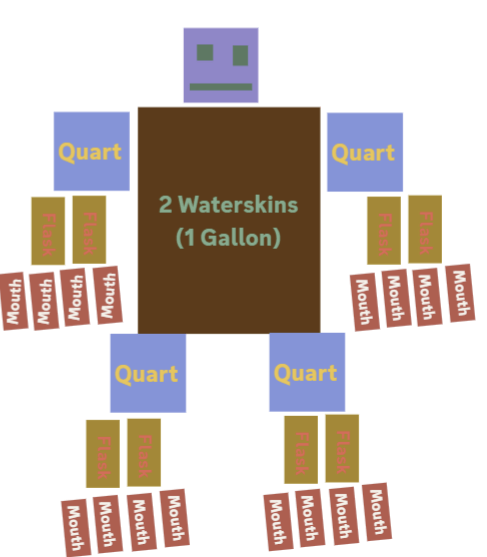
Anybody remember the Gallon Man?

….what is this

I do. He was pretty cool. Here’s an ugly version I cooked up for my Arden Vul game. Sorry you had to see this.

The Reverse Sisyphus: Rolling Stone GLOG Class

Rock falls, everyone dies.

Oh wow, I haven’t posted since 2023 and it’s… 2025! Barely, anyway. Sorry about that, I released my game LIGAMENTS and then kind of fell off the face of the earth doing writing and running games and generally trying to get in touch with my creative side. You know how it is.

But then I was reading this really fun, strangely touching piece of serial fiction, about a rock, which becomes sentient and gains RPG levels. It’s pretty ludicrous, and a very easy-breezy read. Perfect for 4am insomnia, I tell ya!

It’s called Rock Falls, Everyone Dies. It’s hilarious, you should read it after you skim this class inspired by it, link it to a few friends, buy my game, and get on with whatever you were supposed to be doing today.


Rolling Stone

A: You Are a Rock, Steering
B: Energy Shift
C: Pivot Point
D: Avalanche

Gear: None, because you are a rock.

A: You Are a Rock

You are a 5″ rock. You have no hands nor legs. You cannot speak, but see in a strange, watercolor-filtered vision that acts as eyes would, but in 360 degrees. You can hear through vibrations in the earth, air, and anything you touch. Your armor is equal to plate. You take 2x thunder damage and 1/2 fire damage. Your career, species, etc. are all simply, rock.

Your movement is 30ft only when rolling due to gravity, while rolling under gravity, you must move the entire 30ft. When you collide with a creature, or object, you deal 1d4 damage. Your damage increases with your size, which is determined by the number of rolling stone templates you currently have.

SizeDamage
5in1d4
8in1d6 + 1
1ft1d10 + 2
1m1d12 + 1d6

A: Steering

When thrown or rolling along thanks to gravity, you may change your direction left or right. You may “steer” a number of times equal to your templates of Rolling Stone per turn.

B: Energy Shift

You may store any mundane or fire damage taken as energy points. Each energy point takes up a slot, and may be spent to do actions. You may also store energy points by ceasing movement caused by gravity, at 1 energy point per 10ft not moved while under gravity’s potential energy.

Energy PointsActions
1Heat yourself up enough to deal 1d6 fire damage to anything you touch. Effect lasts for a number of turns equal to energy points spent.
1Move 10ft in any direction, dealing damage to anything you strike, unless it is a harder material, in which case you roll damage and take half.
2You begin to glow, emitting light in a 10ft radius. Effect lasts for a number of turns equal to half energy points spent .
2You may vibrate at a certain frequency, changing pitch a number of times equal to energy points spent.

C: Gravitational Pivot

A single point in space up to 15ft away from you acts as an invisible, intangible thread that stays attached until you activate it once more. This “thread” does not flex nor collapse, and will only pivot you in a perfect 15ft radius around its point of origin.

D: Avalanche

Every rock or rock-like object smaller than you within a 10ft circle around you can be controlled and affected with all of your rolling stone template abilities. When you roll, they follow. The circle of influence may be expanded 10ft by spending an energy point, but it must be paid each hour the effect is active.

21 Grams of Silver (GLOG Warlock)

How much would you want in exchange for just 21 grams of silver?

Another Flash in the Pan class for ya’ll as I put the finishing touches on the first full release of LIGAMENTS. This time it’s a class that’s a jack of all trades, and trades away the soul of jack. The Soul Merchant.


Soul Merchant

Striding with purpose through the wet mud dappled with hoof-prints and wheel tracks, the man in the black cloak and hat with a shimmering silver cane was searching for something. After a moment, he found it, a small rune engraved within the design of a butcher’s sign.

By the time he left, his bag, which had been laden with strange silver coins, was empty. He had a fresh horse, enough food for a month-long trip, and a well-sharpened knife.

And the butcher had more workers, and meat, on the way.

A: Death’s Toll, Call It
B: Soul Food, Investment Opportunity
C: Black Bag
D: Double or Nothing

Gear: An easily concealed light firearm, a slick black hat, a light folding shovel, a well-worn book of various funeral rites, and 10 silver coins.

A: Death’s Toll

Money makes the world go round, and you deal in a specific kind of currency. The souls of the dead, trapped in sterling silver coins. To capture a soul, you place a coin in the mouth of the deceased and perform their funeral rites, reversed. This traps their soul in the silver coin, which takes on a ghostly shimmer, depicting the soul’s visage on one side, and a symbol depicting their life on the other.

You may spend these souls to manifest soul constructs of weaponry, tools, and even facsimiles of spells or tonics. All it takes is a gambit action, and spending the correct amount of souls. Each soul coin takes up an entire slot of capacity, you may have a number of manifestations active equal to your Soul Merchant templates. You can dismiss manifestations at any time, but they’re gone.

#Manifestation
1Gear (Light)
1Weapon (Melee, Polearm, or Throwing)
1Minion (costs 1 soul to summon, and 1 every morning)
1Magic Die (must be spent immediately)
1Spell (Random, or +1 to pick)
2Weapon (Splash, Missile, or Firearm)
2Gear (Heavy)
2Tonic (rolled randomly or +1 soul to pick)
3Mount (costs 1 soul every morning)
3Gear (Unwieldy)
XVehicle (capacity is thrice X)

Each soul will be from a person who was once living and breathing. To reflect that, feel free to roll on this table, as well as the career table, to flesh them out. The personality will come up for minions, mounts, and memories, while the style will probably affect the spells and gear you make with their souls.

1d12PersonalityStyle
1SorrowfulPatchwork
2HaughtyLavish
3StoicMinimal
4CuriousCosmic
5PiousSpiritual
6HelpfulSoft
7PricklyRotten
8ChildlikeToyetic
9FearlessRiveted
10InventiveClockwork
11BestialTotemic
12CalculatingCasino

A: Call It

You may flip a soul coin in the air, and say “call it”, meaning pick if it will land on heads or tails. If you or an ally call it right, you get +2 on their next luck test, or knowledge granted by the soul’s career for 1d6 turns. If you call wrong, the soul is spent.

B: Soul Food

For a Soul Merchant, a single soul works just as well as a ration. When you eat a soul coin, flip it. On heads, your mind is altered by the personality of the soul, and their goals become yours for the duration of a manifestation. On tails, you resist their influence but can pull on their memories and career knowledge for the same amount of time.

B: Investment Opportunity

You have the ability to collect souls from willing individuals, who agree to take part in a simple ritual. This ritual involves you placing a silver coin on their tongue and reciting the magic words, thus transferring their soul to the coin.

While their soul is removed, they cannot be frightened, cannot connect with their god, and feel dulled emotions. While you hold their soul, they cannot intentionally harm you, and follow your orders. Spending the souls of the living on manifestations will return those souls to their correct bodies once the manifestations disappear.

To the right buyer, however, a soul coin is worth much more and can be traded for information and services. These buyers are not easily found, but mark their shops with a crest unique to them. They value certain kinds of souls and rely on discretion in their dealings.

C: Black Bag

Given an hour of peace and quiet, you can spend a soul to weave shadows and darkness into a black satchel. It is unassuming, blends in with your clothing, and takes up a single slot, but can hold up to five soul coins. On the back of the bag is your unique crest, which is given to you, not chosen. Manifestations may also be stowed in the black bag instead of dismissing them, though they still count for your maximum number of manifestations.

D: Double or Nothing

If you would fail a roll, you may flip a soul coin, and call it. If you are correct, the roll succeeds, with a distinct extra advantage. If you are wrong, your black bag, and all souls on your person, disappear into nothingness, taken by the brothers.

Design a site like this with WordPress.com
Get started