

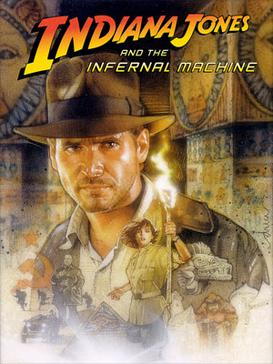
When I was younger, I was always convinced that the first Tomb Raider game got a sort of remake on the Game Boy Color. It makes a lot of sense in my mind, since the title of the game was Tomb Raider. And in the same time period, Indiana Jones and the Infernal Machine also got a port to the Game Boy Color. That game was an interesting remake in 2D. Now, we are not here to discuss an Indiana Jones game, so let us focus on the Tomb Raider games.
I do not always do research before I start playing a game. This game is one perfect example. I just started the game up, expecting the story starting with a rendition of the Ice Caves. But, to my surprise, the game started up different.

The actual subtitle of the game is The Nightmare Stone. On the box-art, we just got Tomb Raider as a title. On the box-art, we see that Lara is running away from an erupting volcano and behind her, you see several skeleton enemies. The bottom section is reserved for company logo’s like Eidos, Core Dynamics, the licensor Nintendo, and the publisher THQ. We also got the “Only on Game Boy Color” triangle in the left corner.
The game was released in June 2000. On June 7th, North America, Europe got it on June 28th and the UK two days later. Only Australia got the game a little bit later. Their version got released on July 18th. Nowhere on the box-art, the game got the subtitle The Nightmare Stone. The game just released as “Tomb Raider” in North America and released as “Tomb Raider: starring Lara Croft” in all other regions. This is a practice also done with the other Tomb Raider games. It would have been easier if they just added the subtitle, to make conversation easier.

The critics gave Lara Croft is first entry on the Game Boy Color very high praise. Various gaming magazines and websites gave this title 8 or 9 out of ten. The average score of this title is 79% on the aggregator GameRankings. One of the lowest scores I could find was by a German magazine named 64 Power in their June issue, giving it a three out of 5 or 60%.
Since Core Design developed this game, it will not be a surprise that you find a lot of developers on this game also worked on the main Tomb Raider games. This game was developed by people who knew how a Tomb Raider game should play. In this title, Lara is hunting after the Nightmare Stone. This stone is in possession of a treasure hunting group who wants to use it to release the evil god Quaxet, a factious god in the Mayan mythology.
Playing through this game, you really want to play through a Tomb Raider game. Of course, there are some big differences since the game got released on a handheld. The most obvious difference is that the game is in 2D. There were only a handful of 3D Game Boy games, and most of them did not involve jumping.
Another significant difference with the main line Tomb Raider games is that this game plays a lot slower. The controls are more limited on the Game Boy Color, and more action-packed gameplay could not really be implemented, per se without it becoming really clunky.

Speaking about the controls, it takes some time to get used to. I mostly played platformers or adventure games on the Game Boy, and I was so used to push the A button to make my character jump. But Lara jumps with the up arrow in this game. Not only that, if you want to climb up ledges, you need to hold B. Which is the button you use to run. If you are moving left or right and press B, Lara starts running. When Lara is running, and you press the jump button, Lara jumps in the direction she is running. This gives you a hint how to jump a gap when standing still. You have to press B first before the jump button to jump over a gap.
This control scheme is quite ambitious since there is no real tutorial in game explaining the controls. You do not have a training or testing level in Lara’s home. The manual explains these things quite well, but if you bought your copy today from a garage sale without the manual, I would advise you to look for it online. The control scheme is something that you will not really expect from a Game Boy game.
Earlier, I mentioned that this game has a slower pace compared to the main line Tomb Raider games. That was intentional. If you start running everywhere, you will find that this game will be quite harsh and brutal. There are several pits and gaps that either eat a good chunk of your health or kills you right away. Enemies are also hidden everywhere, and their damage can be unforgiving.
You cannot save where you want in this game, since the save crystals from early Tomb Raider console games return in this game. Learning where the save crystals are important. It is the only way you can save, and it is you respawn spot when Lara losses all her health. The save crystals are not close to each other, either, so I was always happy to find one.
If you do not really know the controls, it can feel a bit like trial and error. For example, I did not know that when you are running and jump, Lara will land further than from a standing jump. I did not expect this mechanic to be in the Game Boy Color games as well. Other things like dynamite being able to use to explode walls, which is something I’d have loved to get explained to me.
Overall, visually, this game is extremely impressive. Once everything starts clicking together, and you get used to the controls, this game is a hidden gem on the Game Boy Color. When you know what you are doing, this game takes around 4 hours to play through. For a first playthrough, I would say that you can finish this game in roughly 15 hours.

The game must have been quite successful since a year later we got a new adventure in the same engine and style. Eidos tried to get this game released around the time the first Tomb Raider movie released. Tomb Raider – Curse of the Sword, released in late June in North America and in August in Europe.
This time, the game was not released by THQ, but by Activision. Most of the team who worked on the first Game Boy game also worked on this title. Because this game got a shorter development time, this game is shorter compared to the first Game Boy Color game. If you know what you are doing, this game can be beaten in two and a half hours. For a first playthrough, I estimate that it will take 8 to 10 hours.

The sequel got the same reception from critics when it released. This game still shows off impressive visuals for the Game Boy Color. Remember that the Game Boy Color is an 8-bit system, and these two Tomb Raider games had such fluid animations that it looked next-generation. Did you know that there are over two thousand animation frames per game to make the animation work? Lara’s model is also forty-eight pixels, making her one of the most detailed characters on the Game Boy Color.

Personally, I feel like both games are amazing entries into the Tomb Raider series. While they play quite different from their console and PC counterparts, both are an amazing adventure through various locations. You still must solve various puzzles and platform your way around. In Curse of the Sword, you even have a chase sequence on the rooftops.
When I look with a critical eye at these two games in 2024, I would say that the lack of a tutorial for the controls really hurts the game. Also, some people might be put off from the difficulty level of this game. These games have some really difficult sections. Use the save crystals well! Otherwise, you might lose a lot of progress. And if I am really nitpicky, I could say that some areas would benefit from a map screen. But the levels are a bit too complex for those and with the small Game Boy Color screen, the map might not be even readable. Thankfully, there are various sources online, like Stella’s Tomb Raider site (tombraiders.net) that have amazingly drawn maps.
When you read this, you might think that beating these games without a walkthrough is almost impossible. But do not worry. These games are quite linear and straight forward. I rarely got stuck in these games by not knowing what to do next. Most of the time, I did not know I was able to perform a certain action or how to solve a certain puzzle.

The streak of releasing a new game every year continues in November 2002. The Game Boy Color was on its way out, and the next title was released on the Nintendo Game Boy Advance. For this title, Ubisoft Milan was tasked with creating a new game. That is because the main team was working on the sixth main title, Angel of Darkness. Tomb Raider – The Prophecy was released to mixed reviews. It released in early December in Japan.

This game played quite different compared to the Game Boy Color titles and played more as a top-down isometric puzzle platformer. If I am very honest, this is the gameplay style I expected more of the Tomb Raider series on the Game Boy. It is mainly because I associate Tomb Raider more as a top-down game on handhelds than it being a 2D side view game. The Game Boy Color version of Indiana Jones and the Infernal Machine showed me it was possible to have a game like that on Game Boy Color.
The story of this title is about the Tome of Ezekiel. In this tome, a story is told about three magical stones that bring great power. She faces a big cult by the name of Teg-du-Bhorez. The game takes about 6 hours to complete on a first playthrough. If you really know what you are doing, this game can be beaten in 2 hours and a half.

Honestly, for a portable Tomb Raider adventure, I really enjoyed this one. It is a rather underrated gem in my opinion and really can be quite exciting to play. Especially since the formula really works this way on the Game Boy Advance. The big issue is that reviewers compared it too much to the mainline series, which is quite unfair to do. What I can agree with, is that this game can feel a bit repetitive at times in terms of puzzles and level mechanics. But it is way less repetitive compared to the Game Boy Color titles, since a lot more puzzle solving like statue placing is used.

The final Tomb Raider title on the Game Boy line of platforms came in 2006. After the very mixed reception to Angel of Darkness, the IP was given to Crystal Dynamics and Tomb Raider Legend was born. Talking about that, can be an entire article in itself. But, to close off this article, I want to quickly focus on Tomb Raider Legend on the Game Boy Advance. I know there is a port to the Nintendo DS, but I do not have any nostalgic memories for that one. I do have nostalgic memories for the Game Boy Advance port.

Now, let me tell you, the Game Boy Advance port was rough. The game went back to the style in like the Game Boy Color games. Yet, it also tried to do intractable doors. I can totally understand why reviewers back in the day were extremely negative about this game. Especially, since the console and PC versions of this game were such a blast of fresh air in the series.
Still, why did I beat this title 100% three times? Because, it had a certain charm. You could find various secrets in the game to unlock secrets like concept art or even cheat codes. But you were not able to see if you got all treasures in a level. The jumping and swinging controls were a bit awkward, yet you had very forgiving checkpoints.

There are a few things that stick with me to this day, the fact that the final boss is rendered a joke in this version. Just mash the attack button and you easily win. No matter the difficulty. Also, the mini-games and exploring Lara’s home were fun distractions as well. Moreover, I want to thank all the pizza boys who delivered me pizza during the writing of this article, like in the credits of this game.
And with that, I want to wrap up this brief nostalgic look into the 4 Tomb Raider titles on the Game Boy Color and Advance. My name is NekoJonez and if you enjoyed my writing and want to read more of my work, you can find me over at: https://arpegi.wordpress.com. I want to thank you all for reading my article, and I hope you enjoy the work of the other writers in this magazine. But for now, I am out! I hope to welcome you in another article but until then, have a great rest of your day and take care!
Editorial note: This article has been written for a gaming magazine. Did you find this article interesting? Then you should read the other articles right here. Thank you so much Dominus for letting me publish an article. There are various articles about Ultimate Underworld Retrospective – Sin God – The Making of the Wipeout logo design – …




 Wikipedia entry
 If the developers of this game were able to cram the whole PC game into a Gameboy Color game, I would be amazed. But we all know how powerful the Gameboy Color was a playing a 3D game on that wasn’t fully realized yet.
  Even games with a messy story can be quite fun to play. So, is this game fun to play? Well, in my honest opinion, I’m having quite a lot of fun in playing this game, but this game has a lot of special quirks you need to get used to, to be able to enjoy this game to the fullest. The first one is that this game is sort of 2,5D game where you look at Indy from above. Thanks to the good use of shadows and different textures, you can be able to quickly see when you are approaching a cliff.
  Now, visually this game looks fin in my opinion. There are better looking games on the Gameboy Color yet, I find the atmosphere the developers created with the visuals is quite nice to look at. But, it looks the best in the correct ratio. It doesn’t look bad in a bigger screensize, but you will have some blur here and there.
 – Part of the colourful intro animation.
 – US box art.
 – Japanese box art.
 – The title screen.
 – Configuring the controls.
 – Choosing the Ruby or Sapphire tables before starting play.
 – The full Ruby field.
 – Mightyena in the Pokédex.
 – Ready to transfer a Pokémon via the link cable.
 – The Pokéball sits on Spoink, ready to launch.
 – Latios swoops down to save the ball on the Ruby table.
 – The ball has launched on the right-hand side of the Sapphire table.
 – Latias zooms in to save a ball on the Sapphire table.
 – The Egg hatches to reveal Trapinch…
 – …and Trapinch is caught.
 – Light the four clamps to hatch the egg on the Sapphire table.
 – Ralts is hatching from the egg (Sapphire table).
 – Ralts being caught by the Pokéball.
 – Ralts has been caught.
 – Catch ‘Em Mode is activated on the Ruby table.
 – The Pokémon appears as a shadow until you hit the bumpers.
 – I have one more hit to catch Poochyena.
 – Poochyena has been caught.
 – Catch ‘Em Mode on the Sapphire table.
 – Achieving multiple hits on the Shroomish bumpers rapidly reveals the Pokémon in Capture Mode.
 – Taillow has been revealed.
 – The Pokéball captures Taillow.
 – Taillow has been caught, ready to evolve.
 – A chance to capture Voltorb.
 – I have two hits on Voltorb.
 – Voltorb has been caught.
 – Entering Evo Mode on the Ruby table.
 – Selecting which Pokémon to evolve.
 – Enter the Slot to complete the Evolution.
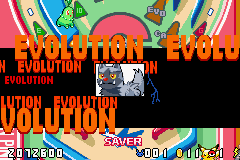 – The Pokémon is evolving!
 – Time to evolve a Pokémon on Sapphire.
 – Choosing Taillow to evolve.
 – The EX token is sitting near Wailmer.
 – The Evolution is complete!
 – Taillow has evolved into Swellow and is added to the Pokédex.
 – Entering Travel Mode on Sapphire.
 – Illimuse painting the new location.
 – Volbeat has filled in the new area on Ruby.
 – The Bonus Round is open on the Sapphire table.
 – Tackling Dusclops in the Bonus Round.
 – You can choose not to enter the Bonus Round – but miss out on big points.
 – Kecleon is briefly visible thanks to the Devon Scope.
 – Ten hits later and Kecleon surrenders.
 – Big bonus points for beating the Kecleon Bonus Round.
 – The Slot is open, ready to offer you a bonus.
 – The Slot reels are spinning.
 – Zigzagoon is jumping to stop the reels – on the Small Bonus, unfortunately.
 – Hitting the Spinner charges Pikachu’s energy levels.
 – Pikachu stops the ball from draining with his Thunderstrike.
 – Upgrading the Pokéball gives higher bonus multipliers.
 – Entering a name on the Sapphire high score table.
 – European Game Boy Advance titles usually offered in up to five languages, with a selection screen.
 – Thanks for reading! Want to continue your retrospective look at the Pokémon franchise? Well, take a look at



 Review of this game
 Review of the game
 First Impression of this game


 – Playing the Red table on a DMG Game Boy.


 Now, I don’t want to brag but I have various ideas to make a very interesting game. In the past, I actually created some arcade clones with
  But, here is the thing. When I was developing a game, I always started with the mechanics and gameplay. For example, when I wanted to create a Break-Out clone, I actually started out with recreating
  Another example is when I wanted to remake those simple flash and phone games that you need to tap a ball or an object to keep it from the ground. When I started to make that game, I got some small ideas for other mini-games with the sprites in that asset pack and I started to create a sort of
  I also messed around in
  A perfect video game needs to grab you and pull you into the story, world, and setting. When I was brainstorming for ideas I noticed that most of my favorite story-driven games take place in one location. For example, in
  Suddenly, various things started to click in my mind. I got my eureka moment. I got it when I remembered the story of
  The twist is that everything in the world happens with games. Think of the mechanics of the
 Maybe it’s an interesting idea to also have separate dimensions where players specialize in a certain genre or style of gameplay. Compare it a bit to the main characters in
 NekoJonez's Gaming Blog