“Macbeth” in performance

Macbeth seems to me particularly difficult to bring off in performance. At least, I have never seen a version on stage that I have found satisfactory – even productions featuring renowned Shakespeareans in the principal roles have disappointed. Of course, I haven’t seen them all, and I am sure there have been many fine productions that I have missed, but limiting myself (as I must) to what I have seen, far from being overwhelmed, as I should be on seeing a great Shakespeare tragedy, I have all too frequently found myself barely whelmed at all. The film versions I have seen haven’t frankly been much better; and the BBC Shakespeare version (from the early 1980s), despite starring eminent actors Nicol Williamson and Jane Lapotaire in the principal roles, was distinctly disappointing.

I have often wondered why this is. After all, it is dramatically very compact (it’s one of Sheakespeare’s shortest plays), and is crammed full of murders and battles and witches and ghosts and all the rest of it. Part of it, I think, is to do with the pacing. The tension builds powerfully and unremittingly over the first two acts, but after that, although we get a series of extremely memorable scenes (the banquet scene, the sleepwalking scene, etc.), the tension can sag quite alarmingly in the scenes in between. (This is particularly true of the long scene in Act 4 set in England.) Of course, Shakespeare was, certainly by this stage of his career, a master of pacing, and the rather awkward pacing of this play rather inclines me to think that what we have is an edited version of a text that had initially been longer. Be that as it may, it does present some problems in performance.

Another problem, I think, lies in the dramatic content being too exciting. This may seem a rather perverse thing to say, but the “greatness” of any drama we think of as “great” (whatever we may mean by that) lies not so much in the plot – i.e. the sequence of events – but in matters that go deeper; but, with this play, the plot itself is so very exciting on the surface, it becomes difficult for a production to peer beneath that surface: all too often, we find ourselves horrified by what the Macbeths do to others, whereas the heart of the tragedy lies, I think, in what they do to themselves. And if a production fails to bring to the fore this particular horror, this terrible damnation of their souls that they inflict upon themselves, then, no matter how exciting the plot may be, I don’t know that the production can count as a total success. But piercing through the excitement of the plot to see the dark horror at the heart of things is not an easy thing to do. And this, I think, is why so many productions of this play have left me unmoved: the horror of what we see on the surface seems all too often to obscure the even greater horror beneath.

Of course, I am sure there have been many very fine productions of Macbeth: it’s just that stagings of this particular play have disappointed me more often than that of any other major work by Shakespeare. It may, of course, be that I have been unlucky in the productions I have seen. But there is one production I have seen (sadly, not on stage) that seems to be one of the finest of any production I have seen, of any play. And this is the 1978 Royal Shakespeare Company production, directed by Trevor Nunn, and featuring Ian MacKellen and Judi Dench in the principal roles. Fortunately, we have a record of this: the production was filmed for television, and broadcast in 1979. And it is available nowadays on DVD. I saw it again a few days ago: and yes, it was every bit as powerful as I had remembered. Suddenly, all the reservations I have had about the pacing of this play seemed to vanish.

Macbeths

Ian MacKellen and Judi Dench as Macbeth and Lady Macbeth

And this was done not through butchering the text: apart from the scene involving Hecate (which is almost certainly a later addition, and not written by Shakespeare), the text presented, a few minor cuts apart, was virtually complete. Even the scene featuring the witches speaking to each other about the latest spells they have cast – a scene all too often excised these days, as modern audiences aren’t taken in by all that superstition – was retained. But what impressed was the way the entire play was conceived.

Although it features battles, witches, murder, a state banquet, and all the rest of it, it eschews spectacle completely. It is staged throughout in a profound darkness, from which the characters emerge at times into a murky kind of light, and into which, their parts done, they vanish again. The lighting is extraordinary. I can but guess at what the effect must have been like live in performance, but, watching it on my television screen, it seemed like a production designed specifically with the screen in mind, rather than a straight filming of a stage production.

Most of the shots are in close-up: some in extreme close-up. The characters, brightly spotlit against a blanket of the dark, are all we can see on screen. Props are kept to a minimum: even in the banquet scene, they appear to be sitting on crates. All this creates a tremendous sense of claustrophobia. (The production was staged in a small theatre, rather in in the main RSC theatre in Stratford, thus ensuring the audience was close to the actors.) After a while, it starts to feel genuinely oppressive, as, indeed, it should.

LadyMacbeth

Judi Dench as Lady Macbeth

None of this would have mattered, of course, if the cast weren’t up to it, but there’s no danger of that. The supporting cast (featuring two actors who were themselves notable Macbeths later in their careers – Bob Peck and Greg Hicks) is uniformly excellent; but in this play, it is the two principals who dominate. And here, Ian MacKellen and Judi Dench give performances that, even on repeated viewings, freeze the soul with terror. We see the most terrible things on stage, of course: at one point, a child is murdered before our very eyes. But at the heart of the tragedy is what these two people do to themselves. In the great banquet scene, Ian MacKellen presents Macbeth as a man who is already mentally unhinged: the sight of him literally foaming at the mouth in sheer terror is not something I’ll forget in a hurry. And in the sleepwalking scene, Judi Dench presents a Lady Macbeth who, while still on this bank and shoal of time, is already a damned soul suffering the torments of Hell. And we can’t but ask ourselves “What have these people done to their immortal souls?”

Ian Mckellen - Macbeth

Ian Mackellen as Macbeth

I saw this production again last weekend, and it remains a nerve-racking experience. Somehow, not even the most frightening of horror films can quite match the intensity of horror projected here.
“Upon such sacrifices…”

The final scene of King Lear starts with Lear and Cordelia, defeated in battle, brought in as prisoners. Cordelia asks whether she can see her sisters, whose wickedness has brought her and her father so low. Lear’s response to this is extraordinary:

No, no, no, no! Come, let’s away to prison:
We two alone will sing like birds i’ the cage:
When thou dost ask me blessing, I’ll kneel down,
And ask of thee forgiveness: so we’ll live,
And pray, and sing, and tell old tales, and laugh
At gilded butterflies, and hear poor rogues
Talk of court news; and we’ll talk with them too,
Who loses and who wins; who’s in, who’s out;
And take upon’s the mystery of things,
As if we were God’s spies: and we’ll wear out,
In a wall’d prison, packs and sects of great ones,
That ebb and flow by the moon.

Magnificent though this is, I am not quite sure how I should take it. It is certainly all too easy simply to revel in the beauty of Shakespeare’s blank verse, in that verbal music he produces that is simultaneously both exquisite and sublime. And certainly, if Shakespeare has chosen – as he obviously has here – to burst into such splendour at this point, then clearly he intended dramatic significance of this splendour to register with the audience. And yet, this dramatic significance is troubling. Does Lear really imagine that he and his daughter could live out the rest of their lives happily in prison? Even if that were possible, would it be desirable? For Lear, possibly: he is an old man, has suffered unimaginable agonies, and would like nothing better than to withdraw from life; but it is hardly desirable for someone like Cordelia, who is still young. And indeed, Shakespeare soon confirms that the heaven Lear imagines for himself and his daughter is illusory: far from living happily in prison with Cordelia for the rest of his life, Lear enters towards the end of this same scene in the utmost despair, with Cordelia dead in his arms.

But if Lear’s glorious lyrical outburst here is simply the deluded imaginings of a man who has lost whatever grasp he had once had of reality, why does Shakespeare make the passage so ethereally beautiful? Is it merely to accentuate the horror when these illusions cruelly shattered? That is certainly one way of looking at it, but that has never seemed very satisfactory to me. The presentation of something so beautiful merely to highlight its pointlessness seems to me a sort of gloating cynicism, a scoffing nastiness, that are quite at odds with the very rich and complex emotions I experience when I see or read this play.

Certainly, immediately after Lear delivers this speech, Edmund brings us down to earth with a very curt “take them away” (these three words completing the line that, in terms of metre, Lear had left unfinished). But then, Lear comes out with the most extraordinary lines of all:

Upon such sacrifices, my Cordelia,
The gods themselves throw incense.

It is a remarkable idea. In a play that has shown us the extremes of human brutality, Lear now suggests that the gods themselves praise and worship certain aspects of humanity. The implication of this is that humans can rise to a level even higher than that of the gods; and further, that the gods themselves acknowledge this.

Now, if we consider these lines in their specific dramatic context, they are meaningless. It is not possible, even if it were desirable, to detach oneself from life in the manner Lear envisages, to wear out one’s years in a wall’d prison while packs and sects of great ones ebb and flow by the moon. But the very striking nature of these lines seems to me to demand that we also consider them beyond their immediate dramatic context. If regarded solely in the immediate context, the “sacrifices” Lear refers to relates to withdrawing from life; but if we try to see it in a wider context, if we try to see what these sacrifices may be that even the gods themselves acknowledge and worship, we may glimpse, at least, something that may, in some way, mitigate the horror – the horror both of what had happened before, and the horror of what is yet to come. This is not to say that it is wrong to see King Lear as, essentially, a nihilist work; but it is to say, I think, that, despite appearances, there may just be a possibility of redemption.

And if there is such a possibility, it comes not from the gods, but from humanity itself. Lear, earlier in his speech, speaks of being like “God’s spies”. (The play is set in pagan times, but, unless the existing texts are corrupt at this point, it is certainly God rather than the gods Lear refers to here.) There seem to me at least two ways of interpreting this. One is that we must set ourselves the task of spying on God – the implication here being that God is not trustworthy. The other one is that we should spy on God’s behalf, and the implication here is that God himself does not know all that is happening in his creation. Either way, the picture is presented of a God whose capabilities are limited – who is either not wholly good, or not wholly powerful. But when humanity itself can offer up such sacrifices, then the gods themselves (Shakespeare has, rather curiously, switched back to the pagan “gods” now) feel it worthy of worship.

But what are “such sacrifices”? It is clearly not a withdrawal from life that Lear speaks of. But one needn’t look too far. This play depicts, certainly, the most bestial atrocities of which humans are capable; but, in Edgar, in Kent, in Cordelia, and even in Gloucester, it depicts also a human goodness that is equally extraordinary. Are these the sacrifices upon which the gods themselves throw incense? Perhaps. If the gods exist at all, that is. But sadly, we have no assurance of that. This is a play that suggests everything, even redemption; but ultimately, it confirms nothing.

The boring bits

Explaining the rules of test cricket to someone unfamiliar with the game – especially to someone who comes from a country in which cricket isn’t played – is certainly a challenge, but a most entertaining one: one can but relish the look of increasing bewilderment and incredulity on the listener’s face as one expounds not merely the rules, but also the various subtleties and nuances; and little can match the delight when, finally, one sees their jaw drop when you tell them that a match can last for five whole days, and still not end with a decisive result.

I am not, I must admit at the outset, a particularly avid fan of cricket. I enjoy it right enough, and, back in those days I always reminisce about here with a misty eye, I remember enjoying the live broadcasts of entire test matches on BBC. But these live broadcasts of cricket are only available now on subscription channels, and I really am not so keen a fan of sports that I’d be happy to fork out for these: not that I have anything against cricket, and  not that I wouldn’t have watched it if it had still been on BBC, but I frankly have other priorities I’d rather be spending my money on. Of course, I can still see the highlights at the end of each day’s play, but it’s not the same. So, over the years, I have rather got out of the habit of watching cricket (and other sports); and, since one cannot really follow what one does not see, I am fast losing interest in sport altogether. But the five-day test match used, I remember, to be wonderful way to waste a few days.

The attraction, I say as I try to explain, is not really of the excitement of the moment, but, rather, of tension building up over long periods. And over time, this tension is cumulative. This is why a mere hour’s worth of highlights doesn’t quite hit the spot: yes, you see all the wickets, you see the most spectacular shots, the best pieces of fielding, the most brilliant deliveries; but what’s missing is the element of time; what’s missing is the pacing of the game, the shape of the thing, some idea of how all the events unfold over time. The difference between watching a full test match and watching the highlights is like the difference between reading a well-crafted comic novel, and reading a joke book from cover to cover. In the comic novel, not every single line is funny, and nor is it intended to be; but in the end, it is a far more satisfactory read than the joke book.

But surely, I am asked, aren’t there dull patches over the five days of play? Aren’t there “boring bits”? Yes, there certainly are, I say. But – and here’s where I am most certainly courting downright disbelief – it’s part of the package. When you see something unfolding over a stretch of time, there are, almost inevitably, boring bits. But if you try to take those bits out, you end up with something like the “twenty-twenty game”, which is a radically simplified version of cricket, and where the purpose appears to be nothing more subtle or sophisticated than hitting each ball as hard as one possibly can. And, since the batsmen have to play aggressively, there are more wickets. So yes, it’s thrills and spills all the way, and, not surprisingly, it’s a sure-fire money-spinner. But ask any seasoned cricket fan what they prefer, and they’ll tell you with a virtually unanimous voice: it’s the five-day Test match that’s the Real Thing. That’s the form that gives the greatest satisfaction, boring bits and all.

Now, I appreciate I am set myself a hard selling job here in trying to convince readers that cricket actually benefits from having in it some boring patches, but I hope I have carried at least some of my readers so far, for now I’m going to go one step further, and claim that “boring bits” are part of the package not merely in test cricket, but also in works of art – in novels, plays, films, operas … in anything, indeed, that unfolds over time. Now, before you call for the strait-jacket, please let me explain.

By “boring bits”, I do not mean passages that are slow. Some works – comedies, say – generally require a generally fast tempo, while other more contemplative works generally require a slow tempo; but, regardless of whether the underlying tempo is an allegro or an adagio, what makes for boredom is not the pacing in itself, lack of variety in the pacing. A work that is relentlessly fast without variation can be just as tedious as a work that goes to the other extreme. So the problem is not necessarily a slow tempo, as such: the problem is when the chosen tempo isn’t justified by the material. And yes, it may be counted a flaw.  But it can crop up in some of the very greatest works of the human imagination. We do not, after all, judge a work by how free it is from flaws: some of the greatest works, we often find, are flawed. Indeed, given how great the artist’s ambition had been in these works, it is hardly to be expected that they could be executed to perfection: perfection tends to be a quality one finds more often in works where artists have set their sights on more modest ends.

Consider King Lear, for instance. I know of no greater work of art in any medium, and yet, one does not need to take a microscope to it to see that it is riddled with dramatic flaws. But really, does it matter? Similarly with Don Quixote. Once again, it’s one of the great pillars of western culture, but can one honestly say that it doesn’t have flaws?

I really do not know how often I have read or seen King Lear over the decades, and the flaws have frankly never bothered me. And yes, Don Quixote most certainly has its longueurs, but I have read that book from cover to cover four times now, and not once did I consider skipping those “boring bits”. Because when something unfolds over time, I want to get a sense of its pacing, I want to get a sense of the shape of the thing. So a genius like Cervantes misjudged it from time to time: so what? I’m happy to stick with the misjudgements of a genius than with the piddling perfection of some mediocrity. And if that seems like idolatry, so be it. As far as I am concerned, the odd bit of boredom is a small price to pay to get close to the mind of a genius. As in test cricket, it’s all part of the package.

We may look at various other works too of the highest artistic merit. Can even the most ardent Wagnerian, or the most avid Mahlerian, really put their hands on their hearts and say there are no “boring bits” in a Wagner opera or in a Mahler symphony? Can even the keenest fan of Andrei Tarkovsky claim there are no boring bits in, say, Solaris, or in The Sacrifice? Is it reasonable for even the most sympathetic reader to maintain that Moby-Dick is free of all longueurs? Of course not. But here’s the curious paradox: taking those “boring bits” out won’t improve the work. Indeed, I’d go as far as to argue that such an excision would have quite the opposite effect.

The wonder of these great masterpieces is not that they are flawless – they clearly aren’t – but that they exist at all, and that they are so very great that the flaws simply do not matter. In the end, they are all, essentially, “part of the package”.

“The Catcher in the Rye”

  • So you write a blog?

I couldn’t deny it. Yes, I replied. What kind of blog? Oh, I write about whatever comes to mind, really, but it’s mainly about books.

  • So you read a lot?

Not a lot, I explain. Compared to many other book bloggers, I actually read very little. But yes, I do read, and I like thinking about what I read, and putting down my thoughts – such as they are – on paper. Or on a laptop screen, at least.

  • So what do you think of The Catcher in the Rye?

Now, that question came out of the blue, and I wasn’t quite prepared for it. But I said, truthfully, that it has been many decades since I read it, and I remember I rather enjoyed it at the time.

A pause. And then:

  • I hated it. I don’t know why it’s regarded as a classic. It was just this whiny kid going on and on. Irritated the hell out of me. I felt like slapping him.

Oh, I said. Well, never mind. Fancy another drink?

Now, to be frank, I don’t really understand why it’s considered a classic either. Oh, not that it’s a bad novel – it clearly isn’t: but if I were to compile one of those tiresome lists of The Greatest Novels I Have Read, I don’t think I’d include The Catcher in the Rye. But I suppose it depends on where exactly you draw the line separating the Great from Nearly-Great-But-Not-Quite, or where exactly you separate that from Very-Good-But-Certainly-Nowhere-Near-Great, and so on. But whatever category you put it in, I don’t think it can be denied that the book is a cultural phenomenon. It’s one of those books that is read even by those who don’t normally read books. The impact it has made is more than literary, and that in itself demands attention.

When it was first published in the early 1950s, it was, perhaps rather quaintly from our contemporary perspective, deemed controversial. Many schools banned it from their reading lists. That in itself gave it the frisson of forbidden goods. It was, seemingly, anti-establishment, a handbook of teenage rebellion. However, nowadays, it is actually required reading in many schools, and that kills off whatever street-cred it might have had. And anyone looking in it for a frisson of that rebellious anti-establishment vibe is likely to come away thinking “Huh?”

For, looking around various comments on the net, I do not get the impression that The Catcher in the Rye is much liked these days – certainly not as much liked as it used to be in my own teenage years, back in the 1970s, when it was considered essential reading. The comments I see now mostly seem to agree that Holden Caulfield really is simply a “whiny kid”, and deeply irritating. Whether I should take these comments as in any way representative of contemporary tastes, and whether the tide really has turned so spectacularly since my teenage years, I do not know. But it seemed intriguing.

Now, even if we were to concede that Holden really is just a “whiny kid”, disliking a character, even the principal character, is, in general, a poor reason for disliking a novel. But I do concede that in this particular novel, we need, if not actually to see the world through Holden’s eyes, to be at least in sympathy with his perspective: otherwise the novel would make little if any emotional impact. In the course of the novel’s action, Holden has what we may describe as a mental breakdown: merely to stand in detached and unsympathetic judgement over this is unlikely to bring us very close to the heart of what the novel is about.

But what is the novel about? The general consensus appears to be that it is about teenage angst, and teenage rebellion. But even when I read it as a teenager I could see that it wasn’t that. Or, rather, the angst it depicts is not something that can reasonably be described as teenage angst.  Something described as “teenage angst” must, by definition, be widespread amongst teenagers: but no other teenager in this novel feels anything like the mental agonies that Holden goes though; and Holden himself is as powerfully alienated from people of his own age group as he is from adults. What we are asked to observe is not, I think, a general condition, but rather, an affliction affecting one particular individual.

And Holden is not really rebellious. His “rebellion” really amounts to no more than walking out of the residential school he attends (he is obviously from a privileged background), and spending a few days by himself in New York. And even in those few days, he doesn’t actually do anything bad, as such: even when he has the opportunity to sleep with a prostitute, he finds he cannot go through with it. Of course, he dislikes all that he sees around him, but, beyond expressing his dislike, he does little to rebel against them.

In many ways, he is very much a product of the society he finds himself disliking. His attitude to homosexuality, for instance: while not openly hostile or malicious, homosexuality is nonetheless something he finds disturbing, and, by modern standards at least, we would certainly deem him “homophobic”. But given the background he has grown up in, it really would have taken a very fearless and independent thinker to hold what we may nowadays consider tolerant and enlightened views on the matter; and Holden as a thinker is neither fearless nor independent. Indeed, he is not much of a thinker at all: his dissatisfaction with life is purely an instinctive, emotional response to what is around him, not an intellectual stance.

So why is he so dissatisfied? Holden himself cannot explain this, for, firstly, he does not analyse himself, and is possibly incapable of doing so; and secondly, neither is he very articulate. His general sense of dissatisfaction is something he feels, but which he cannot understand, or express in words. So it is up to us, as readers, to try to look beyond his natural inarticulacy. One word he uses frequently is “phoney”. He doesn’t explain what he means by this, but we can see that he tends to apply this word to describe what he regards (although he would possibly be unable to articulate it thus) as emotional shallowness, or insincerity. And this he sees all around him. People say things, do things, not because they feel it, but simply because that is the form, as it were, simply because this is what everyone does. What appears to dissatisfy him is a lack of feeling, a lack of emotional depth in peoples’ day-to-day lives. But why seems it so particular with him? However, as with Prince Hamlet (in this if little else), he knows not “seems”: for Holden, it is. It is the seeming in others that he deplores.

And the reason for this, though not immediately apparent, emerges slowly over the course of the novel, and takes centre stage in the climactic passage towards the end, where he meets with his sister Phoebe: Holden is still in grieving for the death of his brother Allie, and he cannot understand why the rest of the world isn’t also grieving with him. How can people – even his own parents – carry on with their lives as before after something so momentous as this? How can they all go inside to take shelter from the rain immediately after his funeral?

This, I think, is at the heart of the matter. The novel is not about teenage angst, or rebellion, or about the difficulties of coming to age: it’s about a sensitive young lad who cannot articulate his grief, nor understand how the rest of the world, his own parents included, could fail to grieve as he does, could carry on living when his own life seems to have come to a halt. And considered as such, it strikes me as a very poignant novel, and not deserving the opprobrium so frequently heaped upon it these days.

I honestly can’t remember how many years it has been since I last read it. And, unlike many other books I have read, it is not one that has been a prominent presence in my mind in those years. But when, prompted by the conversation I reported at the start of this post, I started to think back on it, I was surprised by how vivid it had remained in my mind, by how well I remembered it – even above many other novels that are arguably of a higher literary quality.

A great novel? No, probably not. It probably doesn’t have the artistic scope that one might expect from something labelled “great”. But I think it’s a minor masterpiece, all the same.

A brief rumination on fronted adverbials

Until quite recently, I did not know what “fronted adverbials” were. But now that I do know, I find myself using them all the time. Indeed, looking back on my older blog posts, I find I had used them even before I knew what they were. And, on reflection, I think I used them correctly.

Not that I care too much, frankly, whether I used them correctly or not: I worry when my writing does not convey what I want it to convey, or when my phrasing is inelegant; whether or not I stick to some set of prescribed rules is not something that bothers me at all. Which is not to say I am indifferent to grammar: far from it. I belong to a generation that was not taught grammar at school (hence my ignorance till quite recently of “fronted adverbials”), and I regret my lack of education in this respect: I regret it not because I think a greater knowledge of grammar would help me write better – I don’t think it would – but simply because language is such a fascinating human construct, I would, I think, have enjoyed and have benefited from being taught something of how it is constructed. Of course, I could, and, indeed, do, try to compensate for my ignorance now in my adult years, but I don’t really see why teaching something so very interesting in schools should be so derided.

And it is derided. The reader will, I hope, excuse me for not overwhelming this brief post with a plethora of links to demonstrate my point, but you don’t really need to look too far to find often impassioned diatribes against the teaching of grammar in schools. (The teaching of “fronted adverbials” is particularly looked down upon.) Teaching grammar in schools, we are told, is “quite unnecessary”, and one can write perfectly well without being taught anything at all about the subject.

Now, I do not dispute either of these points. What I do however dispute, very strongly, is that “should not be taught” follows from being “quite unnecessary”. When I press anyone on this point, I am told that children are being taught these things at far too young an age, that they are made to learn these things merely by Gradgrindian rote learning, and that all this inhibits something called “creativity”. Once again, I don’t know that I would dispute any of these points (although I may gently suggest, perhaps, that an element, at least, of discipline may indeed help rather than hinder “creativity”). But I do not want to get side-tracked into these matters. I have no opinion – no informed opinion, at least – on when grammar is best taught, or how. My grouse remains that “unnecessary” does not, must not, imply “should not be taught”. Much of what makes us civilised beings is “quite unnecessary” – in the sense that, in most cases, it does not serve any utilitarian purpose. But if we were to restrict our education only to that which is necessary, to that which is useful – if we were to reduce education, in other words, to no more than its utilitarian value – then that indeed really would be Gradgrindian.

I could have written the opening paragraph of this post without knowing what “fronted adverbials” are. But, like Monsieur Jourdain, who was delighted to know that he had been speaking prose all his life without knowing it, I too am delighted to know what “fronted adverbials” are.  And I really don’t care that it’s quite unnecessary.

Beyond expression

For a long time I used to think that the word “ineffable” described something that one isn’t allowed to swear at. Now that I know what it really means, I don’t think I had been too far off, for that which is too wonderful to be expressed in words really shouldn’t be sworn at. But that such a word exists at all strikes me as remarkable, for in its existence, and in the existence also of its polar opposite, “unspeakable”, there lies an implicit assumption that there are certain things that mere language is incapable of expressing. The ineffable is too great to be expressed in words, and the unspeakable too horrendous: in both cases, language fails us.

It is for this reason, I think, that it is often claimed that music is a greater art form than literature, for it is more expressive: unlike the art form based in language, music can convey the sense of the ineffable. (And also, I suppose, the unspeakable: Schubert and Mahler, amongst others, have both expressed a pitch of terror surpassing anything that may be conveyed by words.) The dictum that music begins where words end is frequently attributed, on the net at least, to both Heine and to Goethe; my searches, however, couldn’t locate a source, and I am always wary of attribution where the source isn’t cited. Rilke, to throw another German poet into the mix, does say in the poem “An die Musik”, Du Sprache wo Sprachen enden (“you speak where language ends”), though one suspects he is putting into words a sentiment that, at time of writing, was already current. A scholarly book to which I have been referred (note to sceptics: Twitter does have its uses if one tries to steer clear of the madness!) claims that the only source for this saying is in the correspondence between Tchaikovsky and Nadezhda von Meck. But be the source as it may, that the sentiment itself is widely accepted seems undeniable.

Mendelssohn said something quite similar:

The thoughts which are expressed to me by the music that I love are not too indefinite to be put into words, but, on the contrary, too definite…

(I take it this is a translation from the German, but I do not know who the translator is: I found it here, from the book Nineteenth Century Piano Music by R. Larry Todd.)

Once again, the sentiment is much the same: music is capable of expressing what words cannot.

Similar claims, I imagine, can be made for the visual arts, and I’d be surprised if they haven’t. Is it possible to express in words what is conveyed, say, by Michelangelo’s Medici Tombs? Or by Velazquez’ Las Meninas? That such works are expressing something is indisputable, but when we try to put into words what it is they express, we flounder. And the reason we flounder is not merely that these works may express different things to different people (although that is no doubt true too): often, despite finding ourselves affected by such works, we fail to express in words just what it is about them that affects us so, even on a personal level.

In this context, literature seems a strange beast. For literature, too, as those of us who love literature will testify, is capable of expressing the ineffable: it is simply not possible to put into words what a King Lear or an Anna Karenina may mean to us. But here, we find ourselves faced with an oxymoron: for, just as painting is composed of colours and sculpture with physical forms, and just as music is composed of sounds, so literature is composed of words and nothing but words; so, in saying literature is capable of expressing the ineffable, we are effectively making the quite ludicrous claim that words are expressing that which words are not capable of expressing.

And yet, unless we think that literature is indeed an inferior art form (and I certainly don’t), that is precisely what we are saying. I used to define poetry as “The manipulation of language to express that which language, were it not for the manipulation, could not express”; I still think that’s a pretty decent stab at a definition, but it falls down somewhat on the fact (for fact I think it is) that this definition could apply to other forms of literature also – to novels  and stories, to plays. Ultimately, it seems to me, this is the profoundly paradoxical aim of all serious literature – to express using language what language cannot express.

But if this is indeed what literature that aims to be serious aims for, and literature that we may justly term ineffable actually achieves, it leaves us book bloggers with something of a problem: what do we say about such literature? If we are talking about fiction, we could, I suppose, merely summarise the plot, but I don’t know that takes us anywhere at all.  Many, I know, stumble upon this blog (and other blogs  too, presumably) by searching for “plot synopsis”, and I have always wondered what they hope to gain from it. Anyway, mine not to reason why: if plot synopsis is what they want, there is plenty available that should satisfy them, though what need it satisfies is frankly beyond me. The problem I have with plot synopses is not a question of “spoilers”: it’s rather that, in any work of literature of any substance, the plot conveys very little of the essence of the work. A mere outline of the plot of Othello, say, says nothing, absolutely nothing, about what it is to experience the work, either on stage or on the page. For that is indeed ineffable.

But, given that the essence of a great work of literature is ineffable – it is so by definition, I think, for it is this very quality that confers greatness – I am on a loser in trying to convey what it means to me, or how I react to it. Oh, of course, I could use a few vague, generic terms – moving, disturbing, thought-provoking, and the like – but they don’t really convey too much. I do try, at least, to go a bit further than that, but reading over some of my old posts, not, I fear, with any spectacular success.

Maybe we should be allowed to swear at the ineffable after all. Fucking Othello!

Sherlock Holmes and the deerstalker

This post is really only for Sherlock Holmes fans. (That is, fans of the Conan Doyle stories: I have to add this rider as there seem nowadays to be many who describe themselves as Sherlock Holmes fans, but who appear neither to have read nor are interested in reading the stories.)  It’s not that you can’t read this post if you’re not a fan – we like to think we’re inclusive on this blog – but I’ll be delving here into Holmesian matters so esoteric and arcane, that those less than obsessed with these stories may well be thinking to themselves “What a sad git!”

Now the preliminaries are over with, let us begin.

Dear fellow anoraks,

Whose invention was the deerstalker? Conan Doyle never mentions the deerstalker explicitly, but near the start of the story “Silver Blaze” (Dec, 1892) we do get this:

“… Sherlock Holmes, with his sharp, eager face framed in his ear-flapped travelling-cap …”

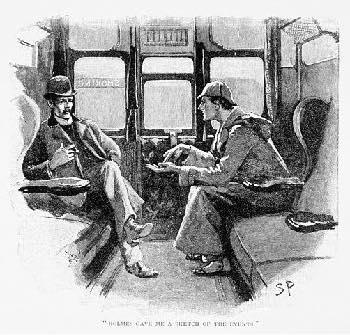
Although not explicitly mentioned, it’s obvious what Conan Doyle meant. And Sidney Paget obliged, illustrating “Silver Blaze” with the now iconic picture of Holmes and Watson sitting in a railway carriage, with Holmes dressed in an Inverness cape and deerstalker hat.

homles1

Sidney Paget’s illustration for “Silver Blaze”

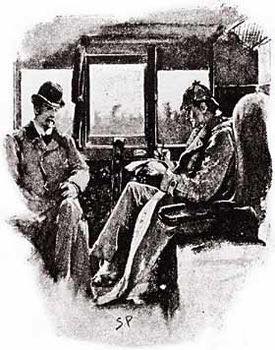
However, there is more to it than that. Just over a year earlier, Paget had drawn a very similar picture, again showing Holmes in his deerstalker (though not, I think, the Inverness cape), for “The Boscombe Valley Mystery” (Oct, 1891). And, as far as I am aware, the deerstalker is not mentioned, directly or indirectly, either in “The Boscombe Valley Mystery”, or in any of the earlier stories.

Holmes2

Sidney Paget’s illustration for “the Boscombe Valley Mystery”

So, the absence of any evidence to the contrary leads me to deduce that the deerstalker was indeed Sidney Paget’s invention, and that, rather than the illustrator following the author, as is usually the case, here, it was Conan Doyle following his illustrator by giving Holmes the deerstalker in “Silver Blaze”.

And also, as far as I can remember, Conan Doyle never mentions, nor even describes anything that could resemble, the Inverness cape. That too, it appears, was Sidney Paget’s invention.

Of course, there was nothing particularly unusual about a deerstalker in those days. Gentlemen often wore it, especially when out hunting. (Which, in effect, is what Sherlock Holmes was doing.) The deerstalker was one of several items of headwear that Paget had drawn for Holmes. But, curiously, those other items of headgear (including, once, a top hat) haven’t remained in the popular imagination: it is the image of the deerstalker that has stuck – to such an extent that one cannot even think of such a hat without picturing Sherlock Holmes.

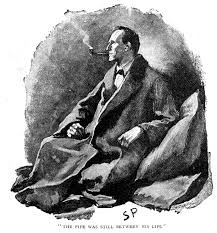
For this, I think we have primarily to thank William Gillette, the American actor who, in 1899, adapted Holmes for the stage, and played the character over 1000 times. (He also played Holmes in a silent film in 1916.) It was he who popularised the Inverness cape and the deerstalker that Paget had introduced, and had added to it the curly pipe, which appears nowhere either in Conan Doyle’s text nor in Paget’s illustrations. Indeed, in “The Red-Headed League”, the pipe is described as “black clay pipe thrusting out like the bill of some strange bird”; and whenever Paget drew Holmes with a pipe (as in the picture below illustrating “The Man with the Twisted Lip”), he invariably drew it as a straight pipe.

Holmes3

Sidney Paget’s illustration for “The Man with the Twisted Lip”

Later, of course, came the Basil Rathbone-Nigel Bruce films, and the deerstalker, Inverness cape, and curly pipe became synonymous with Holmes. And that image remains. Even Jeremy Brett – perhaps now the most widely seen Sherlock Holmes on screen – donning various items of headgear other than the deerstalker has failed to dent this popular image.

***

Now, those of you who aren’t Holmes fans but who have, despite my advice, read this far, may well be thinking to themselves “So what?” Well, so nothing, really. It’s just that I’m something of an anorak in these matters, and, as I sit on my patio this sunny Sunday afternoon, a drink in one hand and a book of Sherlock Holmes stories in the other, these, rather than more profound questions concerning the nature of our lives, are matters I find myself musing upon. Perhaps, if I put a bit of effort into it, I could develop this stub of a post into something more of general interest, and reflect upon how myths develop in the popular imagination, and upon how creations of the imagination, once created, assume a life independent of the creator; and so on. Well, yes, maybe. But I am enjoying this summer afternoon on my patio too much right now to go into all that. Some other time, maybe.

Now back to “The Red Circle”…

Boris and the Vixen

I hope I’m not disappointing anyone, but this post is going to be about opera.

More specifically, about two of my personal favourite operas – Mussorgsky’s  Boris Godunov, and Janáček’s The Cunning Little Vixen – performances of which I had the privilege of attending over the last week.

Other than their both originating from Eastern Europe (one is Russian, the other Czech), and apart from their both being among my personal favourite works, they have little in common. Except, perhaps, that, each in its own way, they’re both quite unusual operas. Mussorgsky’s opera, based on  Pushkin’s sprawling epic play, is itself a sprawling epic opera, but seems rather strangely structured: the central character Boris appears in only four of its seven scenes (in four of its nine scenes in the later 1873 version); and there are long scenes, taking up substantial parts of the opera, that seem at best only tangentially related to the central plot, making one wonder just what they are doing there. This was perhaps inevitable given that Mussorgsky (who was librettist as well as composer) had to radically cut down the text of Pushkin’s play, reducing twenty-five scenes merely to seven: this inevitably results in some narrative discontinuities, where the audience has to fill in the gaps for themselves, and also in a few threads that don’t appear to lead anywhere. It’s a work that seems to want to expand further than what can reasonably be accommodated in a single evening’s performance.

Janáček’s opera is even stranger: it is based not on a play or even a novel, but on a comic strip in a newspaper; it is virtually plotless (a summary of the incidents that occur don’t really amount to what most of us would recognise as a plot); and it tells of the interactions between humans and animals in a woodland setting. Hardly the stuff of traditional opera.

But we shouldn’t wonder at their strangeness: all works of genius are strange to some extent or other. Boris Godunov, like Mussorgsky’s later opera Khovanschina (which was left unfinished), takes us to a turbulent period of Russian history. (Although we may wonder whether there has ever been a time in Russian history that wasn’t turbulent.) The period is the late 16th century: Boris is asked by the populace to accept the crown, to prevent further civil warfare and bloodshed. He agrees, but his very first words set the tone: “My soul is heavy”. Yes, soul: this is a very Russian opera after all.

The version I saw last week performed by the Royal Opera was the earlier, and more compact, 1869 version. It is not a version I am familiar with: the recording I have (and through which I know the piece), conducted by Claudio Abbado, appears to use the longer later version from 1873, but includes also a scene from the earlier version that Mussorgsky had taken out. The differences between the 1869 and the 1879 are fascinating, but it would take a greater Mussorgsky scholar than myself to write a proper analysis of it. As for as I can see, Mussorgsky, for his later version, stripped out a brief scene in which Boris encounters the Holy Fool (who is about as archetypal a Russian figure as may be imagined); adds two long scenes involving various political and romantic machinations in Poland, where Dmitri, the Pretender, is manipulated by the Polish Princess Marina, and who is herself manipulated by the Jesuit priest Rangoni; and added also an extra scene after Boris’ death, in which we witness an attempted lynching, and where, at the end, we see the armies of the Pretender march through the land, as the Holy Fool laments the fate of the Russian people: whoever is in power, it is the people who continue to suffer. In addition to this, Mussorgsky had significantly expanded at least two other scenes. (There are most probably further changes if one were to study the scores in detail – something I am not, alas, qualified to do.)

I did, I must confess, miss those extra scenes, and the extra passages Mussorgsky had composed for the later version; but even this more compact version seemed sprawling. I do not mean that as a criticism: I love the sprawl. Between the famous coronation scene at the opening, and perhaps the even more famous death scene at the end, we find ourselves in the gloom of a monastery cell, where the monk Pimen is chronicling the history of Russia (this scene is primarily expository, though not wholly so: we see also the young schismatic monk Grigory, who will later claim to be Dmitri, heir to the crown). Then, we have what seems to be a quite irrelevant scene set in a tavern, where we encounter the striking figure of the drunken monk Varlaam. True,  it does relate to the main action  in that we also see Grigory, now escaped from the monastery, and trying to make his way across the border into Lithuania; but the focus of this scene falls on Varlaam (sung with some gusto in this production by John Tomlinson): quite apart from anything else, he is given what must be the best “drunk” music ever composed: here was a composer who knew well what it was like to be drunk, and reproduced it unerringly in music. (In this earlier version, we do not see Varlaam again after this tavern scene: in the later version, we see him again in the final scene, attempting to lynch and hang a Catholic.)

Only after all this – some half way through the opera in its earlier version – do we encounter Boris again (after his brief appearance in the opening coronation scenes), and, perhaps to our surprise, we encounter him as a gentle and tender man, loving and solicitous of his children. But his soul is heavy: Prince Dmitri – the real prince Dmitri, not the one who later pretends to be him – had been murdered: he was a mere child. According to Pimen’s narration, it was Boris who had ordered the murder. We never quite get to know the truth of this. But in the terrifying final moments of this particular scene, we see Boris tortured with guilt, and hallucinating: he sees the murdered child appearing to him, and he cries out in terror, disclaiming his guilt. The music Mussorgsky provides for this really does make my hair stand on end: I really know nothing in any other opera to match this for sheer terror.

BorisGodunov

Bryn Terfel as the tortured Boris Godunov. Or, perhaps, me after a rough night. Take your pick. (Picture courtesy Royal Opera)

Some day, I’d love to see the later, more expanded version, but I can’t complain: this was every bit as majestic and as imposing and as dark and terrifying as I have always imagined this opera to be. Bryn Terfel as Boris was simply extraordinary, projecting both the tender side of the character, and also the tortured and demonic side, with equal conviction. I am not really qualified to comment on the musical aspects of the performance, but Marc Albrecht’s conducting, and the orchestra’s playing – and also, in this of all operas, the singing of the chorus: it can be argued that the people are the real protagonists here – left, as far as I was concerned, at least, absolutely nothing to be desired.

(I have now seen Bryn Terfel live on three occasions – as Hans Sachs, as Falstaff, and now, as Boris Godunov. Not a bad threesome!)

With The Cunning Little Vixen, we enter a very different world. We are no longer dealing with kings and pretenders and marching armies – we are in a forest, and the first orchestral sounds we hear seem to evoke the wind rustling the leaves, and the chirping of insects. A forester takes a nap, and a frog lands on his nose. On waking, he finds a fox cub, and takes her home to be a sort of pet for the children. The forester, and all the animals – the fox, the frog, the various birds, the mosquitoes – all sing.

The music is certainly very beautiful but at this stage, one is entitled to ask – What is Janáček playing at? The English title suggests a cute, Disneyfied view of the animal world, but the English title is misleading: the original Czech title is Příhody lišky Bystroušky, which, roughly translated, means (I’m told) “The Adventures of Vixen Sharp-ears“. Somewhat less Disneyesque than the English title perhaps, but it still doesn’t help us much. A summary of the plot, such as it is, doesn’t tell us much either: the fox cub grows up into a vixen, wards off the advances of the dog and kills all the chickens (no Disneyesque cuteness here!), runs off back into the forest, drives out the badger and takes over his home, falls in love and marries a fox (to ecstatic singing from all the other woodland animals), has many fox cubs of her own, and is then, all of a sudden and quite out of the blue, shot by a poacher. And the vixen’s death isn’t even the climactic point of the opera: the orchestra is given a few bars of sad, reflective music on the vixen’s death, and then we move on. In contrast to Boris Godunov, where death seems an earth-shattering event, here, death is presented merely as something that happens every day: it’s no big deal really.

Alongside this, we get the world of the humans: we see the forester at home with his wife; later, we see him in a tavern with a priest and a schoolmaster (Janáček’s drunk music is very different from Mussorgsky’s); the schoolmaster is pining for someone named Terynka, but his love is unrequited; while the priest, returning home tipsy, reflects on the time he had been falsely accused of a sexual misdemeanour. Later, we find that Terynka (still unseen), is to marry someone called Harašta, who is also a poacher: the schoolmaster’s love is fated to remain unrequited. The priest, meanwhile, has left: we are told briefly that he is lonely and homesick. And so on. A lot of incidents, yes, but they refuse to gel into anything resembling a coherent narrative line. Everything just seems to happen – with nothing much leading up to them, and nothing much resulting from them. Even the death of the principal character, the vixen. These things just happen – and that’s all. Even death.

To get some idea what Janáček was “playing at”, we must look to the music.

I’m truly sorry Man’s dominion
Has broken Nature’s social union…

It is “Nature’s social union” that Burns speaks of that Janáček here depicts in his music. On Saturday night, the London Symphony Orchestra, conducted by Simon Rattle, performed all three acts without an interval, and the whole thing emerged like a vast orchestral tone poem with voices, an all-embracing paean to nature, and to its eternal cycles of self-renewal. But of course, the fact that Nature renews herself regularly is scant consolation to us poor sods who face inevitable extinction: and this is acknowledged. The climactic point of the opera comes not with the death of the vixen, but with the Forester’s rueful monologue, in which he reflects sadly, though not bitterly, on the passage of time, and, by implication, on his own inevitable extinction. The music here is almost unbearably poignant: Simon Rattle says in his programme notes that the ending of the opera leaves him in tears, and Janáček himself had asked for this music to be played at his own funeral. I myself find it very hard to listen to this monologue without thinking of Wordsworth’s line “that there hath passed away a glory from the earth”. And yet, this is not quite the last word. Once again, the forester falls asleep, as he had done at the start of the opera, and once again, a frog jumps on to his nose, but it’s not the same frog as at the beginning: it is that’s frog’s grandchild. And in the final bars, the music itself seems to expand to fill the void with sounds of what I can only describe as ecstasy.

vixen

Lucy Crowe as the Vixen, and Gerard Finley as the forester, in “The Cunning Little Vixen”. (Picture courtesy London Symphony Orchestra)

It’s not a long opera: it’s only about 90 or so minutes – shorter than some of Wagner’s single acts. But in that 90 minutes, we find music that is, by turns, gentle, nostalgic, boisterous, exuberant, calm and nocturnal, joyous and celebratory … and even, at times, dark and tragic: the music that opens the third act, say, speaks of death as surely as does any funeral march in a Mahler symphony. This opera, for me, is Janáček’s Lied von der Erde, but how different his focus is from Mahler’s! In both works, I suppose, the sadness and the angst are, as it were, sublimated into a sort of ecstasy, but where, in Mahler, the longing fades away at the end, serenely into silence, here, we seem overwhelmed by the sheer plenitude of Life itself.

Of the performance, there is not really anything I can say other than it held me spellbound throughout. The London Symphony Orchestra produced the most extraordinary sounds and it’s hard to imagine this cast – led by Lucy Crowe as the Vixen and Gerard Finley as the forester (with a telling cameos from Hanno Muller-Brachman as the poacher Harašta, and Sophia Burgos as the Fox) – being bettered. I am not entirely sure what, if anything, Peter Sellers’ semi-staging added to the proceedings, but the way I felt on leaving the Barbican, I was in no frame of mind to complain.

Well, I suppose I’ve probably spent my entire annual opera allowance over just a few days. But it was worth it. I wouldn’t have missed these for anything.

On re-visiting late James

When one speaks merely of one’s literary preferences, of the degree to which one likes or dislikes this book or that, then – as I have often had occasion to say, with, perhaps, a somewhat greater sense of self-importance than is entirely warranted – one reports not so much on the books themselves, but upon one’s own self. Bearing this in mind, I have tried, in my earlier posts at least, and not very successfully even then, to be as objective as I could, keeping my subjective responses to what I read at what I hoped could be described as “at an arm’s length”. But over the years, this has changed, and perhaps that’s just as well. For, after all, there are any number of people who can objectively analyse literature far better than I could: that is something I am not trained in, and probably wouldn’t be too good at even if I were. But what I can do, better than anyone else, I think I can say without undue boasting, is to give an account, a subjective account, of how I, personally, view a work, and why. And if that is autobiography rather than criticism, then, frankly, so be it.

For a description of one’s own subjective viewpoint is necessarily autobiography: what I see reveals where I am, and how I interpret what I see reveals the leanings and biases of my mind. And, now approaching the age of sixty at a faster pace than I might have wished, I find myself increasingly inclined to take stock, to find out where I really am, and how I came to be there; to discover, in short, these leanings and biases of my mind.

One thing I find myself doing increasingly with age is revisiting. I know many would count it a shortcoming on my part to re-tread merely the ground already trodden rather than seek out newer worlds to conquer, but there is so much in that old ground that I know I have missed, or that I know would mean something different to me from what it had meant to me earlier, that it seems pointless not to look back. For each work of art is incomplete without the reader – or the viewer, or the listener: it is only when a work of art is read (or viewed, or heard) does it achieve completion. And since we are all uniquely different people, each completion is necessarily unique. This is not to argue in favour of relativism – to say, as some do, that no individual understanding can be deemed incorrect: the reader’s understanding is but the final component of the pattern, not the pattern itself.

I am currently in the process of re-reading, after some twenty years and more, Henry James’ The Wings of the Dove. Progress is slow, firstly because I tend to be a slow reader, and secondly because the construction of James’ sentences, especially in his later works, is not such as to allow quick comprehension. But in any case, I do not see the point of trying to race through this: I know that James isn’t everyone’s cup of afternoon tea, but his stature as a literary artist is hardly in any doubt, and from what I remember of my earlier reading of these, his last three novels – The Wings of the Dove, The Ambassadors, The Golden Bowl – are among his most profound and heartfelt utterances. The Biblical allusions in the titles of the first and last of these three testify to, at the very least, their seriousness of intent. And I know I did no more than skim the surface in my earlier readings: I did not understand much, but I understood enough to realise that I wasn’t really understanding enough. But what little I did take in, even back them, has been resonating in my mind ever since, and now, I feel, the time is right to revisit. Reading these three books will take a long time – a very long time, I suspect – but that’s all right: I’m in no hurry. And, being a somewhat different person to the thirty-something whippersnapper I was at my first reading, those final pieces I shall now be providing to complete these works will, I think, be very different from previously. And when one is no longer in suspense to discover how the plot will develop, the mind becomes free to focus on other, more important matters,

James published these three massive novels in three successive years, and it seems likely he was working on them at the same time. Or, at least, that he was thinking about them at the same time. So inevitably, I imagine, there will be thematic connections between them. But what themes? That I am not yet sure about. I am some 200 or so pages into The Wings of the Dove, and right from the very first sentence, James warns us that he will not state anything directly:

She waited, Kate Croy, for her father to come in, but he kept her unconscionably, and there were moments at which she showed herself, in the glass over the mantel, a face positively pale with the irritation that had brought her to the point of going away without sight of him.

So much is achieved in this opening sentence. There’s a sense both of time (“he kept her waiting unconscionably”) and of space (“the glass over the mantel”), and also of Kate Croy’s agitated mental state. And yet, any other writer, I think, would have written “Kate Croy waited..” rather than “She waited, Kate Croy, …” I think this is James announcing from the beginning that he will not be stating anything directly; and also, I think, by making the reader pause twice within the opening four words, he establishes a certain tempo, a certain rhythm, which impels the reader to pause frequently, examining carefully what is being said, or, more frequently, what is not being said.  For, even more perhaps than most others of James’ works, this is a novel built upon evasions – evasions both by the characters, in thought and in speech, and evasions by the narrator himself. The very fact of evasion seems to be one of the novel’s major themes. But to what end? What, in fine, is being evaded? Or is that too direct a question to ask?

I have never felt comfortable writing about a book till I have got to the end; and then, more often than not these days, I pour out just about everything I can think of to say about it in a single monstrously long post that no sane person would even want to read. But unless and until I get a sense of the overall shape of a work, I find it very hard to comment. So I had better leave it for now. To be continued, as they say. Unless I do a bit of evasion myself.

So in the meantime, I am progressing, excruciatingly slowly, perhaps, but utterly absorbed and fascinated, attempting to get to the heart of the great mysteries that James hints to us with all the artfulness at his disposal. And whatever final components I as a reader will contribute to complete these works, they are likely to be very different from what I had previously contributed.

Rosmersholm, after Ibsen

The production of Ibsen’s Rosmersholm, currently playing at the Duke of York’s Theatre in London’s West End, has received almost universal acclaim, and deservedly so. It is, indeed, a splendid evening’s theatre. The production is of a very high standard, with very striking sets and lighting; the acting, from all concerned (Hayley Atwell,  Tom Burke, Giles Terera, Lucy Briers), is of the highest level; it is superbly directed by Ian Rickson; and the play, intelligently adapted by Duncan Macmillan, makes s huge dramatic impact. At a time when so much of mainstream West End theatre is intent merely on putting on light-hearted fare that makes little if any demands of its audiences, it is indeed a pleasure to see something that sets out deliberately to challenge. And yet, for all its undoubted merits, I found myself coming out of the theatre at the end feeling somewhat uneasy. And this unease was more than the unease one invariably feels when coming into contact with a demanding work of art. For, although it was advertised as a play “by Ibsen”, albeit in an “adaptation”, I couldn’t help wondering how much of what I had seen was actually Ibsen’s play. For the script had been extensively re-written.

I am, of course, aware of the various arguments for doing so. Neither am I such a purist as to demand a slavishly literal approach: any performance is, after all, an interpretation, and a work as complex as Rosmersholm allows for a wide range of legitimate interpretation. But to be a legitimate interpretation of Ibsen’s play, it must surely interpret Ibsen’s text; and if the text is so radically altered as it is here, then, no matter how fine the results, one wonders whether it can still be described as Ibsen’s play without violating the Trades Description Act.

Oh, the outline was the same. We had a whole household of servants who weren’t mentioned in Ibsen’s text, but they weren’t given any lines here, and it is quite believable that a house as large as Rosmersholm would have so many people working there. The other characters are more or less as depicted by Ibsen. The structure of Ibsen’s play is faithfully maintained, with the same entrances and exits, the same scenes, the same incidents. If one were to summarise what happens in Ibsen’s play and what happens in the adaptation, there is unlikely to be any but the most insignificant difference between the two summaries. The problem is that in a play such as this,  the interest lies not in what happens, as such: it lies in why it happens; it lies is what is going on in the characters’ minds; it lies in the various themes and issues – moral, philosophical, psychological – that come to the fore as the action, such as it is, unfolds. The adaptation by Duncan Macmillan, is, I agree, fascinating in its own right: indeed, it is enthralling, and fully engages with the audience at a level that is nowadays sadly rare in West End theatres. But is this Ibsen’s play?

When I tried some months ago to write about this play, I described it as work in which the politics, though present, were essentially “noises off”: the focus, I felt, was on the interior workings of the mind. In this adaptation, the politics is brought very much to the foreground, and much that Ibsen had merely implied or adumbrated is stated explicitly. Thus, Kroll is made to outline the nature of his conservatism, and delivers a Burkean speech about tradition as an important force keeping society together; and Rosmer, later, is given a speech expressing anger at the social and economic inequalities. Neither is in Ibsen’s text. Rosmer goes further: at one point, he gathers his domestic staff together, and, expressing his guilt for having been “master” of people who should be free, tells them all to go. I’m afraid I did not recognise Ibsen’s John Rosmer here: this was more akin to Tolstoy’s Nekhlyudov. Towards the end of this adaptation, Rosmer tells Rebecca in despair “I want my God back!” This is certainly a striking line, and undoubtedly theatrical, but once again, this is not Ibsen. Yes, Rosmer, both in Ibsen’s play and here, has lost his faith; but in Ibsen’s play, it is a question of interpretation to what extent, if any, he longs for the faith he has lost. I don’t really see what – apart from a moment of theatricality – is gained by explicitly interpreting it in this manner, and, further, by stating this interpretation so unambiguously. This is a play where ambiguity is, after all, important, because the various themes of this play are, by their very nature, ambiguous. Does Rosmer regret his loss of faith? If so, is he sufficiently self-aware to realise this? And even if these  two questions can be answered in the affirmative, is Rosmer the kind of person who would state this so explicitly? The Rosmer in Ibsen’s play doesn’t. The Rosmer here does, and, hence, becomes a somewhat different character from the one Ibsen had depicted.

If anyone hasn’t seen this production, please don’t let me put you off. As I said, it is an enthralling evening’s theatre. But I suppose that Ibsen as an author has come to mean so much to me personally, I feel, in a strange way, protective of him. I certainly do not object to Ibsen being interpreted in ways I disagree with. I don’t even mind Ibsen’s plays being adapted, as it is done here. But I do find myself demurring when a play advertised as being “by Ibsen” when, frankly, it isn’t. This is not Rosmersholm, by Ibsen; this is Rosmersholm, after Ibsen.