A Visit to the Prado, or, What I did on my Holidays

There are, next to each other, two fridge magnets, on our fridge (as one might expect), of Rembrandt’s painting “The Jewish Bride”, and of Velazquez’ painting “Las Meninas”. And I used to say that one was the greatest painting I have seen, and the other the greatest painting I haven’t. Well, I have finally remedied that. Heaven knows why it has taken so long. We finally made that trip to Madrid, and spent a day at the Prado – one day was never going to be enough, but it will have to do for now – and so, yes, I have now seen “Las Meninas” as well.

fridgemagnets

Visiting the Prado is a dizzying experience. There is far too much to take in in a single visit. After a while, one finds oneself walking past paintings one knows to be masterpieces, but feeling too saturated with what one has already seen to try to absorb anything more. And what about all those other paintings that deserve the time I did not have, and the attention that had already drained away? Well, another visit, perhaps, some other time. Maybe a longer stay in Madrid, and more than a mere day. My mind these days is too small to absorb too many things within so short a space of time. (This, incidentally, applies to my reading also, but let us not get side-tracked.)

Not that I responded to everything. I can make nothing at all of Hieronymus Bosch for instance, and “The Garden of Earthly Delights”, so often cited as one of the gallery’s highlights, left me cold. And what is one to make of Rubens? Now, there are a great many paintings by Rubens that I admire – some immensely – but he did churn them out, didn’t he? And yes, I love flamboyance: if anything, my tastes run towards the flamboyant rather than towards the restrained. But there were times I stood in front of some of those canvases, and thought to myself, “This is just silly!” Standing in front of “The Adoration of the Magi”, I actually found myself laughing: not quite, perhaps, the most appropriate response. And yes, this is a comment on me, not on Rubens. But, much though I love the dramatic and the colourful, certain things are beyond even my threshold.

And El Greco. There was a strange one. There was a time when the paintings of El Greco fascinated me, with those colours, at once vibrant and austere, and those forms curiously elongated, but I can see little in them these days except a sort of mystic terror. I don’t think I am so earthbound as to reject anything that may be termed “spiritual” (I use inverted commas there as an admission of defeat: “spiritual” seems far too vague a term to describe what I would like to convey, but neither can I think of a suitable alternative). But, whatever “spirituality” I may profess, an artistic vision that appears to me to offer little other than terror is not one that speaks to me. Not these days, at least: perhaps my receptivity had been broader in my younger days.

But let us not dwell on all that I failed to respond to. What is the point, when there was so much that transported me? Merely to list all the paintings that I loved would be tedious, certainly for myself, and even more certainly, I think, for the reader. So let me highlight just a few paintings that made a particular impression on me. Please indulge me as I choose my personal choices – five paintings that I would take with me from this gallery for my own imaginary private collection.

But choosing merely a few highlights is not very easy in a gallery such as this, where, after having been held transfixed for God knows how long by Velazquez’ “Las Meninas”, I turned round to see through an open doorway Titian’s magnificent equestrian portrait of Carlos V. And this would be my first choice.

Prado-titian

“Carlos V” by Titian, courtesy Prado Museum

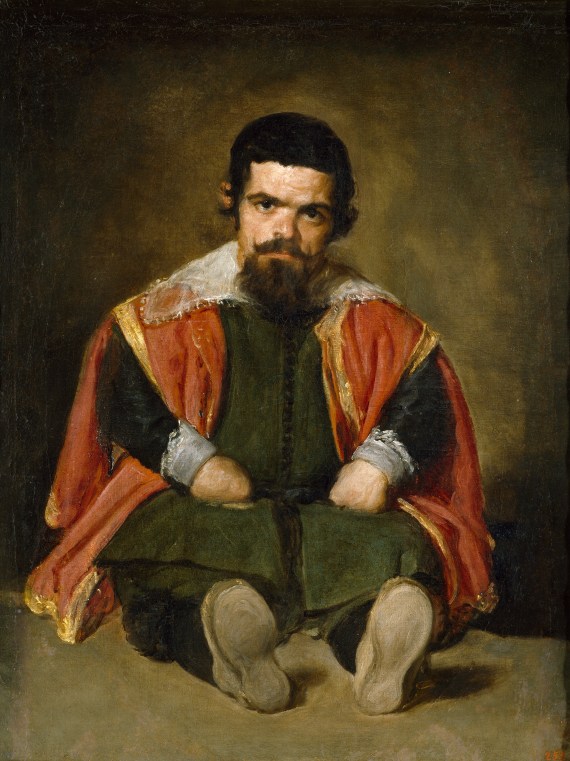
Of course, I suppose I should pick “Las Meninas” too – perhaps the most famous painting in a gallery bursting at the seams with famous paintings. But no – for Velazquez, I will pick his portrait of Sebastian de Morra. He was a dwarf, and was in the court merely to amuse the courtiers with his short stature. But Velazquez paints him as a he would an emperor. He doesn’t hide his physique – quite the opposite – but gives this man, the purpose of whose very existence was merely to provoke mirth, a dignity and a nobility that is nothing short of majestic.

Pradovelazquez

“Sebastian de Morra” by Velazquez, courtesy Prado Museum

My next choice is not so well-known. It is a still life by Francisco de Zurbarán, and at first glance, it is simplicity itself: four vessels, one of metal, the other three of earthenware, arranged in a straight line parallel to the plane of vision, none of them touching or overlapping with each other. Other than these vessels, and the ledge on which they are placed, all is dark. What could be simpler, or, one might think, less remarkable? And yet, the painting projects a sense of stillness, of utter silence, that seems almost sacred. I had said earlier that I do not reject the “spiritual”, and, given my sensibilities, I must say that I find greater spirituality here than in all the mystic visions of El Greco. (Once again, this is not a comment on El Greco … etc. etc. …)

PradoZurbaran

“Four Vessels” by Zurbaran, courtesy Prado Museum

It was towards the end of my visit of the gallery, after many hours’ wandering, and as I was nearing the end of my attention span, that I found myself face to face with Rogier van der Weiden’s “Descent from the Cross”. And it’s one of those occasions where I wish I were more skilled at this ekpharsis business. I wish I could explain why it is that I find myself so unutterably moved by the fact of Christ’s right hand and the Virgin’s left hand being parallel to each other. But I can’t. I can’t explain anything at all about this wondrous painting. Perhaps I had best resort to that old cliché of certain matters transcending analysis, and leave it there.

PradoWeyden_Deposition

“Descent from the Cross” by Rogier van der Weiden, courtesy Prado Museum

My last choice is a Goya. Not one of those horrific “black paintings” – but one he painted at the end of that series: “The Milkmaid of Bordeaux”. I may be completely wrong in this, but standing in front of that painting, I get a sense of serenity. Through that web of silvers and blues and greens, there seems, to me at least, a sense of having, as it were, come through: after all the horrors, after a journey through Hell itself, Goya presents us with a vision of radiance in a simple figure of a milkmaid. But it is also the vision of someone who knows what he has gone through, and hasn’t forgotten. It is a vision of serenity despite all the terrors. All this is no doubt very fanciful, and I do not possess the skill to explain why I feel this way. I can only report on that fact that I do.

goyamilkmaid

“The Milkmaid” by Goya, courtesy Prado, Madrid

Another trip beckons. I don’t know when: it has taken many, many years just to make my first visit. But I know I have to return. I can’t just leave it here.


“The Scarlet Letter” by Nathaniel Hawthorne

The Scarlet Letter opens dramatically with a scene of startling vividness, but Hawthorne makes us wait for it. For he had added a very long chapter titled “The Custom-House”, and subtitled “Introductory to The Scarlet Letter”. I suppose it is up to the individual reader whether or not to treat this “introductory” as an integral part of the novel: looking through various online comments, many readers seem to find this boring, and skip it. I, however, am something of a completist in these matters, and it did not seem to me boring at all: quite the contrary. Written in a most eloquent and musical prose style, it consists, for the most part, of a delightfully diverting account, leisurely narrated, of the custom house in which Hawthorne had worked, with pictures of various colourful characters associated with the place. Hawthorne presents himself as friendly, open, and companionable, and, reading this chapter, I could not imagine to myself a more convivial presence by the fireside. But it wasn’t entirely clear in what way this “introductory” is related to the rest of the novel: for all his apparent openness, Hawthorne leaves this something of a mystery.

In this introductory chapter, which Hawthorne tells us right away will be autobiographical, he tells of his own dreary travails at the custom-house, in order, seemingly, to placate the stern ghosts of his Puritan forefathers with remunerative toil; and he tells also of the apparent drying-up of his literary imagination during his three years spent here. And, towards the end of this chapter, he moves seamlessly from what he had till that point presented as fact, to what, we may surmise, is fiction, by telling us of his discovery of the Scarlet Letter itself – a small piece of cloth with the capital letter A embroidered in scarlet – and of the manuscripts he had found with it, telling the story of Hester Prynne. What follows, he tells us, is his re-writing of the story, “imagining the motive and modes of passion that influenced the characters who figure in it”. “I have allowed myself,” Hawthorne continues, “nearly or altogether as much licence as if the facts had been entirely of my own invention. What I contend for is the authenticity of the outline.”

Of course, there are many other examples of fictions that claim to be derived from authentic documents, with the claim itself implicitly understood to be part of the fiction. What is more puzzling is why Hawthorne should pen so long an introductory chapter merely to make this not very remarkable point, when a mere paragraph or two would have done just as well.

Hawthorne goes further:

While thus perplexed,—and cogitating, among other hypotheses, whether the letter might not have been one of those decorations which the white men used to contrive, in order to take the eyes of Indians,—I happened to place it on my breast. It seemed to me,—the reader may smile, but must not doubt my word,—it seemed to me, then, that I experienced a sensation not altogether physical, yet almost so, of burning heat; and as if the letter were not of red cloth, but red-hot iron. I shuddered, and involuntarily let it fall upon the floor.

Here, Hawthorne explicitly identifies himself with Hester Prynne, the wearer of the Scarlet Letter, and more than intimates some mysterious connection between himself and the Letter, and, indeed, with Hester Prynne herself.

And only now do we come to the first chapter. The opening is rightly famous. The setting is the prison house in Boston, in the Puritan society of the late 17th century.

The founders of a new colony, whatever Utopia of human virtue and happiness they might originally project, have invariably recognized it among their earliest practical necessities to allot a portion of the virgin soil as a cemetery, and another portion as the site of a prison.

Symbols abound. There is the heavily timbered prison door, studded with iron spikes; the prison itself, “the black flower of civilised society”; and, next to the prison door, Nature’s counterpart to this “black flower”, a wild rose bush. And there’s the scaffold, upon which the adulteress Hester Prynne stands to public gaze and scorn, holding to her breast her illegitimate child; and, of course, the embroidered Scarlet Letter upon her breast. These are very explicitly symbols, and are often referred to as such throughout the narrative. But what precisely they are symbols of is not always clear. Indeed, they are often as vaguely glimpsed and as obscure as that most famous literary symbol of all, the white whale dreamt up by Hawthorne’s friend Melville.

The embroidered letter A is clearly the symbol, to begin with, of Hester Prynne’s sinfulness, of her transgression. But as we progress, it acquires various other layers of meaning that are not always obvious. The daughter Pearl is explicitly referred to at one point as a “symbol”: there is about her an element that Hawthorne describes as “pagan”: at one point, she is referred to as an “elf-child”. She is a child of Nature, seemingly unaffected by the stultifying moral codes that bind together this Puritan society. When out in the forest outside the reaches of the town – another symbol – Hester momentarily takes off her Scarlet Letter, but Pearl immediately protests, and Hester puts it back on again. What are we to make of this? And, in the epilogue, we are told that Hester, as an old woman, and no longer under any obligation to wear the Scarlet Letter, insists on keeping it on. We can, should we choose, invent all kinds of correspondences: the letter represents sin, humiliation, expiation, defiance, inner strength – whatever we want; but as with the white whale, the symbol, though resonating powerfully throughout, remains beyond the reach of any such facile explanation.

But whatever the symbolic underpinnings of the story, Hawthorne does not bind himself to them. Hawthorne promises us at the end of the first chapter “a tale of human frailty and sorrow”: not an allegory in which the humans embody abstract concepts, but a drama, played out in human terms. The various symbols certainly resonate, but our understanding of the drama does not depend upon correct interpretation of the symbols – even assuming that these symbols are capable of being interpreted “correctly”: rather, the nature of these symbols help us penetrate the minds of the three protagonists.

The first protagonist is, of course, Hester, publicly humiliated, living the rest of her life in poverty with her daughter Pearl, and shunned by the rest of society. The next is the Reverend Arthur Dimmesdale, Pearl’s father, tormented by his awareness of his own sinfulness, which is known only to himself and to Hester. The third is a desiccated old man, Roger Chillingworth, who makes his first appearance in town on the very day of Hester’s public humiliation: he is, unknown to all except Hester herself, Hester’s husband, though long separated from her by circumstance. He soon discovers for himself the identity of his wife’s lover, and, his identity still secret, delights in tormenting him.

But the story is not really about “sin”, as such: it is, as Hawthorne clearly says, about “human frailty and sorrow”. The “sin” for which Hester – though not her lover, whose identity she refuses to divulge – is punished is adultery: in that society, it was considered a grievous transgression, and we are told that even the death penalty had been considered for Hester. In Hawthorne’s own times, this transgression would not have been so harshly judged, but nonetheless, it still bore a stigma: Hester would most certainly have been ostracised. In our own times, we would barely consider it a transgression at all, given especially that Hester had never really been close to her much older husband, had not heard from him for years, and that he was, in all probability, dead. Hester herself does not appear at any time to consider herself guilty: she stays on in the town, earning a meagre living as a seamstress, but at no point does she express remorse or penitence: on the contrary, she fights fiercely when it is suggested that Pearl be taken away from her; and, despite much pressure put upon her, she refuses to disclose Dimmesdale’s name, either to the authorities or to her husband. The letter A, embroidered upon her breast, and intended to be a humiliating mark of sinfulness, she wears almost as an act of defiance.

Dimmesdale, on the other hand, is torn with remorse and with guilt. But his guilt is not because he has let Hester alone bear that punishment and the public humiliation that he himself fears so much: it is for the act of adultery itself. And the Scarlet Letter that Hester wears so openly, Dimmesdale wears secretly in his heart. He has, indeed, every reason to feel guilty: but like all weak-willed men, the pain he feels is solely for his own self: at no point does he stop to consider what Hester Prynne may be going through. Nonetheless, the pain he feels is real enough, and what he thinks is sorrow for his sin of illicit sex may well be a displaced sorrow for a greater guilt – the lack of human empathy. But Hawthorne is not censorious: human frailty and sorrow are common to us all, after all.

The conceit that this story is Hathorne’s own retelling of an old tale he had found in his manuscript allows his both to be realistic, as he is in the psychological depictions of courage and of guilt, and also unrealistic, as he can bring into his narrative elements of folklore and of the supernatural, claiming that these elements were in the manuscript he had found, but, as a modern man, expressing scepticism about them. At one point, Hester is met by Mistress Hibbins, an actual historical character who had been hanged for witchcraft, but who, at the time of this drama, had been very much alive; and Mistress Hibbins tempts Hester to join her in the woods at night to meet with the Devil. Hester turns down the invitation: despite the Scarlet Letter upon her breast, she is no sinner. But the supernatural is introduced here quite unobtrusively, without ruffling the realistic surface of the story.

The drama plays itself out to its superb climactic scene set during a public holiday, and here, the Scarlet Letter that had burned secretly within the Reverend Dimmesdale’s breast is finally revealed. Once again, Hawthorne gives us the option either of accepting the supernatural, or preferring, in line with what we perhaps unthinkingly expect from nineteenth century novels, a more realistic interpretation. Neither diminishes the extraordinary dramatic culmination of this “tale of human frailty and sorrow”.

All of which still leaves open the enigma of that introductory chapter. Why does Hawthorne align himself so unmistakably with Hester Prynne? Normally, I try to consider a work independently of the author’s biography, but since the author has introduced autobiographical elements so explicitly into the work, that becomes impossible here. Hawthorne had, he tells us, worked at the custom-house because he felt that he owed it to his ancestors to be more than a mere storyteller, but that, during his time there, his imaginative faculties had dried up; and only after he had stopped working there could he return to the art of storytelling. Could it be that he saw his return to his literary vocation as a defiance of his Puritan forebears, much as Hester’s proud display of her Scarlet Letter was similarly a defiance of the Puritan ethos? I honestly do not know. It’s the only explanation I can think of, but it seems to me frankly far-fetched. But leaving aside that introductory chapter – which, though wonderfully diverting, remains for me something of a mystery – what Hawthorne has given us is a wonderfully moving tale, narrated in the most exquisite prose, and drawn with clear precise lines that belie the complexity of its underlying symbols, of human frailty, of human sorrow, and also, I think, of human courage, and resilience, and love.

Jekyll & Hyde

When Nabokov gave a series of lectures on European literature in Cornell University (which he later published under the title Lectures on Literature), he raised many eyebrows by choosing, alongside the likes of Austen and Flaubert and Proust and Kafka, Robert Louis Stevenson’s The Strange Case of Dr Jekyll and Mr Hyde. The choice continues to raise literary eyebrows, and is generally regarded as one of the great man’s eccentricities. Stevenson is still widely regarded as not quite a hack as such, but nonetheless, as Edmund Wilson described him, as a “second-rater” – a purveyor of adventure stories who had, it is true, penned a few children’s classics, but who was hardly a writer to be taken too seriously.

To argue against this contention would involve engaging with the vexed question of what constitutes literary quality – a question to which it is impossible to provide a definitive answer. In the end, we have little alternative but to fall back on Nabokov’s own criterion of literary greatness – the tingle in the spine. Which is, of course, entirely subjective, in a way that literary criticism ideally should not be. But clearly, Stevenson’s Jekyll & Hyde gave the normally fastidious Nabokov such a tingle. As it does me. I realise that a mere assertion hardly qualifies as an argument, but, going by that tingle I most certainly feel, there is not the slightest doubt in my mind that The Strange Case of Dr Jekyll and Mr Hyde is one of the great myths of modern times, among the most resonant of fables, and fully worthy of inclusion in Nabokov’s list. However, making the case for this may be more than slightly tricky.

Before trying to describe what Dr Jekyll and Mr Hyde is, let us briefly consider what it isn’t. It is not a depiction of a “split personality” struggling between Good and Evil. This may seem a somewhat odd thing to say, as a split personality, and the Manichean dichotomy within a single human breast of Good impulses and Evil, are, in the popular imagination, the very themes conveyed by the names “Jekyll and Hyde”.  But whatever we may derive from the countless adaptations of Stevenson’s story (many of them, incidentally, very fine works in their own right), this is not what Stevenson had written. For at the centre of Stevenson’s story is the issue not so much of a split personality, but of a suppressed personality.

Dr Jekyll himself, in his testament (which forms the final chapter of his narrative), describes himself thus:

And indeed the worst of my faults was a certain impatient gaiety of disposition, such as has made the happiness of many, but such as I found it hard to reconcile with my imperious desire to carry my head high, and wear a more than commonly grave countenance before the public. Hence it came about that I concealed my pleasures; and that when I reached years of reflection, and began to look round me and take stock of my progress and position in the world, I stood already committed to a profound duplicity of life. Many a man would have even blazoned such irregularities as I was guilty of; but from the high views that I had set before me, I regarded and hid them with an almost morbid sense of shame.

There is a certain coyness in this: “impatient gaiety of disposition” seems rather mild and innocuous, and it is hard to see how something so apparently innocent, mere “irregularities”, could lead to “an almost morbid sense of shame”. The word “shame” occurs again a few lines later:

Though so profound a double-dealer, I was in no sense a hypocrite; both sides of me were in dead earnest; I was no more myself when I laid aside restraint and plunged in shame, than when I laboured, in the eye of day, at the furtherance of knowledge or the relief of sorrow and suffering.

This “plung[ing] in shame” does seem to imply something more than mere “impatient gaiety of disposition”, and it is hard to not get the impression that Dr Jekyll is not telling us the entire truth about himself.

I thus drew steadily nearer to that truth, by whose partial discovery I have been doomed to such a dreadful shipwreck: that man is not truly one, but truly two.

But what are these two natures? Are they merely the duality of Good and Evil? Perhaps. But how should we understand these terms in such a context? Jekyll had, he said, “plunged in shame” when he had “laid aside restraint”. So if we insist on seeing this duality in terms of Good and Evil (and Jekyll himself does not use those terms), then Evil is what Jekyll had euphemistically called “a certain impatient gaiety of disposition”, and Good is merely that which impels us to restrain it. In short, Evil is the seeking of pleasure, impatient of other considerations; and Good merely the restraint we apply to this. In such terms, Good is not so much a quality that exists independently, but, rather, merely a means of restraint. Far from Good and Evil striving for supremacy in the human breast, humanity is engaged in no more than suppressing as best he can the Evil within.

Since we tend to think of Evil as something more than mere impatient seeking of pleasure, and Good as something more than merely a restraint on pleasure-seeking, these terms are perhaps, in this context, somewhat misleading. But the existence of both within a single human breast certainly creates a duality.

 I saw that, of the two natures that contended in the field of my consciousness, even if I could rightly be said to be either, it was only because I was radically both…

Jekyll tells us that he dreamt of separating these two elements:

 If each, I told myself, could but be housed in separate identities, life would be relieved of all that was unbearable; the unjust might go his way, delivered from the aspirations and remorse of his more upright twin; and the just could walk steadfastly and securely on his upward path, doing the good things in which he found his pleasure, and no longer exposed to disgrace and penitence …

But which of the two does Jekyll aspire towards? The “just”, who finds pleasure in doing good things rather than things that would plunge him into shame? Or the “unjust”, who could be delivered from “aspiration and remorse”? Rather tantalisingly, Jekyll does not tell us. But his potion turns him towards the “unjust” rather than towards the “just”, and the unmistakable pleasure he takes in this – so much so that, even when back in the form of Dr Jekyll, he is keen to repeat the experience – inclines me think that it is the latter, the “unjust”, towards which Dr Jekyll had aspired; and that, far from the experiment being a calamitous failure, it had succeeded even better than Dr Jekyll may have hoped for: he could now enjoy his pleasures without any shame to accompany it. What Dr Jekyll had perhaps under-estimated were the sheer depths of depravity of which we are capable once moral restraints are lifted. And for these depths of depravity, the term “Evil” is not misapplied.

This seems to indicate a rather bleak vision on Stevenson’s part: mankind is essentially depraved, and that which we term “Good” no more than restraints on our depravity. And once the restraint is off, what remains is pure Evil. Of course, we need not see this is a universal condition: there is no reason to see Dr Jekyll as Everyman. But the vision is nonetheless of a darkness at the heart of our beings.

The narration itself takes the form of a detective story. And here, the impact this novel must have made on Stevenson’s contemporary is inevitably diminished, for only in the final two chapters of the novel are Jekyll and Hyde revealed to be a single person – a revelation that should, nowadays, come as a surprise to no-one. That the novel can be enjoyed even when this twist is known is testament, I think, to its literary qualities. For the fictional world it presents, in prose of often startling vividness, is an uneasy, unsettling world. It is also a very male world: the only female characters are the maid who witnesses the murder of Danvers Carew from her window, and the little girl in Mr Enfield’s story in the opening chapter. Mr Utterson the lawyer, Mr Enfield his cousin, Dr Lanyon, and Dr Jekyll himself, all appear to be bachelors. The feminine aspects of humanity seem conspicuous by their absence.

In the opening pages, Mr Enfield tells Mr Utterson of a recent experience of his: at three o’clock of a “black winter morning”, he had seen a hideous-looking small man, who answered to the name of Mr Hyde, quite deliberately trample upon a little girl he had accidentally bumped into and knocked over. The story rather raises the question of what the little girl was doing out at that time of the night. Of course, she might have been one of the many homeless out on the streets, but the question is something Mr Enfield does not dwell upon. Neither does he tell us what he himself was doing out at that time of the night: “I was coming home from some place at the end of the world,” he says rather airily to Mr Utterson, who does not ask him to expand. The fog and the murk of the city are straight out of Dickens, and they seem more than merely physical; and the various questions implicitly posed but left unanswered, and, for that matter, unenquired into, may not be entirely unrelated to the “impatient gaiety of disposition” that Dr Jekyll refers to – those “irregularities” that lead to “an almost morbid sense of shame”.

Mr Utterson decides to seek out Mr Hyde, who, he is convinced, is blackmailing Dr Jekyll. Once again, he does not care to enquire into what precisely he thinks Jekyll is being blackmailed for: as he says himself, he lets his “brother go to the devil in his own way”. Private vices – “irregularities” – are best left private.

Sir Danvers Carew, a pillar of the establishment, is beaten to death on the streets late at night. The scene is witnessed by a maidservant, but she witnesses it not from her employer’s house, but from her own. And a maidservant’s house is unlikely to have been in the more desirable localities of the city. So what was Sir Danvers Carew doing wandering the streets late at night in such localities? Once again, the question is not addressed.

All these tantalisingly unaddressed questions leave behind a sense of incompleteness, of matters not divulged because, perhaps, they are best left as they are: one’s brothers may go to the devil, each their own way. A world is created in which surfaces hide much that is best not looked into. And it is in the context of this world, a world in which that which lies under the surface is best left alone, that Stevenson looks at the strange case of Dr Jekyll and Mr Hyde. Here, we look under the surface, and we see what is released once the flimsy restraints we place upon ourselves are removed. And the vision we see of a moral chaos dwelling beneath the veneer of civilised refinement seems to me as vivid and as terrifying as in anything I think I’ve come across.

I do not wonder that Nabokov rated this novella so highly. To me, it ranks with James’ The Turn of the Screw and Conrad’s Heart of Darkness – novellas written only a few years after Dr Jekyll and Mr Hyde – as the most unsettling depictions of the moral chaos that lies immediately under the surface of our human lives.

The darker films of Billy Wilder

Mention the Golden Age of Hollywood – the 30s, the 40s, and into the 50s (although the studio system that gave rise to that Golden Age was already collapsing by then) – and most people these days … well, let us be on the safe side and say “a great many people these days” … will have a mental picture of the “Dream Factory” – a pipeline churning out frothy escapism, undemanding entertainment that is best seen with one’s brains left safely at home. Of course, there’s no denying that much that came out of Hollywood back then was indeed light, frothy entertainment: no-one will be watching the Astaire-Rogers musicals, say, or screwball comedies, expecting anything too serious. Although it may be added that should anyone take their brains along to these films rather than leave them at home, those brains would not necessarily feel insulted by what they see: there are gradations even in light, frothy entertainment.

But there was far more to the Dream Factory than merely confecting sweet dreams. Even at the height of the Depression, when, heaven knows, escape from a bitter reality was very much needed, the focus was not always purely on “escapism”: even comedies such as the Laurel and Hardy films acknowledged the reality of the Depression (Stan and Ollie were frequently penniless vagrants), and Chaplin, in films such as The Kid or Modern Times, certainly didn’t hold back. Social criticism was very much an integral part of the gangster movie genre at Warner Brothers; and in 1940, barely a year after the Great Depression is reckoned to have ended, John Ford made a magnificent cinematic adaptation of Steinbeck’s The Grapes of Wrath: those who reckon Hollywood films of that era were essentially frothy escapism can still let out an astonished gasp or two as one of the characters in that film describes in shockingly graphic detail how his children had starved to death.

The darkness Hollywood films of that Golden Era were prepared to depict was not necessarily merely the darkness of social evils, murky though they were: sometimes, the darkness was of the human heart. And here, Billy Wilder, especially, excelled. In some sixteen or so years – between 1944 and 1960, to be precise – Billy Wilder co-wrote and directed, amongst, it may be admitted, more light-hearted fare, five films that look very uncompromisingly indeed into the darkness of the human heart. These films are, in chronological order, Double Indemnity, The Lost Weekend, Sunset Boulevard, Ace in the Hole (also known as The Big Carnival), and The Apartment. Each of these films features as protagonist a man who, through flaws and shortcomings in his character, finds himself morally compromised, and becomes, as a consequence, filled with self-disgust. (In Double Indemnity and Sunset Boulevard, this protagonist shares the spotlight with a female character who, too, is very deeply flawed, though in very different ways.)

At this point, when the reader is, I’m aware, wondering what all this is leading to, and when I too am eager to press ahead and satisfy the reader’s curiosity on that score, I have to issue one of those tiresome “spoiler alerts”. I know I have to, because when I don’t, I receive indignant e-mails. So here it is: If you have not seen these films – more particularly, if you have not seen The Lost Weekend and The Apartment – and plan to see them, and feel that the essence of good drama lies in finding out what happens next (at least on first viewing), and, in particular, in what happens at the end, then it is probably best that you read no further. For it is on the endings of The Lost Weekend and of The Apartment that I intend to focus.

With that out of the way, let us continue.

Three of these five films (Double Indemnity, Sunset Boulevard, Ace in the Hole) end in tragedy: they could hardly have ended any other way. The other two films are also dark and tragic in content, although tragedy is averted at the end. In The Apartment, the last film of this unofficial series, the deeply flawed protagonist is, at long last, allowed to redeem himself morally. And there is a real sense of joy when this happens: there is a sense of release, a rare concession, amidst all the pessimism and all the cynicism and all the vitriol, that a way out, even given our profound human shortcomings, may be possible. It is possible not by the Grace of God – the presence of God is not particularly apparent in any of these films – but by a moral strength that even the most unremarkable of us may retain within ourselves. This ending moves us because it is so hard won, because we have, both earlier in this film and in the previous films, been shown the various red hells into which our sightless souls may stray. For, until that ending of that final film, we are, morally, in very murky waters indeed. We are far from the Dream Factory here.

All five of these films seem to me masterpieces, but speaking entirely subjectively (as I often do on this blog), it is The Lost Weekend that particularly intrigues me. Its protagonist (played by Ray Milland) is an alcoholic, but the film is not really about alcoholism, as such: at least, alcoholism is not its central theme. The central character, Don Birnam, seems to have everything going for him: he is handsome and charismatic, he is intelligent and cultured, and he is supremely articulate. But he is haunted by a sense of failure.  He had aspired, and aspires still, to be a writer, but all he has to show for it is a series of unfinished manuscripts. His tragedy is not merely that he is mediocre, or, worse, talentless; his tragedy is also that he recognises it, and that he cannot come to terms with what he recognises. And he takes refuge in drink, and in exercising his supreme articulacy with the barman:

It shrinks my liver, doesn’t it, Nat? It pickles my kidneys, yeah. But what it does it do to the mind? It tosses the sandbags overboard so the balloon can soar. Suddenly I’m above the ordinary. I’m competent. Extremely competent! I’m walking a tightrope over Niagara Falls. I’m one of the great ones. I’m Michelangelo, moulding the beard of Moses. I’m Van Gogh painting pure sunlight. I’m Horowitz, playing the Emperor Concerto. I’m John Barrymore before the movies got him by the throat. I’m Jesse James and his two brothers, all three of them. I’m W. Shakespeare. And out there it’s not Third Avenue any longer, it’s the Nile, Nat. The Nile, and down the Nile sails the barge of Cleopatra.

As the film progresses, we see Don Birnam travel through what seems like the circles of some Dantean inferno. Even now, some  seventy-five years after the film’s release, I doubt I have seen anything more horrific in a film than the sequence in the drying-out ward, or the terrifying alcoholic hallucinations Don Birnam has back in his flat.

But the tragedy that seems inevitable is averted. His girlfriend Helen (played by Jane Wyman), persuades him to start writing again, and he sits down to pen a novel based on his experiences. We, the viewer, may be left unsatisfied by this. Don Birnam has had false starts before, we know; and, further, we know also that, despite all his qualities, he does not have whatever it takes to be a writer: what stirs his imagination is not what he is writing, but rather, the idea of being a writer. When I saw this film in my younger days, I had no doubt that he would return to his drinking, and that what we see on screen is not so much a new start, but, rather, tragedy deferred.

But in my latest viewing (last week), I thought differently. Shortly before the end, Don has redeemed his revolver from the pawnbroker, obviously planning to shoot himself, and Helen, knowing this, and not really knowing what to do about it, pours him a drink; and when he expresses puzzlement, she breaks down and says “I’d rather have you drunk than have you dead”. Now, call me sentimental (as you probably will), but I suddenly found myself rather moved by this. Helen has, after all, stayed by him even when she has been told, by Don himself amongst others, to get out while she still can. And if she would rather have him drunk than dead, then maybe she would rather have him talentless than dead too. Maybe she could reconcile him to his lack of talent. Maybe. The future, as the film ends, is still uncertain, but if Don is to redeem himself, it won’t be through discovering his talent (he doesn’t have any), but, through Helen’s love, by being reconciled to himself by her love. And if that sounds sentimental, I’d counter that, perhaps, too often, we miss out on profound matters by our fear of being sentimental as much as we do by actually being sentimental. At any rate, this last viewing, the ending did not seem to me so inevitably dark as it used to seem.

It is only at the end of the last film of this series, The Apartment, that the protagonist (played here by Jack Lemmon) is allowed unambiguously to redeem himself. What he had been doing really was unspeakably sordid: in return for promotion, he would lend out his apartment to senior managers in his office for them to carry out their extra-marital affairs. But in this film, the protagonist is, at long last, allowed to rediscover his moral bearings. And yes, the driving force, once again, is love. Perhaps these Wilder films are not quite so cynical as they are so often made out to be: yes, morality is frequently flouted and love frequently slighted, but morality and love both exist, and they are both potent, redeeming forces.

By the time The Apartment was released, in 1960, what we think of as The Golden Age of Hollywood was finished. Perhaps The Apartment and John Ford’s The Man Who Shot Liberty Valance, released two years later, were the last remnants of that age. And while that age did turn out the most glorious entertainment, it wasn’t blind to the darkness either. And no director, I think, peered into that darkness as insistently as did Billy Wilder. But it would be a mistake, I think, to see in even his darkest films merely undiluted pessimism and cynicism.

O poor Robinson Crusoe, how could you possibly do so?

In Daniel Defoe’s novel, the eponymous hero, Robinson Crusoe, during the 28 years he spends on his desert island, sometimes asks himself whether his fate was God’s punishment for having committed the primal sin of disobeying his father. And it struck me, even on my first reading as a child, that, given that Crusoe had been the owner of a plantation that was worked by slaves, and that, further, given that Crusoe had himself been a slave trader, there were somewhat greater transgressions than merely filial disobedience that the Almighty could have punished him for. Crusoe’s failure to see something so obvious as this struck me then, and strikes me still, as a chilling piece of irony that underpins the entire novel. And to the question “Did Defoe intend this irony?” I’d answer “Does it matter?”

Not that I’m one of those readers who divorces the text from the writer, seeing the former as merely a product of its times, and hence, no more than a reflection of the various power structures of those times. Far from it. The terrible irony I see underpinning Robinson Crusoe strikes me as very much a  literary quality: it shifts the focus of the novel from that of human resourcefulness and self-sufficiency (which are usually taken to be the novel’s principal themes) to the more interesting themes – from my perspective, at least – of the human capacity of self-delusion, and humanity’s failure to recognise its own moral culpability, repining as we do at the thought of imagined sins when far greater crimes are staring us in the face.

Now, all the available evidence concerning Defoe indicates that this irony was not intentional on the author’s part, but I really don’t see what that should make a difference to the way I perceive this novel. Especially when this irony enhances both its literary and its moral qualities.

This year is the three hundredth anniversary of this very famous novel, and it is perhaps only natural that we should be disturbed by its content. I will not list the various reasons why modern readers may find the content disturbing: they are well described in this article that recently appeared in The Guardian. However, the headline-writer appears not to have read the article: “Robinson Crusoe at 300: why it’s time to let go of this colonial fairytale” says the headline, although Charles Boyle, the author, says quite explicitly:

The argument here is not with Defoe, who was a clever and contrary man. His acceptance of slavery as necessary for profitable business is one thing; his belief that Britain is a nation of immigrants and his championing of education for women are others. Nor is the argument with the novel itself … My quarrel is with the way the novel has been used, and continues to be used …

His quarrel, in short, is with interpretation. And Defoe’s novels, in general, are open to various interpretative stances. This is primarily because each of his major novels (at least, the ones that I have read: Robinson Crusoe, Moll Flanders, Journal of the Plague Year, and Roxana) is a first person narration, and can, and, to my mind, should, be taken as a dramatic monologue. Thus, we find ourselves compelled to evaluate what is being said in the context of our understanding of the person who is saying it. In Moll Flanders, for instance, we notice the irony of Moll expressing, near the end of her narrative, penitence for her criminal life, while, at the same time, being content to live on the proceeds of that same criminality. That Moll is not aware of this irony is no reason why we shouldn’t take a different view. In Robinson Crusoe, we go a step further: not only is the fictional narrator not aware of the irony underpinning his narrative, it appears, from evidence external to the novel itself, that Defoe himself was possibly not aware either. But the irony nonetheless exists, and, to my mind, makes it a greater novel.

Charles Boyle’s other criticism – that of the pedestrian nature of the prose – may be possible harder to counter. Defoe was primarily a journalist, and only took up novel-writing comparatively late in his career; and he made a point of writing his novels in clear, precise, journalistic prose. It was, it seems to me, a conscious artistic decision. I must admit I do not find the prose “pedestrian” at all: indeed, the nature of the prose seems to me to serve its purpose well – to provide the utmost clarity and transparency even while concealing subtleties and ironies hidden even from the narrator. This conflict between transparency of the narrative style and the secrets hidden within the narrative itself seems to me to reach its apogee in Roxana (the work I take to be Defoe’s masterpiece), where, by the end, despite the absolute clarity of the prose, we cannot even be sure of what precisely happens, let alone how we are to interpret it.

It would be very wrong to “throw away” Robinson Crusoe as the Guardian headline-writer seems to suggest: but perhaps we should look again at this novel and, indeed, at Defoe’s other novels too, all of which seem to me to contain far more than is immediately apparent.

On bookshops, cathedrals, and fanciful analogies

We all have a favourite bookshop. And if we don’t, we should. We who are into blogging about books – we book-lovers, or, to employ a diction more suited to our pretensions, bibliophiles – should ideally have one particular bookshop that is particularly close to our heart. Not necessarily the biggest, nor even the best stocked, but one to which, for whatever reason, we find ourselves sentimentally attached.

For me, that is not an easy choice to make. Living as I do in a place from where it is as easy to travel to Central London as it is to Oxford, I am a bit spoilt for choice. In London, I do like Hatchards, which, unlike other big bookshops, has not diluted its bookishness by incorporating a coffee shop within its premises. And the big Waterstones in Torrington Place, near University College London, is particularly well-stocked, and is a delight to browse in. On the other hand, I have been known to describe the Blackwell’s in Oxford as my “spiritual home”. Spending a day in shops like this, if you ask me (and you probably don’t), is worth more than all your online outlets put together.

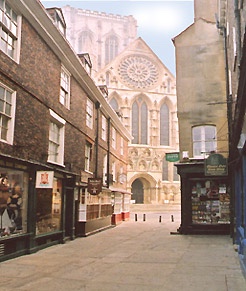
But there is one bookshop that is particularly close to my heart: Minster Gate bookshop, in York. It is an antiquarian and second-hand bookshop, and is much smaller than the ones I have mentioned, but it has character. The ground space is actually very small, but what it lacks in horizontal space, it makes up for in vertical: there are five storeys, including a basement, connected by very steep and very narrow flights of stairs. And these stairs, not having much room to extend, turn one hundred and eighty degrees between each successive pair of floors, creating a small landing half-way up. (I’m sure there is a technical architectural term to describe this, but since I do not know what it is, I have no choice but to provide laboured descriptions.) And these small landings each have a set of shelves, which one can only peruse by having to move to one side every now and then to let other customers squeeze past.

Minster Gate bookshop, York. Picture taken from bookshop’s website.

Needless to say, there’s no café here. Nothing compromises its air of bookish seriousness. And the stock is a delight. Being primarily an antiquarian and second hand bookshop, this stock is always changing, but every time I have been there – and I first went there over forty years ago now – I have found no shortage of items to tempt me. I don’t live very close to York these days, but when I do visit, not having a look at this bookshop is as unthinkable as not having a look at York Minster itself.

Which brings me to what is, perhaps, the greatest charm of this utterly charming bookshop: its close proximity to the mighty York Minster. The shop is situated a mere few yards from the magnificent soaring south transept of York Minster, which is one of the world’s greatest sights.

York Minster Cathedral, rising majestically above the city of York

The building itself I cannot help thinking of as a symphony in stone. I am not sure why this analogy with a symphony keeps coming to mind, but it seems apt: there is to this edifice an uncompromising and massive grandeur; it soars high, high above the maze of narrow streets around it, and looks down with a seeming disdain upon the small world below which seems almost too insignificant to encompass such glory. And, no doubt fancifully but nonetheless compellingly, this puts me in mind of the craggy grandeur I find in Beethoven’s symphonies, which, while enjoining us (quite literally in the finale of the ninth) to live our lives heroically, give us at the same time an image of a vastness so immense and so incapable of being adequately embraced by mere mortals such as ourselves, that we are put very firmly back in our place.

The interior of York Minster

The contrast between York Minster and Salisbury Cathedral – another favourite of mine, and one which, being closer to where I now live, I visit often – could not be greater. Instead of rising above narrow medieval streets, Salisbury Cathedral is situated in a spacious and airy close. Indeed, the world “close”, though literally accurate in this context, is also inappropriate, as this “close” is as open as may be imagined. Within this “close”, the cathedral is surrounded by gentle lawns and trees. The building itself epitomises grace and elegance. Even that famous spire, which is actually higher than any of the towers of York Minster, imparts no sense of massiveness or of grandeur, but rather of a certain lightness.

Salisbury Cathedral

For some tastes, compared to the mighty York Minster, Salisbury Cathedral conveys merely charm, is merely decorous, and is, hence, in the final analysis, merely insipid. I disagree, most vehemently. If York Minster is a Beethoven symphony, then Salisbury Cathedral is a Mozart piano concerto, delighting the senses with its charms, but touching also the strings of the heart, and sounding the deepest of chords. But then again, there are those who also think Mozart’s music is also a mere display of triviality, or, at best, of pleasant but ultimately insignificant fripperies. It is best, I think, just to shrug one’s shoulders and pass such people by.

And yes, Salisbury Cathedral is equally glorious inside

To complete the set, I think I should mention also the third of my three favourite cathedrals – Chartres Cathedral. In Chartres. France. And I guess I should liken this, too, with the works of a great composer. Bach, perhaps? The great passions, maybe, or the B minor mass? No, enough of this. An analogy that was no more than mildly fanciful to begin with reveals its silliness all too easily if stretched too far. So let us not stretch matters here.

Porch of North Transept Of Chartres Cathedral

But wait, wait … I got sidetracked. I was meaning to tell you about what I bought at the Minster Gate bookshop, and next thing I knew, I was talking about cathedrals and symphonies and all the rest of it. This is what happens when one has no discipline in one’s writing. So, let’s get back to where I had started: books. Or, rather, buying books.

What – I need more books? When I have so many at home I haven’t read yet? Of course, all bookish people – to which tribe, dear reader, I assume you belong – have been asked that question. And other questions too: Why do you have so many books in the house? Have you read them all? Yes, but surely you’re not going to re-read all of these? And so on. Nowadays, tired of explaining at great length why I surround myself with books, and still, despite my detailed and (as I like to imagine) articulate replies, encountering puzzled and uncomprehending faces, I have taken to saying, having put on as serious a demeanour as I can manage, that I fill my house with books because I believe they ward off evil spirits. That usually shuts ‘em up.

And the two books I came out with from Minster Gate bookshop yesterday to ward off evil spirits was a volume of Nabokov’s short stories, and a hardback edition – which, though second hand, looks not merely unread but unopened – of David West’s commentaries on the sonnets of Shakespeare. David West was, of course, a noted classical scholar: I have been greatly enjoying lately his translations of the odes of Horace (and I gather his translation of the Aeneid is also very fine). I am very curious to see what he makes of Shakespeare’s sonnets.

I’m on a long train journey back home tomorrow, so I should have plenty of time to start reading these. And even if I don’t, they will, I am sure, prove most effective in warding off evil spirits.

Please note: while the pictures of Salisbury and of Chartres are my own, the much better taken pictures of York I found by Google search, and they were not accompanied by a copyright notice. There was no intent on my part to breach copyright, but if I have inadvertently done so, please do contact me. Thank you very much.

“The Master Builder”: a postscript

My last post was a long one, and given I have already spent over four and a half thousand words on it, I really shouldn’t need to add a postscript. But on reading my post over again, there seems to me that something important is missing. At no point do I address the question “What do I, personally, think the play The Master Builder is about?”

The standard answers come easily. It is about a very great number of things, not all of which can  be articulated; to state directly what “it is about” is necessarily reductive, because if “what it is about” can be directly stated,  Ibsen wouldn’t have employed such intricate indirections; to insist on one single interpretation is to deny a host of others; that even one’s personal perspective on a work so profound and so complex as this changes over time, often from reading to reading; and so on, and so forth. All of which is true, but since I do not aim to give an objective overview of any work I discuss here on this blog, I really should be obliged to offer at least my own subjective perspectives. Not insist upon them, but merely to offer them, such as they are.

In an article on this play that appeared some nine or so years ago (and which I had not seen till only a few days ago), distinguished Ibsen scholar Toril Moi (whose book Henrik Ibsen and the Birth of Modernism I most warmly recommend) speaks of Hilde being fascinated by and longing for sex, and yet, at the same time, being afraid of it. She compares Hilde to Hedda Gabler, who used to listen fascinated to Loevborg’s accounts of his various debaucheries, but who threatened him with a gun when he had made an advance on her. (I must admit this is not a parallel that had occurred to me.) And in Solness, Toril Moi sees a man who, underneath all the various complexities – the various neuroses, the various pieces of myth-making about himself – is afraid simply of death.

Moi has interesting things to say also about Aline Solness, who, far from being a desiccated old woman in her sixties, is someone who had borne children only thirteen years earlier, and is most likely in her mid-to-late thirties. It is surely her relative youth that makes her living death so much more terrible.

For me, the marriage of Aline and Halvard is among the greatest mismatches in drama. Aline’s greatest sorrow is not the loss of her children, traumatic though that had been: it is the loss of her childhood, the violent break from the only world in which she had been happy; it is her dislocation into a world that feels forever alien. She has nothing of her husband’s energy and vigour, her husband’s zest for life and longing for joy: if Halvard feels chained to a corpse in being tied  to a woman who is incapable of moving on from her emotional attachment to a vanished past, she, on her part, cannot live in a present that has nothing to offer her but regretful memories of what has been forcibly wrenched from her.

Hilde, on the other hand, wishes to escape her past, but where she is to escape to is not certain. She describes her home as a cage, and herself as a wild bird; and when she is asked if she may wish to return to her childhood home – that one thing that Aline Solness desires more than anything else – Hilde replies that wild birds do not fly back into their cages. When she had been about twelve or thirteen – when, like  Juliet in Shakespeare’s play, she had been in the early stage of her journey from girlhood to womanhood, and was becoming aware of her sexuality – she had seen the vigorous and charismatic Solness, then, perhaps, in his early forties, climb up to the top of the tower; and she had found it thrilling beyond anything she had ever experienced, or had experienced since. From then on, her family home had been merely a cage from which she had to escape. So deep is her longing to escape the domesticities of home, that at times she becomes almost masochistic – as at that rather shocking moment when she speaks of the ancient Vikings, and of her excitement not at the thought of carrying away others (as Vikings used to do), but of being carried away.

And there’s Solness himself, of course. Yes, he is afraid of death. But I think he is afraid of something even more than that: he is afraid of nothingness. He is afraid of the possibility that nothing really matters. To me, the crux of the whole play, the climactic point of the drama, occurs during Solness’ final duologue with Hilde in the third act: he tells her of his defiance of God – even though he cannot bring himself even to speak God’s name; he tells her that from moment on, he had determined to build no more churches for God, but houses – houses for people to live in. From that moment, his world was to be people-centred rather than God-centred: he would embrace what we would nowadays describe as “humanism”. But it was no good: he has found no fulfilment in this either. All he has found was nothingness. And it is this nothingness he fears, more than anything else.

That first time he had climbed up the tower despite his fear of heights, he had done so to express his defiance of God whom he had believed in. Now, he climbs the tower again, but this time, he does so in defiance of nothingness, which he now also believes in. If nothingness is all that reality has to offer, then the greatest castles that can be built, the only castles that can be built, are “castles in the air”.

I have, in the above, refrained from citing passages from the text to support what I am saying. This is partly because I have done enough of that in my last post, and also because what I am offering here is, without apology, my own personal view of the play.

And of course, the usual caveats apply: I am not insisting upon my view of the work; there are a great many other valid ways of seeing it; I am sure I will see things differently again the next time I encounter it; and so on. But, for the moment at least, this, I think, is what lies at the centre of all the various complexities and profundities of this inexhaustible work – the fear that, at the heart of it all, there is simply a vast nothingness.

“The Master Builder” by Henrik Ibsen

*** SPOILER WARNING: The following post inevitably reveals some of the plot details of this play, and so, if such things are important to you (they needn’t be), it is possibly best not to read this post till you’ve read or seen the play for yourself. 

All quoted passages are taken from the translation by Barbara Haveland and Anne-Marie Stanton-Ife, published by Penguin Classics


The Master Builder continues to puzzle and bewilder audiences and readers. When watching a performance in the theatre, or reading the text at home, one can hardly miss its intense, life-and-death seriousness. But what is it all about? All kinds of possible interpretations have been put forward – that it is a political allegory, a representation of Man turning against God, a dramatisation of inter-generational conflict, an exploration of Nietzschean concepts of morality, and so on. Ibsen himself, when asked about its interpretation, replied that he simply wrote about people, and that he didn’t see what all the fuss was about. Of course, he was being disingenuous, but perhaps that is not a bad way of approaching this inscrutably obscure drama. It’s not that the play is not about a great many different themes and ideas, but, perhaps, none of that makes too much sense unless we engage first with the people – the characters on stage who carry the drama.

The setting seems realistic enough. In the first scene, we are in an office in the house of master builder Halvard Solness, and we see his employees at their work. This could easily be the setting of a realistic social drama, such as The Pillars of Society. And indeed, in the course of the drama, nothing happens that is unrealistic – in the sense that nothing happens that is physically impossible. But yet, it becomes impossible to take this drama on purely realistic terms. At the heart of the drama are a number of scenes between Master Builder Solness, and his young visitor, Hilde Wangel (whom we had seen in the earlier play The Lady From the Sea), and the duologues between them seem to make little sense if considered from a strictly realistic perspective. From such a perspective, we could say that they are both, in essence, mad – that they are both locked into their own personal fantasies, and that these fantasies somehow feed off each other. We could say that, on occasion, the reality of the lives around them enter into their fantasies; but equally – and, by the end, fatally – their fantasies also obtrude into the real world.

But to leave it there is to relegate this drama into the realms of nonsense: what interest could there possibly be in the fantasies of two crazy people? The reviews of the first London performance did, indeed, see the play in such terms (there’s a wonderful collection of quotes from these reviews in Michael Meyer’s biography of Ibsen): “… a play written rehearsed, and acted by lunatics”; “… platitudes and inanities…”; “… the most dreary and purposeless drivel … pointless, incoherent, and absolutely silly…”; “three acts of gibberish…”; “dull, mysterious, unchaste”.

It is easy to look back on such uncomprehending early criticism, and congratulate ourselves on our greater understanding, but it remains true, I think, that if we fail to enter imaginatively into the fantasy worlds created by Solness and by Hilde, and if we fail to see these fantasies as important counterpoints to the very real and solid world with which they overlap, then the criticisms quoted above may be seen as entirely reasonable, and “dull, mysterious, unchaste” may appear an entirely reasonable summary. Ibsen did, indeed, as he insisted, portray people, but to understand the nature of the people he portrayed, we must prepare ourselves to enter into their fantasies, and take them as seriously as the reality which, throughout all the dramatic complexities, never quite go away.

The opening scenes are very realistic indeed: Ibsen needed a strong, solid base on which to build. Master Builder Solness (Bygmester Solness, as the Norwegian title proclaims) is described in the stage directions as being in his “late middle age”: I think we can take that to mean he is in his 50s – hardly in the first flush of youth, but far from descended into the vale of years: we see him as vigorous, energetic, masterful, exerting his personal power over people around him; and, if the drama that unfolds is to make sense, he is charismatic, and still sexually attractive. Certainly Kaja, his bookkeeper, is completely in thrall to him: he is, naturally, fully aware of the power he exerts over Kaja, and is happy to take advantage of it.

Kaja’s intended, Ragnar Brovik, and Ragnar’s father Knut, also work in the office, as architects and designers. Old Knut Brovik once had his own construction business, but that had failed, and we see him merely an underling of Solness. Now, obviously old and ill, he would like to see his son succeed in the business, and he asks Solness to recommend Ragnar’s design for a commission, but Solness, terrified of the thought of being supplanted by a younger generation (as he, as a young man, had supplanted Knut Brovik), angrily refuses.

BROVIK: Am I to depart this life so poor?

SOLNESS [appears to be  struggling with himself; at length he says quietly, but firmly]: You will have to depart this life as best you can.

BROVIK: Well, so be it. [He walks away.]

SOLNESS [going after him, almost despairingly]: But I can’t do otherwise, you see! I am the way I am, after all!

Like God Almighty, he is what he is.

This opening exchange lays bare the essential character of Solness. He can be cruel, he can hurt people; but cruelty is not something that comes to him naturally. He has to struggle with himself before he utters those immensely cruel words “You will have to depart this life as best you can”. And afterwards, he has to try to explain himself. As the scene continues, we see him pour out a glass of water for his employee, and seeing that he is ill, advises Ragnar to take his father home. He is not amoral: he has a sense of what is right and what is wrong, of what is kind and what is cruel, but he cannot do otherwise: he is what he is.

So far, so realistic: this could still be a play from Ibsen’s earlier years. But in the scene that follows between Solness and the doctor, Solness comes out with the most extraordinary paranoia: has not Aline, Solness’ wife, asked the doctor to keep an eye on him? Has not Aline confided to the doctor that she thinks he is … mad? The doctor denies this, but Solness doesn’t quite believe him.

Because to some extent, you see, she – she might have reason to think such a thing.

Solness changes the subject quickly after this, but if we had thought this a realistic play, we are, perhaps, a bit less sure of our ground now. The ground shifts even further as Solness tell the doctor that he feels that he has certain supernatural powers: his deepest desires, he feels, though unspoken, somehow communicate themselves to others, and these others, unbidden, serve him: he can, he is convinced, bend the will of others to his own merely by desiring.

And then there comes a most extraordinary exchange that seems to confirm Solness’ suspicions concerning his own sanity. Contrary to the doctor’s suspicions, he is not, he insists, having an affair with his bookkeeper Kaja, but he allows his wife to suspect that he is:

Because I feel there is a kind of – kind of salutary self-torture for me in simply allowing Aline to think unjustly of me … it’s like paying off some portion of some vast and bottomless debt …

The doctor at this point throws up his hands and says he doesn’t understand a word of this, and we in the audience may start feeling the same. But Solness goes further: he is frightened. Yes, he has been successful in his career, “but at some point, the turn will come”. The younger generation will rise up, he says, and will overthrow him. Youth will come knocking at the door. And, as if to underline how far we have strayed by this point from the strict realism with which the play had begun, there is indeed a knock on the door at this precise point, and it is indeed youth who is knocking. But not the youth that Solness had been expecting: it is a young lady, a stranger, Hilde Wangel, who seems to have known Solness, but whom he cannot recognise. Having laid the basis of the drama in these few short but densely packed scenes that start with strict realism, but which, in Solness’ conversation with the doctor, drift towards what seems like madness, Ibsen now introduces Hilde, the final character of the drama. The prologue, as it were, is now over.

Hilde had appeared in a play Ibsen had written some four years earlier – The Lady from the Sea. There, we had seen her a teenager, living with her elder sister and her father, both gentle and loving souls, and with her stepmother, from whom she feels alienated. The play does end with a promise of renewal, but Hilde herself had emerged a not entirely sympathetic character: she is fascinated by the fact that a neighbouring young man is, unknown to himself, terminally ill, and, while others are kind to him despite his foolish and conceited nature, she teases him mercilessly. There was, in that play, something predatory about her, a certain failure of human empathy. Ibsen presumably felt that given the supporting role she had played in that drama, there wasn’t room to develop her character as he might ideally have wanted; whether he did or not, he brings her back here, and allots her a more prominent role. There is still an element of the predatory about her: though it is not explicitly stated – virtually nothing is explicitly stated in this play – she has certainly come to take Solness away from his wife. But there is more. She is, we find out, also locked into her own personal fantasies, although how much of her fantasy is also real is, from the beginning, uncertain, and open to question.

Solness does not recognise her at first. She has to remind him: some ten years ago, when she had been about twelve or thirteen, Solness had gone up north to Lysanger, Hilde’s hometown, to build a church. And, on that occasion, to consecrate the new church, Solness had climbed up the high tower and had placed upon it a wreath. Hilde describes the scene in almost ecstatic terms:

… it was so splendid and so terribly exciting. I couldn’t believe there was a master builder in all the world who could build such an enormously high tower. And then the fact that you were standing up there yourself, at the very top! In person! And that you weren’t the slightest bit dizzy. That was the most – kind of – dizzying thought of all.

But there is more. Hilde goes on to claim that afterwards, he, Solness, had found her alone, and had told her she looked beautiful, like a princess. Solness has no recollection of this, but Hilde continues. He had promised that in ten years’ time he would return like a troll; that he would carry her off; and that he would buy her a kingdom, and a castle. Solness feels uneasy: he doesn’t remember this, but doesn’t contradict her. But then, Hilde says, he had bent her back and had kissed her, passionately, many, many times.

In our own times, with our greater awareness of child abuse, we are likely to find this narration deeply shocking. I think it is intended to be shocking. There can be no excuse for any man behaving in such a manner with a twelve-year-old girl. And indeed, at this point, Solness himself is very deeply shocked by the accusation, and he vehemently denies it. But, very disconcertingly, she is not accusing him: she has come, she says, to claim what she had been promised – her kingdom and her castle. The ten years, she says, are up, and since he hadn’t come to her, she has had to come to him. And in a tone that seems both joking and serious at the same time, she claims from the Master Builder the promised kingdom.

Solness first claims that all this is something she may have dreamed, but then seems to halt in his tracks: “Wait, though,” he says, “there’s something here that goes deeper…” Could it be that the memory of actually having done all this now resurfaces? Or could it be that he thinks that he had communicated to her his unspoken desire, and, as he is convinced he has the ability to do, he had, through some supernatural power, bent her will to his? We never do find out whether the story Hilde tells is indeed true – whether Solness really had done all this. But true or not, Solness, though remaining puzzled as to her true motive in seeking him out after all these years, is happy that she had come: he seems to find in her someone who is, if not necessarily a kindred spirit, someone he could talk with openly, in the hope of being understood. He invites her to stay in his house, in one of the three empty rooms, the nurseries that have never been used.

In the course of the play, a series of quite extraordinary duologues develop between Solness and Hilde, as each invites the other into their own fantasy, and they find these fantasies, in effect, complementing each other. If we are to look at it purely from a realistic perspective – and while this is not the only perspective, it is one always worth bearing it in mind – regardless of whether or not Solness had made advances towards the then twelve-year-old Hilde, she had been drawn to him; and now, a grown-up woman, she has come to take him away from his wife. And he – again regardless of whether or not the reported incident had actually happened – had secretly desired her then; for how could he have communicated his desire to her if he had not desired in the first place? And he continues to desire her now. But that is only a very partial view of the drama. To get to the mysterious and elusive heart of the play, we must enter into their fantasies, which develop on a related but somewhat different plane from reality. We seem, in some ways, to be back in the world of Peer Gynt, where reality and fantasy seem to exist and develop side by side, interpenetrating and reflecting each other, but never quite touching.

There is, of course, a third point in the triangle: Aline, Solness’ wife, to whom Solness feels he owes a “vast and bottomless debt”. In the first two acts, she seems a pallid, almost a ghostly, presence, solicitous of her husband, but very unlike her husband: she is retiring and self-effacing, and almost entirely passive. When she says she will help Hilde settle in, she adds it’s her “duty”. The emptiness of duty devoid of love had been a theme in many of Ibsen’s earlier work – in particular, Ghosts – and this sense of emptiness strikes Hilde forcibly. Why had she not said she would help Hilde because she wanted to? This emphasis on duty has such a coldness about it.

But before this, there had been a brief but remarkable scene between Solness and Aline, which, like so much else in this play, seems almost impossible to summarise. Solness, we know, feels guilty towards his wife, although we do not yet know why. In this scene, she surprises him by expressing her own sense of guilt. “I should have hardened myself. Not let the shock get hold of me.” We cannot be sure at this stage what she is referring to. Solness tries to assure her that things would be better for them once they move into their new house, but she can see no such hope. Eventually, Solness gives up trying to persuade her, and vents his frustration:

SOLNESS [clenching his hands and crossing the floor]: Oh, but this is all so hopeless! Never a ray of sunshine! Not so much as a glimmer of light falling into this house!

MRS SOLNESS: This is no home, Halvard.

SOLNESS: No, well may you say that. [Heavily] And God knows you could be right – maybe things won’t get any better for us in the new house either.

MRS SOLNESS: They never will. Just as empty. Just as desolate. There as here.

The worst is that these two, caught in their joyless life together, are actually solicitous for each other, and have for each other a kind of love, even in their mutual misery. Later in the play, Solness describes his marriage in startlingly vivid terms:

And now she’s dead – for my sake. And I am chained, living, to the dead. [Frantically] I – I – who cannot live a joyless life!

The soul within Aline seems dead. At the start of the third and final act, Hilde has a scene with Aline, after which she says “I have just climbed out of a tomb … I am chilled to the bone…” In Ghosts, Ibsen had depicted a world stripped of human joy by insistence on duty – unquestioning duty that is to be carried out for its own sake, without love. Here, similarly, Solness, who cannot live without joy, feels he is chained to a corpse. But if Aline is indeed a corpse, Solness knows it is he who has killed her. This is the “vast and bottomless debt” he feels for her, and he is caught hopelessly between this immense sense of obligation he feels for her, and an overwhelming desire to break free.

The past that has led to this present is related in Act Two – but then again, only through Solness’ narration, which is not necessarily the most reliable. He has, in his career, been successful, but that success had only come at a great cost. His wife’s family home had burnt down, to the ground. This had given him the opportunity to divide the estate into small plots, and build houses on them. And that fire he had willed. He had noticed a fatal crack in the flue of the old house which, if not seen to, could cause a catastrophic fire; and every day, he would look at that crack, willing the disaster to happen. And yet, when the fire did happen, it wasn’t because of that crack: it was proven that the fire had started elsewhere. However, he had willed it: that, for Solness, was enough:

SOLNESS [confidentially]: Hilde, don’t you too believe that there are certain special, chosen people who have been granted the blessing and the power and the ability to wish for something, desire something, want something so deeply and so – so inexorably – that they’re bound to get it in the end? Don’t you believe that?

In Solness’ mind, there are, as he calls them, “helpers and servants” – supernatural beings who are summoned merely by the fact of his desire. And so, because he had willed it, the house had burnt down, and the entire family had had to evacuate into the freezing cold night. And the price paid was even greater than the house: their newborn infant sons, twins, had died shortly afterwards. But for this, Solness refuses to accept responsibility: he claims that Aline had caught a chill that night, and that her breast-milk had become infected; but that she had insisted that it was her duty to carry on breast-feeding them.

Now, this part of Solness’ narrative I, personally, would take with great scepticism. First of all, there is no evidence, either in medicine or in popular folk belief, that this can happen. And secondly, even if this really did happen, one may justly ask how Solness, in those days before full post-mortems, could be so sure of it. I would guess that this is another of Solness’ fantasies, part of the mythology he has created around himself. He is prepared to invent the mythology of his “helpers and servants” to justify the immense sense of guilt he feels for his wife, but to accept responsibility for the death of his children was too much, even for him; and here, I think, he had to transfer the guilt to his wife, and, significantly, to that particular aspect of his wife’s character that he finds so intolerable – that sense of loveless duty.

Later, at the start of the third act, Hilde speaks with Aline, and, like her husband, Aline finds herself telling things to Hilde that she is unlikely to have told anyone else – certainly not to her spouse. To Hilde’s surprise, Aline feels no remorse for the death of the children: that was God’s will, and it is her duty to accept. But it’s the smaller things that hurt more – things that to most other people may appear insignificant: in that fire, her childhood dolls had been burnt, and that she cannot come to terms with. Her connection with the past, her childhood, had been destroyed.

We are not told this, but we may infer that, after the fire, after the death of their children (of which the symbolically empty nurseries stand as a permanent reminder), she had suffered some sort of mental breakdown. Which, of course, would have been untreated in those days. In an earlier scene with her husband, she blames herself not for the death of the children (that story about the infected breast milk is, I think it is safe to assume, entirely Solness’ fantasy), but for not being strong enough after the tragedy had struck. And so she remains, a living corpse to whom the still vigorous Solness finds himself chained. This is what he has willed – this is the desire his “helpers and servants” have brought to fruition.

This is what folk call having Fortune on your side. But let me tell you how that Fortune feels! It feels like a large, raw patch here on my chest. And the helpers and servants, they go around tearing chunks of skin off other people in order to close my wound. But still the wound won’t heal.

Hilde diagnoses him: he has an “ailing conscience”. This is not the Master Builder she had pictured. She had pictured a man with a robust conscience, a man unafraid to strive for what he desired. That was the man whom she had seen those ten years ago, on the tower, unafraid, not dizzy. And she had heard “harps in the air”. Soon afterwards, Hilde hears from Aline that Solness is actually afraid of heights, and dare not climb up towers any more. Hilde is outraged. Is it true that “my master builder dare not – cannot – climb as high as he actually builds?” Does he, after all, have a “dizzy conscience”?

It would be easy to see Hilde as merely a harpy, compelling Solness to leave behind his moral obligations. And while there is certainly some truth in this, this is not the entire truth either. After all, it is she who persuades Solness to do the right thing with Ragnar Brovik, and to approve his design. And, after speaking with Aline, she seems to lose her own will: her conscience, too, is not as “robust” as she had thought.

I cannot hurt someone I know! Cannot take away something that belongs to her.

Solness, too, acknowledges his moral  obligations:

HILDE: That a person doesn’t dare to reach out and seize his own happiness. His own life! Simply because someone they know is standing in his way!

SOLNESS: Someone they’ve no right to pass by.

HILDE: Who’s to say one doesn’t, in fact, have the right to do that? But, then again – Oh, if only one could sleep through the whole thing!

Hilde’s hopes seem dashed. Claims of moral obligation, which she had once thought dispensable, now assert themselves. As Rebecca West had found in Rosmersholm, the Rosmer way of life ennobles, but … but it kills happiness. It makes impossible the joy that Solness cannot live without.

And now, Solness, in the final duologue between them, tells her of what he had actually done when she had seen him on that one occasion, defying his fear of heights and actually climbing that tower. It had been ten years ago, shortly after the death of his children.

Solness had, he tells Hilde, come from a “religious home from a small village”. And he had believed that building churches was the finest thing he could do.

SOLNESS: I feel he ought to have been pleased with me.

HILDE: He? Who’s he?

SOLNESS: Him – the one the churches were for, of course! The one they were meant to glorify and praise!  

Solness cannot even bring himself to speak God’s name. But that day, on top of that tower that he would usually be afraid to climb, he had rebelled against God, whose name even now he is unable to articulate. He had said to God that he shall no longer build churches. He shall build houses – houses for people to live in. But it was no good: for at the centre of Solness’ own house remain those empty, desolate rooms. John Rosmer, having rejected the God he had once believed in, but unable to shake off the God-given guilt, had to pass judgement on himself; Solness, similarly having rejected Him whom he cannot even name, and similarly weighed down by guilt, now faces the horrifying fact of nothingness:

So you see, that’s what it all amounts to, no matter how far I look back. Nothing built, basically. And nothing sacrificed to be able to build anything either. Nothing, nothing – all of it.

This contemplation of nothingness is the bleakest point of the drama – its moral and spiritual nadir. But there is a coda. Solness and Hilde, from this point onward, both appear to retreat completely into the fantasy worlds they have created for themselves. Solness will give his princess the castle he had promised her, and it will be the finest castle that may be built – a castle in the air. He will, once again, defy his dizziness: he will climb the tower, and prove himself free. To Aline Solness, living in the real world and terrified for her husband’s safety, he is foolishly endangering his life for no reason; but on a different dramatic plane, this is his victory, and this is Hilde’s victory: she sees him great again. Of course, he crashes to the ground, and dies: from the perspective of the real world, it was madness. But Hilde, by this stage, is completely locked in her fantasy.

HILDE [in a sort of quiet, bewildered triumph]: But he got to the very top. And I heard harps playing in the air. [She waves her shawl above her head, and cries with wild rapture] My – my master builder!

The master builder that others see – their master builder – fell to his death in a foolhardy escapade. But her master builder finally dared to climb as high as he builds: he got to the top.

***

What are we to make of this strange play? I have tried in this post to give as lucid an account as I can of how I see the play, but reading over what I have written, I can’t help but feel that my interpretation simplifies matters, smooths out too many complexities. Perhaps that is the fate of all interpretations. Great works of art are all, despite possible interpretations, ultimately inscrutable, and do not give up their secrets. In this dizzyingly enigmatic and elusive play, Ibsen takes us into realms of the human mind which even he had not entered before. It is a play that continues to fascinate my imagination, even as I struggle to articulate why.

Changes

Like wines or whiskies, we all age differently. As we alter physically with age, so our perceptions also change, the way we view the world alters – imperceptibly, but, over the course of years, often quite dramatically. And it leaves one wondering whether there is any unity underneath it all – whether there is an underlying me that has remained constant through all the alterations; and if so, what that me really is.

And if not, whether there is a me at all.

O chestnut tree, great rooted blossomer,
Are you leaf, the blossom, or the bole?

Some time back, I ruminated here on my loving the symphonies of Bruckner a few decades ago (I am at an age where I think of these matters in units of decades rather than merely of years), but finding them frankly rather boring these days. I hastened to add, as I do now, that this does not indicate that Bruckner’s music is not worth liking, or that my tastes have necessarily changed for the better: it is not so much a critique of my changing tastes that nowadays occupies my mind, but, rather, a fascination with the fact of the change itself.

What the changes betoken, I do not know, but the changes themselves I can at least record. Perhaps I should begin with that which is constant – those works of literature (let us restrict ourselves to literature here: otherwise this post will degenerate very quickly into a tedious series of lists) that I loved in my youth, and which I continue to value: King Lear, L’Education Sentimentale, Anna Karenina, “The Wreck of the Deutschland”, and so on. Even here, I find, I value these works now for reasons different from the ones that swayed my judgement all those years ago. I first read L’Education Sentimentale when I was eighteen, I remember, and was much affected by the disappointments and disillusions of its protagonist Frédéric Moreau; now, in my sixtieth year, I see in the dashing of Frédéric’s youthful illusions not merely the specific disappointments of one specific individual – the sort of individual I was then determined not to be – but, rather, a reflection of the general sadness of life, in which, however great one’s achievements, or delightful one’s joys, there remains in the midst of it all a lingering sense of emptiness. The novel still strikes in me a powerful chord: but the chord is different. Or, more accurately, the chord is the same, but I now hear certain notes in that chord more clearly than I used to. And, no doubt, there are certain other notes that I used to hear prominently that have now receded into the background.

Back then, I loved the novels of Zola. I read as many as I could that were then available in (what were then) modern translations, since the older translations, I was reliably informed, were often bowdlerised. By my count, I read eight of those novels, and much regretted that all twenty titles of the Rougon-Macquart series were not then available in reliable English translations. Now, they are, and, as I understand from Twitter, many book-bloggers are embarking on a group-read of Zola. Some twenty or so years ago, I would have been enthusiastic, but I cannot, I’m afraid, summon up much enthusiasm for this now. I do not mean, of course, that Zola is an inferior writer: quite clearly, he isn’t. It is just that the riches he has to offer do not mean as much to me as they used to. His strengths – his descriptive powers, his keen awareness of social and economic trends, his skill in organising vast amounts of material into coherent structures, the extraordinary vividness of his narratives – are as impressive now as ever they were. Are my tastes merely jaded with age? I don’t think so, as there is still much that I love and value dearly. It is just that what Zola has to offer, wonderful though it still is, is no longer something that attracts me: the focus of my interests has become narrower.

And at the same time, I find myself being called back to works that continue to resonate in my memory – works that I know I will see from different perspectives were I to revisit them now. I have recently been re-reading – and writing about on this blog at no doubt tedious length – the plays of Ibsen, and, recently, I have been immersing myself in the very late plays. And they strike me with an intensity even greater than what I had experienced in previous readings. They strike me as the works of a visionary. That, I realise, is a vague term, but I do not know how else to put it. His piercing vision in these works seemed to look through the solidities of the everyday, and penetrate into regions of the mind and of the spirit in ways that resist summary, and make a mockery even of any attempt at explication. Which leaves me in a quandary: how the hell do I write about them? What should I write? I have already written long posts on several plays by Ibsen, and I suppose I really should finish this series of posts, and, little read though they undoubtedly are  – I am writing for myself, I keep saying – I would like to finish the series as best I can. But the world of late Ibsen is one that is difficult to penetrate, and perhaps impossible completely to understand. I suppose I am at a stage where I feel that, in the immortal words of the late Magnus Magnusson, I have started so I’ll finish: I can but try my best, safe in the knowledge that, after all, not too many people will read these posts and witness my inadequacy.

And there are some other works toothat seem to beckon. I have long given up any hope of being well read: better, I now feel, to know a few works well, then many works superficially. So while I have not given up entirely on further broadening my horizons, I find myself more frequently attracted to re-reading what I have read before, from my now inevitably older perspective. And what I find beckoning particularly strongly these days are the late novels of Henry James – The Wings of the Dove, The Ambassadors, and The Golden Bowl – the last of these, especially, possibly the most elusive and enigmatic novel I think I have encountered. As with the late plays of Ibsen, the late novels of Henry James are also works that I would describe – for want of a better word at my disposal – as “visionary”. Given the extreme difficulty of these novels, and given also the slow pace of my reading, it may well take me a year or so to read them: but surely, it would be a year well spent.

In the meantime, I suppose I should gird my loins – however one girds one’s loins: I never quite understood what that meant – and get started on writing something on Ibsen’s The Master Builder. These late plays of Ibsen are, after all, more or less permanent fixtures of my mind, so I might as well examine them more thoroughly, if only to try to understand why they mean so much to me.

A sense of longing

The internet is so full of banalities attributed to various luminaries – some of these banalities so simple-minded and so poorly articulated as to be thoroughly embarrassing – that I try never to introduce a quote into this blog without mentioning its source. However, try as I might, I cannot find a source for the following quote that is widely attributed to Vladimir Nabokov:

No single word in English renders all the shades of toska. At its deepest and most painful, it is a sensation of great spiritual anguish, often without any specific cause. At less morbid levels it is a dull ache of the soul, a longing with nothing to long for, a sick pining, a vague restlessness, mental throes, yearning. In particular cases it may be the desire for somebody of something specific, nostalgia, love-sickness. At the lowest level it grades into ennui, boredom.

Maybe Nabokov never said this – who knows? But I’m quoting it nonetheless because, at the very least, it isn’t banal; and, further, it is so well articulated that one could easily believe that Nabokov had actually said it; and, most importantly, the state of mind it describes – “a longing with nothing to long for” – is one I find fascinating.

There is, it seems, a similar word in Portuguse – saudade. And its import is rather well described by singer-songwriter Nick Cave (and in this instance, I can pinpoint the source, as a friend of mine, who is a fan of Nick Cave, pointed this quote out to me):

‘The love song is the sound of our endeavours to become God-like, to rise up and above the earth-bound and the mediocre. I believe the love song to be a sad song. It is the noise of sorrow itself.

We all experience within us what the Portuguese call saudade, an inexplicable longing, an unnamed and enigmatic yearning of the soul, and it is this feeling that lives in the realms of imagination and inspiration, and is the breeding ground for the sad song, for the love song. Saudade is the desire to be transported from darkness into light, to be touched by the hand of that which is not of this world. ‘

  • Nick Cave, “The Secret Life of the Love Song”

Once again, the longing is “inexplicable” – inexplicable because, as with toska, it is a longing with nothing to long for.

In doing a Google search on saudade, I find that it is believed by some to be characteristic of the Portuguese and Brazilian people. I am not sure about that. For while it is certainly curious that some languages have a word for this and others don’t, this vague sense of an intense longing for that which cannot even be named seems to me common to all people, of all times. At least, I know of no culture that hasn’t, somewhere along the line, expressed what I understand to be toska, or saudade. This inexplicable yearning seems almost the hallmark of Romanticism, but the Romantics did not invent it. How can one not find it in, say, the songs of John Dowland? Or, say, in Twelfth Night (which, sadly, is too often presented on stage as little more than a knockabout comedy), in a passage such as this?

OLIVIA

Why, what would you?

VIOLA

Make me a willow cabin at your gate,
And call upon my soul within the house;
Write loyal cantons of contemned love
And sing them loud even in the dead of night;
Halloo your name to the reverberate hills
And make the babbling gossip of the air
Cry out ‘Olivia!’ O, you should not rest
Between the elements of air and earth,
But you should pity me!

For whom is Viola longing? Not Olivia: neither in her real person, nor in her assumed role, does Viola love Olivia. Perhaps it’s an expression of her love for Orsino, whom she secretly loves, but this seems unlikely: although Viola has indeed fallen in love with Orsino (“Even so quickly may one catch the plague?”), he is too self-absorbed and too insignificant a figure to be a worthy object of such ardent lyrical pining. No – this yearning has no object that is nameable: it is indeed the “unnamed and enigmatic yearning of the soul”.

In ages more religious than ours, this longing was often (though not always) identified as longing for union with God, and, indeed, presented as such. But we found, much to our surprise, that even when belief in God declined, this longing didn’t. Generally, this longing had to be tied to some identifiable object for it to make some semblance of narrative sense, and that object, usually, is one’s beloved; or, more usually, one’s lost beloved. That seemed to make sense. But the whole point of this longing is that it doesn’t make sense. Thus, all too often, we come across longing the intensity of which far transcends its ostensible object. Is the protagonist of Schubert’s Winterreise, or of Schumann’s Dichterliebe, longing merely for the girl who rejected him? Would the longing of Tristan and Isolde be stilled if they were to get together, marry, and settle down as Mr Tristan and Mrs Isolde? The very idea seems absurd. But if their longing seems to be for more than merely union with their beloved, what precisely are they longing for?

This is a mystery at the heart of things that the Romantics, far from smoothing over, actively embraced. The popular conception is that they embraced this mystery in reaction to the rationalists of the 18th century who had rejected the very concept of mystery, but nothing ever is so simple as such broad-brush summaries may suggest: each age is so multi-faceted that any such sweeping statement can very easily be demonstrated as absurd.

However, there is good reason for the 18th century to be thought of as the “Age of Reason”: more than ever before, and, perhaps, more than ever since, the universe was seen as perfectly ordered, and all effects traceable to causes. What could be more ordered than, say, a Bach fugue? Or a Haydn string quartet – even those of his Sturm und Drang period? But it will never do to constrict great artists by such pat formulae: even in the Age of Reason, there were artists subverting it. In Gulliver’s Travels, say, Swift presents us with a society ruled entirely by reason – the land of the Houyhnhnms – but which is, for that very reason, a monstrosity: as Orwell commented, it is a state of totalitarianism so advanced that the Thought Police isn’t even required; and this perfection of reason, paradoxically, drives Gulliver mad, and fills him with a genocidal rage.

And then, there’s Mozart. It escapes me how anyone could fail to find that quality of saudade in his music, but they have done, and, in many cases, still do.  In Cosi fan Tutte, he and his librettist Lorenzo da Ponte took on what was essentially a trivial and rather misogynist little anecdote: two young men, to prove that their beloved young ladies were faithful to them, woo each other’s girls in disguise; and the girls, being but women, and hence, fickle, fall for it. Cue crude, knockabout comedy, cynical guffaws, and all the rest. But, as Shakespeare had done in Twelfth Night, Mozart takes this unpromising framework of a story, and, alongside the comedy (which he does not ignore), imbues it with such profound melancholy, such ineffable longing – such pain at the absence of something that these four young people desire beyond anything else in the world, but which they cannot name – that the base metal of this rather objectionable little anecdote is miraculously transformed into the pure gold of a great work of art that seems to express the inexpressible.

The Romantics, somehow, didn’t get it: they thought it trivialised feelings which should be sacred. Beethoven thought the opera was a slander of Eternal Womanhood, and was immoral. Wagner went further: even the music, he thought, wasn’t up to standard, and Mozart had failed to provide good music for this precisely because he knew the dramatic content was poor. Only in the twentieth century did the opera come back into the standard repertoire, but, just as it was dismissed in the previous century because it was deemed too slight and artificial, it was those very decorative qualities that seemed to appeal to even perceptive commentators: Sir Thomas Beecham, an eminent Mozartian, praised it as “a long summer day spent in a cloudless land by a southern sea”.

In our own time, perceptions about this work have changed yet again. We seem to sense that, bursting out of the seemingly ordered framework, there is a tangle of human emotions that no purely rational view of humankind could ever accommodate. And at the centre of this tangle is that anguished longing for something that is not. Mozart, that archetypal Classicist, knew about this agonised longing at least as well as any of the Romantics did. Why should he not? It has, after all, always been with us. Like Viola, we are still calling upon our “soul within the house”.