It all seems to come down to autobiography in the end.
Recently, fellow blogger Hai Di Nguyen ruminated on which particular century, in terms of the arts, meant most to her, and came down in favour of the nineteenth. I find this question an intriguing one, if only for the light it throws on oneself: for that which draws us most is that which most addresses those matters that particularly concern us, and, that being so, examining the former inevitably sheds light on the latter.
Of course, every work of art is a product of its time, and that some may transcend their time does not make them any the less so. But the specific issues addressed by these works may have, underlying them, more general issues, and this may lead to something at least approximating universality. So Ibsen’s A Doll’s House, say, while addressing the very specific issue of women’s position in 19th century western society, addresses also the more general issues of the masks we have to wear to be part of the society we live in; of the compromises we make with ourselves to accustom ourselves to these masks; and of the immense pain and disruption involved should we decide to take these masks off, and discard them. The specific is now of little more than historic interest, but should the specific open doors to a consideration of the general, then something may be produced that resonates across time. And so, from the perspective of our own time, that period of the past that resonates with us the most powerfully reveals much about our own particular concerns, about our own preoccupations. And so, inevitably, it all comes down to autobiography.
Either that, or I have merely become solipsistic in my old age.
And of course, there is more involved in this question than the issues raised by the work. There’s also the aesthetic sense, which, other than perhaps a few obvious observations, is beyond analysis. Some may prefer the Baroque operas of Rameau or Handel, others the Romantic operas of Verdi and Wagner; some may prefer the still lives of the Dutch Golden Era, others the surrealist visions of Magritte or Dali. There’s no right or wrong here: de gustibus, and all that. Here too, it could be that our aesthetic tastes reveal much about our person, but that is not an area I’d care to speculate about.
But back to the question: which century means the most to me, in terms of the arts? (And let us restrict our discussion here to the arts of the western world, as my ignorance about all that was happening in other parts of the globe would become embarrassingly apparent otherwise.) Like Di, who posed the question, I too think that, for me, it’s the nineteenth. Which, in some ways, is a strange choice: after all, the writer who has given me the greatest joy is Shakespeare; the artist, Rembrandt; the composer, Mozart. (Not original choices, I know, but I make no claim for originality.) And conversely, there are many writers, artists, and composers of the nineteenth century, sometimes even major figures, whose art I can find myself merely admiring from a respectful distance (George Eliot, say); or whose art I actually find myself disliking, for reasons I cannot articulate entirely satisfactorily (the Pre-Raphaelite Brotherhood comes rather obviously to mind here). However, should I list the works of art that mean most to me – and, in this era of Twitter, we all love making lists, especially as that saves us the immense trouble of having actually to talk about the works we are listing – I strongly suspect that the greater part of that list would be works would be from the nineteenth century. And, if I may bend the rules a bit and speak of “the long nineteenth century” – that is, from the publication of Lyrical Ballads in 1798 to that of Ulysses in 1922 – that would, I think, cover virtually everything I value most.
(Reading over that last sentence, I see that the word “virtually” is doing a lot of work. Indeed, the entire sentence is nonsense. But it does have some rhetorical value, so it might as well stay.)
If we try to take a wide view of the 19th century, we find, I think, a progression, very roughly speaking, from Romanticism to Modernism. In 1800, we had Goethe and Schiller, and the Young Guns Wordsworth and Coleridge: we were in the era of High Romanticism. And by the end of the century, the plays of Strindberg, the later works of Ibsen and of James, or the earlier works of Conrad and of Yeats, were all, quite clearly I think, laying the seeds of what we would later call Modernism. Most of what came between cannot really be called either Romantic or Modernist: I rather like the term “Inbetweenism”: it’s my own coinage, and I acknowledge it’s not very likely to catch on.
In music, the categorisation is a bit different. The major composers around 1800 were an elderly Haydn, and a young Beethoven, and, while we may see the seeds of Romanticism in even the young Beethoven, both are usually categorised as Classical rather than as Romantic. (Even Schubert, who flourished slightly later, is generally considered Classical, although, to my ears at least, he was very Romantic indeed. Even in terms of dates, the year of Schubert’s birth, 1797, is far closer to those of such acknowledged Romantics as Berlioz, Chopin, Schumann, or even of Verdi and Wagner, than it is to that of the more classical Beethoven. However, he is categorised in textbooks as a Classical composer, so let’s not start a fight over that.)
And the music composed at the end of the nineteenth century, that is usually classed as “Late Romantic”, seems, once again to my ears, to be significantly different from the works of early Romanticism: the emergence in that era of composers such as Debussy, Mahler and Strauss do, in retrospect at least, appear to be pointing towards something very different. So, whatever the textbook labels may say, there seems to me, once again, a movement from the High Romanticism of the earlier part of the century towards what we would now regard as Modernism.
One may make similar observations about the visual arts. The classicism of Jacques-Louis David gave way to the unabashed Romanticism of Eugène Delacroix, and, by the end of the century, we had Paul Cézanne, whose paintings, many would say, does more than merely point towards modernism.
All of this, I agree, sounds very schematic, and it would be easy to produce counter-examples: but taking a broad-brush view – that is, by blithely ignoring counter-examples that could potentially disrupt the proposed pattern – I see in the nineteenth century a flourishing of Romanticism followed by a movement away from it. One work from almost exactly the middle of that century – Madame Bovary (published 1856) – seems to exemplify that movement: it depicts, to my mind with great regret, a disillusionment with Romanticism, an awareness of its inadequacy in our human lives; and, at the same time, it refuses to propose any worthwhile set of values that may take its place. The movement away from the Romantic is clear, and what it appears to embrace instead, though not with any enthusiasm, is nothingness. This is a question that future generations of artists had to address: the ideals of Romanticism are no longer adequate, but then what? Where do we go from here?
And this, I think, is a question that continues to resonate with me strongly – all the more so because I feel myself still in thrall to Romanticism and to its ideals, and can only read Flaubert’s debunking of those ideals with sadness – a sadness that I have convinced myself the author also shares. And this, perhaps, is why the works of the nineteenth century resonate with me so strongly – in all the branches of the arts.
But of course, all this would mean nothing if these works did not also appeal to me aesthetically. I know of no music I revere more than I do the later compositions of Beethoven and of Schubert, from the 1820s: I find it hard to believe these are works of mere mortals. Meanwhile Rossini was developing what we now recognise as “Italian opera”. (Earlier Italian operas by, say, Monteverdi, though obviously masterpieces, sound very different). Donizetti and Bellini consolidated the form, before Verdi built upon their achievements to create what, for me, is the body of operatic work I love most. (Alongside Mozart’s, obviously!) And by the end of the century, Puccini had already composed La Bohème, with Tosca just around the corner. Wagner, meanwhile, has claims to be the most towering artistic figure of his time, and perhaps even of the century – and not just for his contribution to opera, immense though that is. And one wonders how we would now be regarding Bizet or Mussorgsky had they lived long enough to produce masterpieces beyond Carmen or Boris Godunov. What little they left us is stunning.
Non-operatic music also flourished – and how! Berlioz doesn’t, admittedly, come to me easily – his music is something I usually need to work on – but I remain entranced by the music of such other early Romantics as Mendelssohn, Chopin, Liszt and Schumann. Later generations produced Brahms, Tchaikovsky, Dvořák, Smetana, Fauré … Yes, I am sure there are other eras that could boast equally fine composers, but none that attracts me more. Even Bruckner, whom I don’t always see eye-to-eye with, as it were, can transport me into another world. And by the end of the century, there was a new rising generation – Mahler, Sibelius, Debussy, Elgar, Ravel, Nielsen, etc – to assure us that the future of the tradition was in good hands.
In painting, Turner and Constable were, in 1800, young artists establishing themselves, but as the years unfolded, they both produced the most extraordinary masterpieces – Constable giving epic form to the English landscape, and Turner painting pure light. And in Spain, there was Goya. By 1800, he was already middle-aged, and was established, but the outbreak of the Napoleonic Wars inspired in him a series of canvases and etchings depicting possibly the darkest and the most disturbing vision of any artist. It is a good idea when visiting the Prado not to start with the later works of Goya: it drains you, making it difficult to take in adequately the other paintings in the gallery.
In the middle of the century, there emerged in France an artistic movement known as Impressionism – although the artists associated with this movement had artistic visions too widely varied to fit comfortably under a single umbrella. Degas painted forms with a firm sense of solidity, while Monet seemed to dissolve everything into light and colour. (The paintings of his extreme old age, well into the next century, seem to me every bit as radical as the school of Abstract Expressionism.) Meanwhile, Manet went his own way, painting scenes from everyday contemporary life that seem to counterpoint the great French novels of that era. No-one, not even the masters of the Renaissance or of the Baroque, has produced a work of greater pictorial brilliance, or of greater emotional depth and complexity, than The Bar of the Folies Bergère (currently hanging in the Courtauld Collection in London).
“Un Bar aux Folies-Bergère” by Edouard Manet, courtesy of The Courtauld Institute, London
It didn’t stop with the Impressionists. The next generation – imaginatively known as the Post-Impressionists – built on these achievements, and gave expression to their own highly charged individual artistic visions – van Gogh, Gauguin, Munch, Cézanne, Seurat, etc. They are often spoken of in terms of their influence, but the actual level of their achievements is apparent enough. And it’s breathtaking. (Even Gauguin – sometimes!)
And then, of course, there’s literature.
As the century started, Romanticism was in the ascendancy – with Wordsworth and Coleridge at their peak, and the next generation – Keats, Shelley, Byron – soon to follow. Blake was still around, but he was possibly too eccentric to be considered part of any school. There were other great Romantic poets around Europe too – Goethe, Schiller, Heine, Pushkin, Leopardi, etc – but I am less familiar with their work than I am with that of the English Romantics: these are still the poets I find myself reaching for first when I want to read poetry.
Scott, at the time, was the most famous and most influential novelist in the world, and while his star shines considerably less brightly now than it used to, his finest novels – Old Mortality, say, or Heart of Midlothian – deserve still to be read. But the novelist from that era who has best weathered the changing fashions of taste is certainly Austen. It has taken me some time to get round to Austen’s novels, and I still find myself needing to work hard when I revisit them; but the fact that I do nonetheless revisit them speaks more eloquently than I could of their artistic stature. The other novel of that period that I find more consonant with my temperament is that demonic masterpiece by James Hogg, Private Memoirs and Confessions of a Justified Sinner.
By the middle of the century, the novel had become the principal medium of literary expression; and this dominance continued throughout the century. The names trip off the tongue easily – Dickens, Thackeray, Trollope, The Brontës, Gaskell, Eliot and Hardy from Britain; Melville, Hawthorne, Twain and James from across the Atlantic; Balzac, Stendhal, Hugo, Dumas, Flaubert, Maupassant and Zola from France; Benito Pérez Galdós, Leopoldo Alas and Emilia Pardo Bazán from Spain; Manzoni from Italy; and, of course, that extraordinary flowering in Russia – Gogol, Lermontov, Turgenev, Goncharov, Dostoyevsky and Tolstoy (not to mention the great short story writers, Leskov and Chekhov).
The flowering of the novel in the nineteenth century may sometimes have been equalled, but has never, I think, been surpassed – not even by giants such as Joyce or Proust. If I had to name my own personal favourites from this formidable list, it’s Dickens and Tolstoy, and that solitary masterpiece Wuthering Heights.
Mention should also be made of the quite remarkable rise in the last decade of the century of popular literature of an extremely high quality. In many ways, Robert Louis Stevenson had been a forerunner of this in the previous decade with his brilliant tales of adventure (he died untimely in 1894), but the 1890s saw, among other things, the adventure yarns of Henry Rider Haggard, the ghost stories of M. R. James, Bram Stoker’s Dracula, Anthony Hope’s The Prisoner of Zenda and Rupert of Hentzau, and, of course, the appearance of Conan Doyle’s Sherlock Holmes stories. This tradition of quality popular literature continued into the early decades of the next century. Popular literature does not often have long shelf lives, but that so many of these books are still read for pleasure – that is, read for reasons other than that of literary scholarship – speaks for itself.
And, of course, there was drama. Drama as a medium of artistic expression had begun to play second fiddle, as it were, to the novel, which was more adept at entering into peoples’ minds, even into the secret and hidden chambers of their minds, and depicting the inner lives of the characters. However, first Ibsen, and later, Strindberg and Chekhov, developed ways to get around this. This flowering of drama, though not as broad in scope as that of the novel, was in its own way every bit as remarkable.
So that’s it, really. Without denying the claims that may be made for other centuries, the nineteenth century holds, for me at least, the greatest fascination, in all areas of the arts. Except for cinema, of course, but I really am not quite the cinephile I sometimes pretend to be. Even without cinema, there’s more than enough here to occupy one for an entire lifetime.
The conversation had turned to the subject of melancholy. I’m not sure how it had taken the turn, but there it was: perhaps there is something about alcohol that, contrary to all expectations, induces, at least beyond a certain age, a contemplative sadness rather than a riotous mirth. And in this state of maudlin semi-inebriation, we asked ourselves, for no reason that seems sensible to relate in my now sober state, what films we had seen that could reasonably be described as “melancholy”.
It was surprisingly difficult. There are many sad films, but sadness isn’t quite melancholy. Or, rather, melancholy is a special kind of sadness. There are films where the sadness is intense, and that very intensity prevents these films from being melancholy. For similar reasons, tragic films couldn’t count as melancholy either: the darkness visited upon these characters in such films – in Sunset Boulevard, in Mouchette, in Midnight Cowboy – evokes emotions that are too close to the surface to be deemed melancholy. Eventually, I suggested the films of Ozu – Late Spring, Tokyo Story, etc. – and we all agreed that these films could indeed be described as melancholy.
At least, those of us who had seen these films agreed.
To be entirely honest, I was the only one in our group who had seen these films. So I agreed. With myself.
But it struck me how rare a quality melancholy is – not merely in films, but, it seems to me, in other art forms too. For melancholy is more than mere sadness. To be truly melancholy, the sadness must be qualified with pensiveness, and pensiveness implies a certain distance. Immediacy kills melancholy. And this, I think, is why melancholy is rarely, if ever, to be found in tragedy, which demands an immediacy of response. The sight of the eyeless Oedipus, of the lifeless Cordelia, of Woyzeck’s little child skipping off innocently to see his parents’ bodies, all hit us with the force of a sledgehammer: there can be no room here for pensiveness, no distance that is so vital for melancholy to flourish.
But that is not to say that melancholy necessarily presents a more diluted version of the darkness in our lives: the distance created by the pensiveness mutes the presentation, it is true, but it does not mute the immensity of what is presented. We may find ourselves in a melancholy state of mind when we return home from the theatre, and, at some distance from what we had experienced, ruminate sadly on the tragedies of Woyzeck and of Marie, and on what their little boy will have to go through after the curtain falls; but the distance from which we may ruminate all this does not diminish the horror of what we had witnessed on stage. While we had been in the theatre, the immediacy and the intensity with which that horror had been presented had allowed no distance, and hence, no space for rumination; no melancholy, in short. But even when that distance is achieved, the immensity of the horror remains undiminished.
A work that may be considered melancholy does provide us with that distance, with that space for rumination, even as we are experiencing it. And that space must not, should not, diminish that we are ruminating upon. All this, naturally, is difficult to pull off, and perhaps that difficulty goes a long way towards explaining why melancholy works are so comparatively rare. But they do exist, and, in compiling my own personal list of all the works I have encountered in various art forms that may be considered melancholy, I was surprised by how many of them are actually comedies: Twelfth Night, Cosi fan Tutte, The Ambassadors, The Cherry Orchard, La Règle du Jeu …
Perhaps this shouldn’t be so surprising. For, after all, comedy need not be frivolous, nor humour flippant. And comedy can, to a far greater extent than can tragedy, offer that distance that is so essential for a sense of melancholy. And if the artist is skilful enough, a sense of melancholy can survive even broad comedy: it can survive Malvolio’s cross-gartered yellow-stockings, or the partner-swapping sexual shenanigans of Cosi fan Tutte, or Trofimov falling down the stairs in The Cherry Orchard. Even as we laugh at such things, they reveal these characters to be vulnerable – as vulnerable, indeed, as we are. We laugh, ultimately, at ourselves, and as we laugh, we realise that we’re all in the same absurd boat together. And such a realisation but deepens the melancholy.
I read Henry James’ The Ambassadors lately. I say “read” rather than “re-read” advisedly, as a novel of this stature reveals itself in such new forms at each reading, it does not seem like treading old, familiar ground. This time round, I was particularly struck not so much by its profound melancholy, which had been obvious even the last time round, but, rather, by its reaching towards that which resists expression – its reaching towards that the very unattainability of which prompts such sadness. And, also for the first time, I realised that the novel is, indeed, as is often claimed, a “comedy”. Perhaps the difficulty I’d previously had in negotiating its prose had inhibited the laughs, but, though the prose remains as difficult as ever, as it does in all late James, I now find myself, after, admittedly, many years of practice, better equipped to relate to each other the various different clauses in each sentence, and to reach the end of each with the beginning still fresh in my mind. No mean feat, I think, though I say so myself. And those who doubt James’ sense of humour could do no better than to look at the opening of his preface to this novel in the New York Edition:
Nothing is more easy than to state the subject of ‘The Ambassadors’ …
Describing as it does a novel in which the author takes as far as is possible (although he may have taken it even further in his very next novel, The Golden Bowl) his habit of implying all sorts of things without ever stating anything directly, this, a very rare direct statement from this writer, is about as mischievously misleading as anything I can imagine. And yes, it made me laugh.
To illustrate what this novel is so easily about, James directs us to the second chapter of the Book Fifth, in which the ageing Strether advises a young man to live his life fully:
‘Live all you can; it’s a mistake not to. It doesn’t so much matter what you do in particular so long as you have your life. If you haven’t had that, what have you had?’
The monologue continues in much the same vein, and finishes with the repeated exhortation to “Live, live!”
But for all that positivity, there is something vital that is missing: how, exactly, does one live all one can? How does one have one’s life? What do these things mean in the first place? Strether, throughout the novel, finds his perspectives broadening, his vision deepening; and in the course of all this, he realises that his life has not really been lived, that something that is essential to living his life well has been missed. But whatever it is that is so essential cannot be described; it cannot, except, perhaps, very vaguely, even be apprehended. And therein, it seems to me, lies the source of the deep melancholy that permeates this novel, despite, or perhaps even because of, the comedy: that which might lead us to live fulfilling lives seems tantalisingly within grasp, but seems to vanish as soon as we try to give it a solidity of form. We are all doomed never to find the key to our fulfilment.
The late Jamesian style, maddeningly frustrating though it must be to even the most devoted of followers (among whose ranks I think I am now making a belated entry), is no mere quirk or affectation: only by cultivating such a style could James write about that which resists expression. It works through hints and allusions rather than through direct statement because direct statement is not possible: brief, vague glimpses are all that an artist can give us. And with what artistry James gives us these glimpses! With what intricate craft does he bring so tantalisingly close to us, as tantalisingly close as it is to Strether, the sense of a possibility of grasping that which cannot possibly be grasped!
I do not believe this could have been brought off in a tragic novel: tragedy, it increasingly seems to me, militates against melancholy. Its effect is too immediate, too raw; it fills up the available space too insistently to leave much for the rumination that is required for melancholy. It is through comedy that melancholy is best approached: the laughs but deepen the sense of wistfulness – the sense, as here, of reaching towards that that is too vaguely understood, too intangible.
Has any film achieved such a sense of melancholy? The films of Ozu, certainly. Charulata too, perhaps: regular readers of this blog will know that’s a very favourite film of mine, and rarely far from my mind. But even in that film there develops a passionate vehemence towards the end that drives out the melancholy. There may well be other films: I do not claim to have seen anywhere near all the films that demand viewing. But be that as it may, melancholy remains an elusive quality, I think, in any art form. But when found, as in The Ambassadors, it is a quality I cherish.
All excerpts from “Oidipous at Kolonos” in the post below are taken from the translation by Gregory McCart, published by Everyman.
I have used the usual Anglicised form “Oedipus at Colonus” in the title of this post, since that is how this play is commonly known in English-speaking countries, but in the actual body of the post, I shall be adopting the spellings of proper names as used by Gregory McCart – for instance, Oidipous rather than Oedipus, Kreon rather than Creon, Kolonos rather than Colonus, and so on. However, out of habit, I guess, and no doubt inconsistently, I refer to Sophocles rather than to Sophokles.
Sophocles has a reputation for piety, though I must admit that is not the impression I personally get from my readings. In none of the seven existing plays of his do I find anything in his depiction of divinities that seems to me worthy of reverence. The obvious riposte to this is that my idea of what deserves to be revered is very different from that of the Greeks: that is indeed a fair point. But before we decide whether or not the divinities as presented by Sophocles are indeed worthy of reverence, we need to focus on how precisely he presents them; and how he presents them strikes me as very deeply troubling, even in this late play in which the tragic protagonist finally finds what we may describe – in terms belonging uncomfortably to the Christian age – as “divine grace”.
It is difficult speaking of this play in the context of Sophocles’ other works, since by far the greater proportion of his other work is missing; but fortunately, Oidipous the King, the play to which this play may be regarded as a sequel, has survived. And an even earlier play, Antigone, to which this play may be regarded as a prequel, has also survived. These three plays are sometimes referred to as a trilogy, but we are frequently warned against regarding them as such: they date from very different periods of Sophocles’ life, we are told, and were written as standalones. However, referring to them as a trilogy may not be too far off the mark, since Sophocles appears to have gone out of his way to ensure consistency both of character and of plot between Oidipous at Kolonos and the earlier play Oidipous the King; and further, he places in Oidipous at Kolonos clear references to the events of the even earlier play Antigone. So, although the three plays weren’t conceived or written as a trilogy, Sophocles was clearly keen to knit the plays together in a consistent narrative and thematic web.
(There are also clear references in Oidipous at Kolonos to the mutually destructive enmity between the brothers Eteokles and Polyneikes, the theme of Aeschylus’ play Seven Against Thebes; and if, as is possible, Sophocles had also written a play on this theme – one of the many that are now lost – we may even be justified in speaking of the whole thing as a tetralogy.)
But whatever the consistencies between Oidipous the King and Oidipous at Kolonos, they are very different stylistically. The earlier play is taut in construction, with each scene leading inexorably to the next, with a grim sense of inevitability that itself evokes terror and awe. Oidipous at Kolonos, on the other hand, seems loose and episodic, with no obvious logic knitting the various episodes together. The pace is leisurely, making this by some distance the longest of the existing Greek tragedies. The opening and final scenes are clearly related: in the first scene, Oidipous appear a blind beggar, polluted, hated by the gods, shunned by mankind, led through his wanderings and tended by his faithful daughter, Antigone; and in the final scene, we see a reversal, as Oidipous undergoes a sort of apotheosis: the gods cleanse him of pollution and deem him worthy of acceptance, thus bringing his turbulent life to an unexpectedly serene end. But what happens between is very episodic, and fitting these episodes together into a coherent and unified whole is no easy task.
In the opening scene, Oidipous and Antigone have come to Kolonos, in the outskirts of Athens, and have unwittingly wandered into the sacred grove of the Eumenides. The local people, the chorus, are horrified to see him there, for to intrude upon such sacred ground is a gross impiety; and they urge him to step outside. They are more horrified still to discover who he is: they may feel compassion for him, but are unable to offer hospitality to one so notoriously polluted. Oidipous proclaims his innocence: none of his acts of horror, he says, had been committed with the knowledge of what he was doing. Indeed, for the killing of Laios, he goes further: even if he had known, he says, his action was no crime:
… And yet, how can I be depraved by nature
when I merely fought back after I was injured? Even if I’d known
what I was doing, how can that make me depraved?
This is very different from the Oidipous we had seen at the end of Oidipous the King: there we had left him guilt-stricken, and actually longing to be exiled:
Cast me out of Thebes as soon as possible
to where I’ll not meet up with anyone
…
Do not condemn me ever while I live
to dwell here in the city of my fathers
[From Oidipous the King, translated by Gregory McCart]
But here, not only do we see Oidipous defiantly proclaim his innocence (he does so three times in the course of the play), we see him harbour a profound resentment and hatred for his brother-in-law Kreon, and for his sons Eteokles and Polyneikes, who, he claims, had forced him into exile against his will. There are clearly discrepancies here between the two plays, and Sophocles is careful to paper over the cracks:
… For on that day, the very moment
when my passion blazed, when even to
be stoned to death was most welcome to me,
no-one came forward to fulfil my craving.
Eventually, when all the pain had mellowed,
I saw my passion had outrun, had punished
more than due, the errors of my past.
This describes what had happened afterthe end of the previous play: the “pain had mellowed”; he had felt he had already been “punished more than due”; the self-flagellation with which the earlier play had ended had not lasted. Thus, the incongruities between what he had felt at the end of the previous play, and what he feels now, are smoothed over: Oidipous had, effectively, changed his mind.
It would have been easy for Sophocles simply to have departed from the narrative of the previous play; but instead, he seems keen to ensure consistency, and it is hard to see why he should do so – unless, of course, he wanted this play to be seen as a credible continuation of the earlier.
At any rate, the chorus, on hearing Oidipous’ pleas, and his declaration of his own guiltlessness, agrees to leave it to their ruler, the noble Theseus, to decide whether or not Oidipous is to be given refuge.
There are, effectively, three episodes between this opening scene and the final, each involving a visitor from Oidipous’ past.
The first visitor is his daughter, Ismene, who, unlike her sister Antigone, had remained in Thebes, but who had nonetheless remained loyal to her exiled father. The purpose of her appearance is largely expository: she tells of the enmity that has developed between her two brothers, Polyneikes and Eteokles, the sons of Oidipous: Polyneikes, the elder, has been exiled from Thebes, where his younger brother Eteokles now rules; and, having raised an army, is threatening now to attack the city of his birth. Ismene tells also of a prophecy that the presence of Oidipous, alive or dead, will be propitious for the city, and that Kreon is, for that reason, planning to bring Oidipous back – not into the city itself, for he is still polluted, nor even to offer him burial within the city on his death, for his pollution outlasts even his life, but, rather, to keep him just outside the city’s borders, but within its power. Oidipous is, not surprisingly, unimpressed, and rails both against Kreon, and against his two sons. It is at this point that Theseus, the ruler of Athens, enters. Oidipous pleads for refuge, assuring Theseus that his presence in Athens, even when he is dead, would be propitious for the city. But in the course of making this assurance, he presents a very disconcerting picture of the afterlife. Should Athens ever be attacked, he tells Theseus,
At that time, my sleeping, hidden corpse,
cold in their earth, will drink their hot blood,
while Zeus is Zeus, and Apollo true.
Not quite, perhaps, the picture of eternal bliss of the Christian imagination. But the noble Theseus is happy to accept the polluted Oidipous, and assures Oidipous of his friendship and hospitality. In a very solemn passage, instructions are given on the rites that must be followed to atone for Oidipous’ intrusion into the sacred grove of the Eumenides, and Ismene is dispatched to carry them out.
Both the friendship and the hospitality promised by Theseus are put to the test in the second of the three episodes, which is initiated by the entrance of Kreon – the brother-in-law (and also, due to well-known complications, the maternal uncle) of Oidipous. This episode is largely melodramatic: Kreon, duplicitous in all he says and does, tries to persuade Oidipous to return, but Oidipous, knowing what he does, and filled with a bitter and implacable fury, rejects his advances. Kreon then claims that he has already captured Ismene, and proceeds now to capture Antigone also: neither the chorus nor the blind and aged Oidipous can prevent him. Theseus now lives up to his previous declarations of friendship by rescuing the two sisters (the rescue takes place offstage). It is a strange episode in many ways: it involves, among other things, the involvement of the chorus in onstage action (something it is often claimed never happens in Greek drama) as they try, ineffectively, to prevent Antigone from being seized. And these unexpected bursts of action – both the onstage capture of Antigone and the offstage rescue – seem, perhaps, somewhat incongruous given the very leisurely scenes of dialogue that had preceded it.
The third and last of the three episodes before the finale involves another person from Oidipous’ past – his son, Polyneikes, who, as Ismene had told us, has been exiled from Thebes by his brother Eteokles, and who has now raised an army to attack his native city. He has come now for his father’s support in his venture.
We hear of his presence before we see him: Theseus had seen him as a suppliant at the altar of the god Poseidon. Oidipous, still enraged, refuses at first to meet with his son, and Theseus has gently to remind him that Polyneikes is a suppliant at the altar of a god, and “respect for the god must be observed”. It is at this stage that Antigone is given a quite extraordinary speech, invoking not reverence for the gods, but the purely human need for forgiveness and reconciliation:
… Even if he committed
the most atrocious things against you,
to do the same to him in return is not right.
She continues:
… Look
at what you suffered for your parents.
See what’s happened and you’ll realize, I’m sure,
that the result of bitter anger is more bitterness.
Oidipous unbends to the extent of allowing Polyneikes into his presence, but no further. He says afterwards that it was Theseus’ urging that prompted this concession: of Antigone’s impassioned plea he says nothing.
Polyneikes is shocked on seeing his father in such a state: this shock may be feigned, as that of Kreon had been, but it is certainly possible that it may be real – a possibility Oidipous is not prepared even to entertain. Oidipous hears his son out, but responds in the vilest of terms, first lambasting him, and then cursing him with a violence that recalls to a Shakespearean reader Lear’s curses on Goneril:
You vermin! When you had the power and
the throne in Thebes, which now your bother has,
you were the one who drove out your own father.
…
My curses crush your supplication and
your claim to the throne, if Right, honoured of old,
still sits with the ancient laws of Zeus.
Go! I spit you out! I am not your father!
And he adds to this curse a vatic pronouncement:
… You will die at the hand of your brother
And in turn kill him who banished you.
Before Polyneikes leaves in horror to face the doom his father has prophesied, Sophocles gives him a tender and moving dialogue with his sister Antigone, whose plea for forgiveness and reconciliation had clearly fallen on deaf ears. Here, brother and sister bid other what they both know will be their final farewell. And if Oidipous had foretold earlier the doom awaiting Polyneikes and Eteokles, Polyneikes’ words now foreshadow the doom awaiting Antigone:
… if his curses
are fulfilled, and you happen to
return home, don’t treat me with dishonour.
Lay me in a grave with funeral gifts.
Now we enter the final scene, in which the cursed Oidipous, polluted and hated by the gods, is finally cleansed, and, after so long and such terrible suffering, is accepted. Following immediately from a scene of foretold horror and of heart-rending pathos, the mood changes miraculously: here, at journey’s end, we have a radiant serenity, a sense of wonder and of awe, and a sense, almost, of joy – at least, of as much joy as may be permitted in so deeply tragic a world.
This divine acceptance had been foreseen in the very first scene of the play, in which Oidipous had wandered unwittingly into the sacred grove of the Eumenides. On hearing where he is, he had declared:
Then they may kindly draw me as a suppliant.
I will never leave this resting place.
… This sign draws my life together.
And now, at the end of this play, he senses that the time has come in which he is finally to be “drawn together”: the blind man who previously had been led by his daughter now stands up and walks unaided into the skene, which represents the sacred grove of the Eumenides:
Come. Don’t touch me. Allow me to find
the hallowed grave myself where I will reach
my lot in life and lie covered in this earth.
This way. Here. Walk this way. This way Hermes, the Guide,
himself leads me – and she, goddess below.
Oh light, no light – though once before, my light –
My body feels you now … this last time.
I creep towards my consummation, life
Hidden below.
These broken, cryptic utterances appear to hint at that which cannot be expressed – to the ineffable. Oidipous sees in his blindness divinities hidden from those who can see, and this most turbulent of human lives is granted at last a peace that passeth all understanding. And so the play ends.
However, this leaves two very important questions unanswered – one structural, and the other thematic. Firstly, if this final scene both resolves what we had been presented within the first, and fulfils what Odipous had sensed there, what purpose is served by the scenes that come between? Are they there merely to fill in time while we wait for the finale? If so, we must concede that, whatever its other merits, this is a very ill-constructed play. And related to this is a thematic question: why have the gods granted him this absolution? Is it merely their whim, and nothing more?
In Samson Agonistes, Milton’s closet drama that is very clearly modelled upon this play, we have, once again, a blind man who has forfeited divine grace, but who, by the end, wins back the grace that he had previously been denied him; but Milton shows us very clearly how and why this grace is won back. However, we see nothing comparable here. What we see of Oidipous through the course of this play is merely an inflexible, implacable, and a very angry old man: it is hard to see what the gods have seen in this to justify their final acceptance.
All this may be something that we mortals should not even enquire into, as it is beyond all human understanding. Maybe we should simply accept the arbitrary nature of the blessing conferred by the gods upon Oidipous near his death, as we had accepted the arbitrary nature of the cursed fate they had allotted to him even before his birth. For, after all, the gods are due our reverence, not our questioning. This is certainly a coherent interpretation of this play: as a gospel relating to a later religion tells us, the wind bloweth where it listeth, and thou hearest the sound thereof, but canst not tell whence it cometh, and whither it goeth. Fair enough. But coherent though such an interpretation may be, it is not, I think, a very satisfactory one, at least from an aesthetic perspective: a work in which the central sections bear little or no relation to its resolution is, by any standards, a poor play, especially when the resolution itself cannot be understood because it lies, we are to understand, beyond the scope of our comprehension.
But there is another interpretation possible – albeit one that is troubling, and not very easy to accept. What if the gods reward Oidipous not despite his obduracy, but because of it? What if Oidipous’ implacability is precisely what renders him worthy of divine grace?
Such an interpretation may seem odd to us, used as we are to relate divinity with what is Good. Surely, it is Antigone’s plea for forgiveness, for reconciliation – the plea that Oidipous so conspicuously ignores – that represents divine will? But there is no reason to think so: Antigone is filled with love and with pity, but, very noticeably, she does not invoke the gods when she makes her plea; Oidipous, in contrast, does invoke the “ancient laws of Zeus” when he curses his son:
… if Right, honoured of old,
still sits with the ancient laws of Zeus …
Even as a corpse, he had told us, he will drink hot blood, “while Zeus is Zeus and Apollo true”.
Antigone’s love and pity, her desire for forgiveness and reconciliation, are human: but Oidipous’ insistence upon the ancient laws, “honoured of old”, is divine. Good and Evil don’t come into this, and neither do such human emotions as love or pity: the gods are beyond such considerations. And if Oidipous shows himself as implacable, he shows himself godlike, for the gods themselves are implacable. Achilles in The Iliad is godlike when he sweeps relentlessly through the Trojan ranks, slaughtering all in his path: he becomes human when, out of pity, he relents to Priam’s plea, but in becoming human, he is no longer godlike.
So where does Sophocles’ own sympathies lie – with the human pleas of Antigone, or the godlike implacability of Oidipous? Now there, it seems to me, is a question not to be asked. Sophocles is a dramatist, depicting the fate of humanity as he sees it; and as he sees it, the gods inhabit a realm beyond human comprehension, and human values such as love and pity and tenderness mean nothing to them. If the gods are worthy of reverence, it is only by virtue of the power they wield over our human fates, and by nothing else. And in the meantime, we humans must endure whatever fate the gods, for whatever reasons of their own, may will upon us.
Such a vision is deeply troubling, but it is, I think, Sophocles’ vision: it is expressed very clearly in his earlier plays, and I do not think that vision had mellowed in this very late (and possibly his last) play. Indeed, by relating this play so clearly to his earlier tragedies, it is reinforced. The gods’ acceptance of Oidipous does not negate or compensate for all the suffering these same gods had earlier inflicted on him; and, as we are reminded, neither will the gods prevent the mutual slaughter of Polyneikes and Eteokles, nor intervene when the good and heroic Antigone – like Cordelia in a later play – hangs in despair in prison. The gods care nothing for the goodness or heroism of Antigone, any more than they will for those of Cordelia.
This play does not end, as it could so easily have done, with the serenity of Oidipous’ cleansing and his acceptance by the gods: it ends, instead, with a reminder of what is yet to come, and which Sophocles had already depicted in one of the bleakest and most despairing of all tragedies: it ends with Antigone asking to be sent back to Thebes, and with Theseus assenting. Sophocles’ audience knew, as do we, what happens next.
***
Yeats, in his loose version of Oidipous at Kolonos, devised a chorus that takes its cue I think, from the fourth chorus of Sophocles’ play, and in it he distilled what he took to be the play’s essence. It is, I think, the darkest poem I have encountered:
Endure what life God gives and ask no longer span;
Cease to remember the delights of youth, travel-wearied aged man;
Delight becomes death-longing, if all longing else be vain.
Even from that delight memory treasures so,
Death, despair, division of families, all entanglements of mankind grow,
As that old wandering beggar and these God-hated children know.
In the long echoing street the laughing dancers throng,
The bride is carried to the bridegroom’s chamber through torchlight and tumultuous song;
I celebrate the silent kiss that ends short life or long.
Never to have lived is best, ancient writers say;
Never to have drawn the breath of life, never to have looked into the eye of day;
The second best’s a gay goodnight and quickly turn away.
This is the time of year when I normally take a break, and wish everyone a very Merry Christmas and Happy New Year. It’s a bit superfluous this year as I’ve hardly been posting anything anyway, but that’s no reason to jettison the annual tradition.
It may be wondered, I guess, why I, who, given my name, am very obviously from a Bengali Hindu background, should be marking a Christian festival when I don’t even mark a Hindu one. Why do I wish everyone a Merry Christmas when I have never wished anyone a Happy Diwali? Or, rather, given that for Bengali Hindus it is the Durga Puja rather than the Diwali that is the principal religious festival, why I have never wished anyone a Subha Vijaya.
It’s a fair question, I guess. I suppose part of the reason is that I never had a religious upbringing. My parents, deeply attached though they were to Bengali culture, were not even slightly religious. They did miss the Durga Puja though: that was, after all, a major part of the tradition they had grown up in, and they loved it as much as western Christians, even those who aren’t religious, love Christmas. But Durga Puja in Bengal is very much a community event. I still remember, quite vividly, my grandfather taking me around town to see the various images that had been set up of Durga and her divine family. Each institution, each large family house, each sub-community within the larger community, had one – a tableau depicting the ten-armed goddess Durga, accompanied by her daughters Lakshmi and Saraswati and her sons Ganesh and Kartik, slaying the demon Mahishasura.
I must have been younger than five, for that’s the age I left India to come to Britain, but even at that age, I took in, and remember still, the excitement, the colours, the hustle and the bustle, the general air of bonhomie and festivity. And, had I not been so suddenly transplanted to a very different environment to begin life anew, that is the festival that would have remained dear to my heart.
As it was, a very different tradition took its place. The Durga Pujas stopped abruptly: given that it was, in essence, a community event, we couldn’t really recreate it at home; and the Bengali community we eventually found in Glasgow in the early 1970s was, back then at least, too small to stage such an event. But the need we all have not merely for festivity, but also for custom and ritual, remained. And in the western world, the focal point of all that was obviously Christmas.
Memories of those early Christmases in the new world remain very vivid. I think the first western music I ever heard were the carols we sang in school. Being the only pupil in that school who wasn’t white, I soon became typecast as the Second King in school nativity plays, and I remember very vividly making my entrance with the other two Kings, singing – quite prophetically, as it turned out – “westward leading, still proceeding”.
Nowadays, we live in a society far more obsessed with questions of identity than anyone was back in the mid-1960s. I am sometimes asked whether my parents objected this “Christianisation” of their wee boy, and the answer is “No – they didn’t even think of objecting”. Hinduism is a very syncretic religion anyway, and my parents weren’t, as I said, themselves religious: they saw nothing to object to in my learning about, or even taking part in, the Christian religion and its traditions. Neither did they object to the teaching of Bible stories in class, the Christian assemblies we had at start of day, and so on. They continued describing themselves as “Hindu” in census forms, but that’s about as far as it went.
When my parents moved to Lancashire in the mid-1970s, they found there a Bengali community large enough to celebrate Durga Puja, and naturally, they took to it. But there was little there for me: I was a teenager by then, and there wasn’t much to excite me at these events where all the uncles and aunties (all friends of my parents were uncles and aunties), dressed in their fineries, socialised, while I sat there effectively twiddling my thumbs. It was Christmas that had now taken over as the principal annual celebration: I had, after all, been westward leading (still proceeding) from the age of five. And now that I’m nearer my dotage than I am to my childhood years, I have far too many vivid memories associated with Christmas – especially those early Christmases – not to wallow in them.
There are other religious festivals too, of course, and I’m sure those who have grown up in those traditions will respond to them much as I respond to Christmas. I do not mean to belittle any of these: devout or faithless, religious or secular, we very much need, I think, some sense of custom and of ritual. Eid, Diwali – or Hanukkah, which the Jewish people are currently celebrating – it’s all good.
So no, I won’t wish you Happy Holidays. I find that bland, and a bit silly. Merry Christmas. Happy Hanukkah. Happy whatever you celebrate, whenever you celebrate it. As the late and much lamented Dave Allen used to say, may your God go with you.
Normally on these occasions, I put up a painting by an old master depicting the Nativity. This year, for a change, I am putting up a wintry photograph I took on my phone.
The title, of course, is Bradley’s. A. C. Bradley’ famous book, published nearly 120 years ago now, still looms large in the field of Shakespeare criticism, and, as the borrowing of the title indicates, is a major presence in this book. Ryan frequently quotes Bradley, often at length, and mostly in agreement. But this isn’t, of course, a mere re-tread of Bradley’s interpretative ideas: that would be pointless. But neither is it entirely a refutation. Ryan, in the introduction, says that his own interpretative ideas have “profited from building on and arguing against Bradley’s views”, but “have conscripted Bradley in the service of a conception of Shakespearean tragedy and interpretations of the plays that are radically different from his”.
Bradley viewed these tragedies primarily in terms of character, of the particular internal workings of the characters’ minds; but Ryan extends this to consider the impact of the society these characters inhabit, and, in particular, the systemic injustices of that society. Too much Shakespearean criticism, Ryan goes on to argue, underestimates the impact of the latter.
Perhaps Bradley’s focus on the internal workings of the characters’ minds is understandable: we like to think of these tragedies as being universal, but if the cause of the tragedy lies in specific features of society that may be changed, then, once the changes are implemented, there can be no further cause for tragedy; and hence, no sense of universality. Ryan argues that attributing the cause of the tragedy primarily or even entirely to the personal flaws and shortcomings of the protagonist leads to reductive readings, reducing these tragedies merely to fables or to morality plays; this is certainly true: one need not look too far to find earnest enquiries into characters’ “tragic flaws”, as if identifying Othello as jealous or Hamlet as indecisive somehow helps us understand and clarify these works. But equally, placing the cause of the tragedy to systemic injustices of society also runs the risk of reduction: a depiction of tragedy caused by such systemic injustices is, implicitly at least, a call to reform society, so that such tragedies can no longer happen; and calls for social reform cannot be seen as anything other than social manifestos, or even, perhaps, as agitprop. And this, too, is a reduction.
But of course, Ryan is too subtle a critic to go too far in that direction: while a summary of his thesis in his introduction inevitably presents a simplified view, in the detailed analyses that follow, his interpretative ideas prove considerably more complex and nuanced. At any rate, his impatience with the “find the tragic flaw” school of criticism, which, to judge by its prevalence online, still seems to be widely taught in the classroom, is refreshing.
Like Bradley, Ryan focuses primarily on Hamlet, Othello, King Lear, and Macbeth, but he includes also shorter chapters on the other tragedies (except for that rather curious stump of a play Timon of Athens); and also on Parts 2and 3 of Henry VI. (Part 1 he dismisses as not being part of the series, whatever the titles given in the First Folio may indicate).
In these two Henry VI plays, there are two characters who seem well placed to be seen as tragic heroes – Humphrey, Duke of Gloucester in Part 2, and Richard Duke of York in Part 3 – both highly placed men of power, who meet with tragic downfalls. But more interesting than either is the character of Henry VI, a quiet, gentle man, who has no appetite for the wicked power games played around him, and is horrified by the carnage they bring about, but is unable to stop any of it. It has been argued that it is Henry’s weakness of character that expedites the bloodbath, but Ryan rejects this: the carnage is caused by strong, bloodthirsty, warlike nobles, all jockeying for power, and the contention that the bloodshed may have been averted by Henry acting in a similar manner, Ryan rightly argues, doesn’t bear scrutiny. What interests Ryan is not so much the alleged weakness of Henry’s character, but, rather, the division between Henry’s public role as a monarch, which Henry finds oppressive and hateful, and his private inner self, that desires escape from the endless horrors. This division is made clear in Henry’s lines in Part 2 when his uncle, the Duke of Gloucester, is stripped of power. As Henry leaves the court, in the deepest dejection, he says to the assembled court: “what to your wisdoms seemeth best / Do, or undo, as if ourself were here”. This, Ryan argues, “bespeaks a disengagement strikingly at odds with the tender, imaginative empathy he displays” elsewhere for the doomed Duke of Gloucester; but “it chimes perfectly with his desire to withdraw himself from ‘ourself’, from the virtual royal self he appoints to remain present in his absence”; he recoils from “his own intolerable identity”. The compassionate self breaking away from an identity imposed upon him by an iniquitously hierarchical society is an early indication, Ryan argues, in what may well be Shakespeare’s earliest existing play, of the tragic vision developed more fully in the more mature tragedies – a vision that is predicated upon the inner being of the individual struggling against the expectations and responsibilities placed upon it by an external, systemically unjust society.
That this external society is systemically unjust, Shakespeare is in no doubt. Throughout his work, there is an awareness of this injustice, and also intimations of a utopia. In our own time, as we look back upon the attempted establishments of various heavens on earth, and the hells on earth that have in each case ensued, we are rightly suspicious of utopian political ideals. But that does not banish thoughts of a utopia – built upon an awareness that what we have now is iniquitous. From the earliest existing plays to the last, Shakespeare has this dream of a utopia in mind, and, Ryan argues, his tragic vision has its roots in his protagonists inhabiting a world that falls far short of what it should, and maybe could, be; the tragedy is not merely an outcome of a “tragic flaw” peculiar to the protagonist, but, rather, of the protagonist struggling against being “cabin’d, cribb’, confined” within the limitations of a grossly imperfect world.
In Henry VI Part 2, the utopian vision is given explicit expression in the scenes of Jack Cade’s rebellion. Cade is, it is true, a cruel and often absurd figure, and his followers recognise this in their sarcastic undercutting of his pretensions to royalty; but they follow him all the same, because the utopianism he preaches – of a land where all wealth is literally held in common – is one that appeals. And in any case, his cruelty is no more barbaric than that of those he is rebelling against: if we are sickened by the plethora of severed heads that appear on stage in the scenes depicting his rebellion, Shakespeare follows it up with a similar plethora of severed heads in very next act, in the aftermath of the Battle of St Albans. Severed heads continue to make their presence felt in various other scenes of Part 3. If this first batch of severed heads is a symbol of Cade’s barbarity, what are we to make of the severed heads that appear as a consequence of the nobles’ struggles for power? Is there any reason to take the ruling elites as any more civilised than Cade?
The vision of utopia is presented here in the scenes of Cade’s rebellion, along with the inevitable contradictions inherent in such a vision: the classless society Cade propounds can only be established with Cade becoming king, and his own followers aren’t blind to this irony. The same vision of utopia, and the same inherent contradiction, appear also in the play believed to be the last that Shakespeare wrote (apart from a few late collaborations): in The Tempest, Gonzalo too imagines what an ideal state would look like, and again, he imagines a state without hierarchies. “No sovereignty”, he says, at which point the scoffing Sebastian breaks in: “Yet he would be king on’t”. Shakespeare seemed to realise, throughout his career, that such a utopia, harbouring as it does such profound internal contradictions, is not achievable. And yet, that dream of utopia has persisted: it is apparent in the last play, The Tempest, as well as in the first, Henry VI Part 2. And from first to last, these utopias look much the same: all wealth held in common, no social hierarchy, equality between all its citizens, and so on. Whether attainable or not, it is a dream Shakespeare cannot help but harbour. And this dream is implicitly – and sometimes more than just implicitly – present also in the plays that come between the first and the last. These plays, argues Ryan, view the action from the perspective of such a utopia: the cause of the tragedy is not just in the specific internal workings of the protagonists’ minds, but in the conflict that arises between the characters’ greatest inner needs and desires, and the iniquitous society within which their inner selves are cabin’d, cribb’d, confined. And also – and this, I think, is a particularly subtle point – in the way that the values of this iniquitous society infiltrate the mind of the protagonist, so that the struggle is not merely between the individual and the outside world, but also one between the character’s world-corrupted mind, and the nascent inner self that resides within.
As an example of this, we may consider the character of Othello. When, in the first act, Othello defies convention and marries a white woman, her father, Brabantio, accuses him of witchcraft, as he feels it is unnatural for his white daughter to actually wish, of her own volition, to want to marry a black man. Othello, positioning himself here as a utopian who insists upon racial equality, summarily dismisses this: he is in a powerful enough position here not to have the worry about defying of social customs. And yet, in Act 3, when Iago makes exactly the same point, Othello, his mind now under pressure, gives way to it: “And yet, how nature, erring from itself…” The racist assumption (and Ryan, quite rightly, has no compunction about calling it racist) that attraction between races is “unnatural”, has infiltrated Othello’s mind also: what he had once easily dismissed he can no longer put out of his mind, so subtle and so powerful are the forces of the society he inhabits. External forces of society he could oppose while they remain external, but once they become part of him, it’s a different matter.
Titus Andronicus
It is within this framework of the mind tragically at war, knowingly or unknowingly, with the forces of an iniquitous society, that Ryan analyses these plays. He manages to make more of a case for Titus Andronicus than I would have thought possible: this is, after all, the only play in the canon I have wished Shakespeare had not written. My objection is not so much to the extreme violence – there was no shortage of severed heads in the Henry VI plays, for instance, and one hardly needs reminding of the horrendous onstage eye-gouging scene in King Lear – but, rather, to what seems to me an inadequate response to the horrors. The only reaction of the characters to unmitigated violence is to respond with even greater violence, as if humans were merely machines programmed to commit unspeakable outrages against each other. It may be that this is what humans are, but if so, they aren’t, it seems to me, worth writing plays about. In Ryan’s analysis, though, Titus does learn humanity – at least, up to a point: to begin with, he is a man who has bought in to the brutal values of Imperial Rome to such an extent that he kills even his own son when he stands in his way, and never shows any remorse for it. However, Ryan argues, after the horrific violence on his daughter Lavinia, Titus, perhaps for the first time in his life, begins to feel compassion for a fellow creature. It still doesn’t prevent the explosion of grotesque violence in the final scene, but nonetheless, Shakespeare dramatises the presence of an inner, compassionate being lurking underneath the inhuman values absorbed from an inhuman society.
Ryan shows a particular interest in the character of Aaron – a villain, certainly, but no more morally depraved than the society he strives against. He is a close relative of Jack Cade, of course, and also of the Duke of Gloucester (later Richard III); and, in later plays, of Iago and Edmund. These villains can confide in us, the audience, and even make themselves likeable to us, for we too are products of an iniquitous society. We may object that we aren’t villains, as they are, but they may respond that they are at least being honest in having no illusions about the society in which they live. This is why, Ryan argues, it is difficult to present these characters in performance as unlikeable, despite their obvious evil. And yet, by presenting themselves as likeable, on a certain level at least, they implicate us in their evil.
Romeo and Juliet
In his essay on Romeo and Juliet, Ryan expands on his idea that “Shakespearen tragedy is conceived and scripted from the vantage point of a possible future foreshadowed by the present”. The love the two protagonists feel for each other, equally given and received by both and free from any taint of domination or submission, is not consonant with their times: it belongs to some future time unthinkable in the volatile macho environment of Verona, with its pointless deadly enmities, its sporadic outbursts of violence.
“You kiss by the book,” Juliet says teasingly to Romeo at their first meeting; and indeed, Romeo is still in thrall to the “book”, that is, to what is sanctioned by convention; but the feelings that both protagonists find overtaking them is new – it belongs to some possible future age, free from the bounds of a dead and deadening convention. However, “what they show to be humanly possible is not historically possible”; and therein lies the tragedy.
Julius Caesar
In Julius Caesar too, Ryan finds the characters inextricably tangled in historic complexities that they themselves are not fully aware of. Brutus may speak of his honour, of his love of Rome, but the arguments of Cassius that move him do not point to such things: rather, they are aimed to arouse is Brutus the same resentment that Cassius himself harbours – resentment that Caesar, a fellow patrician, could rise above them. This hidden motive of Brutus accounts for the unconvincing arguments he makes to himself for Caesar’s assassination (“It must be by his death…” in II,i). As Coleridge had observed, Shakespeare could easily have given Brutus convincing reasons, but he didn’t. Brutus’ arguments aren’t convincing because he himself is not really convinced by them: he is merely deluding himself about his altruistic love of Rome, and he is deluding himself because his true motive – his patrician pride, handed down from earlier generations – is too ugly, too uncomfortable to be faced. So, far from being a tragedy about honour and decency misled by faulty reasoning, we have, in Ryan’s words, a “clinical indictment of a society … that privileges the gratification of the powerful over the needs and rights of a powerless multitude, while masquerading as a society that has the best interests of all its citizens at heart”. As in Romeo and Juliet, the iniquitous conventions of past generations continue to weigh down heavily upon the protagonists. And this heavy burden Shakespeare dramatises from the perspective of a future that can recognise these iniquitous conventions for what they are.
In the longest section of the book, Ryan focuses in depth, as Bradley had done, on Hamlet, Othello, King Lear, and Macbeth.
Hamlet
Naturally, Ryan has little time for attempts to find flaws in Hamlet’s character that cause the tragedy: the formulation presented explicitly in Olivier’s film version of “a tragedy of a man who could not make up his mind” is rightly dismissed as too banal to merit serious consideration. Ryan summarises a few other formulations too of what Hamlet’s “tragic flaw” might be, before declaring it would be “otiose to review all the permutations of this line of thought” – all these permutations assuming, as they do, and without justification, “that the problem lies with Hamlet rather than with the world and the situation in which he finds himself”.
What makes the situation even more complex is that Hamlet assumes this himself: Hamlet, too, is constantly questioning why he does not carry out the revenge that he is sworn to, and becomes frustrated that he cannot pluck out the heart of his own mystery. Ryan shows through thorough and careful references to the text that none of the formulations concerning Hamlet’s supposed flaw, including those made by himself, squares with what is actually in the play. But the play does, Ryan insists, “guide us towards its own quite different conception of Hamlet’s tragic predicament”; however it does so “by the indirect art of implication”; and so, as Polonius says to Reynaldo, we must by indirections find directions out.
In Ryan’s analysis of the play, the question besetting Hamlet is not so much “Why do I not carry out the revenge?” – although Hamlet poses this question to himself quite explicitly – but, rather, “How may one live in a world filled with such wickedness and iniquity?” The revenge is finally achieved in the last scene, but not as a consequence of premeditated strategy towards that end: indeed, at no point in the play, not even in the final act, is there any strategy on Hamlet’s part. The revenge, if such it is, comes about arbitrarily, committed in the heat of the moment. And even then, Ryan points out, there is no mention on Hamlet’s part, not even the slightest hint, that he is paying his uncle back for having murdered his father, the elder King Hamlet. This final scene wraps up the plot, but, as Shaw had commented, the Gordian knot is cut rather than untied. “The only thing that could untie the knot for Hamlet,” Ryan continues, “would be the transformation of society into one fit for what human beings could be, instead of one fit for scoundrels, pawns, and parasites it forces most of them to become”. Such a utopia is not achieved within the play, and one cannot help wondering whether such a utopia can be achieved at all: I suppose this depends on the extent one thinks society is responsible for the creation of “scoundrels, pawns, and parasites”, and to what extent one thinks the potential to be “scoundrels, pawns, and parasites” lies latent in humanity, ready to bubble up to the surface regardless of how society is structured.
For Hamlet himself is not, after all, immune to moral corruption. The image of a disease that spreads and corrupts is, after all, central to this play, and Hamlet, being but human, is prey to it also. His heartless treatment of Ophelia is much mentioned, as is his utter lack of remorse for his part in her tragic fate (his declaration of love for Ophelia in the graveyard scene is more a parody of Laertes’ bombast than it is an expression of anything heartfelt, and, it may be argued, parodying the grief of a bereaved brother is itself cruel and heartless). Throughout the play, it seems to me, we see Hamlet’s increasing intolerance with human weaknesses, even where, as with Ophelia, that weakness is understandable given the circumstances. And there is, it seems to me, something inhuman about such intolerance: such intolerance of human flaws can itself be seen as a human flaw.
Ryan notes the identification at certain points of the character of Hamlet with that of Claudius – such as at the electrifying moment in the play-within-the-play where the murderer, Lucianus, turns out not to be the brother of the king, as might have been expected, but the nephew: this makes the play-within-the-play a threat as well as a re-enactment, but also, quite startlingly, it aligns the projected act of revenge with the original crime. This could indeed be a eflection of Hamlet’s fear that in carrying out the revenge – the revenge that is demanded by the code of the society that Hamlet inhabits – he but becomes an epigone of that which he hates, but I wonder if this is all there is to it: even if we reject the code of blood revenge, killing to achieve a justice that cannot be achieved by the formal processes of law is surely different in nature from killing for power and for lust. Rather, it seems to me, the aligning of the two characters at this point – at the mid-point of the play – serves to underline the extent to which Hamlet’s moral character has already been corrupted. And this, it seems to me, is an important aspect of the tragedy of Hamlet: Claudius’ fratricide – an image of the first instance of bloodshed in the Book of Genesis – creates waves of evil and of corruption that engulf all in their path, and not even Hamlet can be immune.
But the greater point remains, I think, that the problem, the root of the tragedy, lies not so much in Hamlet himself, but in the world that he inhabits, and that looking for a flaw in Hamlet’s character to account for the tragic outcome – especially when the flaw is identified as something so banal as indecisiveness – is misconceived.
Equally misconceived are questions regarding Hamlet’s failure to carry out the revenge. Hamlet is a revenge tragedy where revenge is not really at the centre of the play: by the time we get to the final act, except for the brief passage where Hamlet tries to justify to Horatio his hatred of Claudius, revenge is not mentioned at all – not even at the point where it is finally carried out. The focus of the play has moved way, way beyond that.
Othello
Ryan has no problem using the term “racism”. It is often objected that the term – indeed, the concept itself – is the product of a later era, but if the features we now understand as “racism” are depicted by characters in a Shakespeare play, why shouldn’t the term be applied?
For the society Othello inhabits is certainly racist. Iago, Rodrigo and Brabantio all come out with racist slurs. The inter-racial marriage between Othello and Desdemona Brabantio considers unnatural: how could a white girl actually want, of her own free choice, to marry a black man? There must be witchcraft involved – some drugs, perhaps that have affected her judgement. The Venetian court overrules Brabantio, but only because it desperately needs Othello’s services.
This is also a deeply misogynist world – a world in which women are expected to be unfaithful, and cuckoldry is a running joke and something to be feared, because, in a society where the man is expected to be in command of his household, cuckoldry exposes the husband’s lack of virility and of authority. And a consequence of this fear of cuckoldry is an extreme jealousy: Iago too is not immune from this.
In Ryan’s reading, neither Othello nor Iago is a startling anomaly: both are very obviously creations of a deeply imperfect and unjust society. Othello is easy prey because the circumstances of his inter-racial marriage, regarded as “unnatural”, predispose him towards insecurity: as soon as Iago mentions that Desdemona’s love for a man of a different race is unnatural, Othello, instead of dismissing it out of hand as he had done in the first act (when he had known he was in a position of power), takes it seriously. He doesn’t even have to think about it.
As for Iago, Ryan dismisses Coleridge’s formula of “motiveless malignity searching for a motive”. Now, this is a formulation that I have in the past found convincing, and so, as I started to read this passage in Ryan’s book, I marshalled to my mind the various reasons why Iago’s stated motives – that he was passed over for promotion, and his own jealous suspicions that his wife Emilia had had an affair with Othello – may be considered insufficient to account for what he does. But I needn’t have bothered: Ryan is – as is to be expected, I guess – well aware of all this: his point is that Iago does have a motive, and that motive is that he simply hates Othello. And where I had seen this as a brute fact that could be delved into no further – and hence, inscrutable – Ryan locates the source of this hatred in the values of the society that both Iago and Othello inhabit. Iago, far from being a mysterious font of inexplicable evil, is, to Ryan, all too explicable: there is nothing mysterious about him at all. The motives Iago states are, it is true, symptoms rather than causes of his hatred, but the hatred itself is not a mystery: it can be traced back to the vile and malignant values of a vile and malignant society.
Ryan applies a similar lens to Desdemona. After she has been humiliated by Othello, there is a strange passage beginning “’Tis meet should be used so, very meet…”. This passage is usually taken as ironic, because there seems no other reasonable way of taking this, but Ryan raises the possibility that, just as Othello has internalised the racism around him, Desdemona may also have internalised the misogyny. If so, this is particularly troubling. It could also mean that Desdemona’s final words, in which she refuses to blame Othello for her murder, are also indicative of the same internalisation. It is a coherent view of the play, no doubt, but it leaves me uneasy. Desdemona’s words, virtually from beyond the grave, seem to me miraculous in every sense, a breathtaking testament to the power of human forgiveness; but I appreciate that such an interpretation could be seen as merely sentimental. Nonetheless, viewing these words, which had seemed to me (and seem to me still) as nothing short of miraculous, as but a pathetic utterance of a woman deluded even at the point of death, I cannot help but seeing as reductive – reducing a tragedy of cosmic dimensions but to a sordid little tale of delusion and of domestic violence.
However, Ryan merely holds out the possibility of this particular interpretation: he does not insist upon it. What he does insist upon, quite rightly, is the wrongness of seeing the tragedy as a consequence merely of Othello’s personal character flaw – of his mistaken conviction of his wife’s infidelity, with the distasteful unspoken implication of such an interpretation that had the conviction not been mistaken, his actions would have been justified. It is, rather, as Ryan presents it. a tragedy of people whose utopian love, in defiance of the stultifying values commonly accepted by the world in which they live, is eventually corrupted and destroyed by those same stultifying values.
King Lear
Of all Bradley’s essays, the ones on King Lear have longed seemed to me the least convincing, and this because his approach, focusing as it does on analysis of character, is least appropriate for this play. For the characters here – at least, compared to the characters in Shakespeare’s other tragedies – are quite simple. The scope of the tragedy, its causes, its consequences, stretch out far beyond the characters, and encompasses the world itself. And perhaps even further. It is not just the characters’ minds that are in turmoil here: the entire fabric of the universe itself seems to undergo violent convulsions, and, at points, as in the Fool’s strange speech in III,ii where he appears to prophesy a prophecy (“This prophecy Merlin shall make, for I live before his time”), we lose whatever temporal bearings we may have had: time itself suddenly seems unstable and insecure.
Ryan focuses on the significance of the word “nothing” – clearly an important word in the play, and repeated many times in many different dramatic contexts. But first, he draws our attention to a striking passage from Timon of Athens, a play Shakespeare had been working on possibly just before writing King Lear, and which was probably, for whatever reason, abandoned:
Why, I was writing of my epitaph.
It will be seen tomorrow. My long sickness
Of health and living now begins to mend.
And nothing brings me all things.
The quality of nothing is not here merely an absence of something: it is referred to by Timon as something positive, something actually to be desired. It is what Cordelia says she has for Lear when she is asked how much she loves him: nothing. When Edgar decides to disguise himself as Poor Tom, he says: “That’s something yet; Edgar I nothing am.” He could easily have said something like, say, “Edgar I am no more”, but Shakespeare structures that line such that the words “something” and “nothing” counterpoise each other, so that the “nothing”, rather than denoting merely an absence of “something”, is, as it had been with Timon, a quality in its own right,
Lear, too, is reduced to a nothing, and again, Ryan asks whether this “nothing” is merely negative – merely an absence. In I,iv, when Lear first begins to notice his authority questioned, he speaks of himself in the third person:
To which the Fool answers “Lear’s shadow”. Once again, Lear’s speech can be taken purely as enraged irony on his part, but Ryan intriguingly poses a different possibility. Should the “shadow” mentioned by the Fool be seen as entirely negative? Through the course of the play, we see a transfiguration in Lear: the man who could actually say to his daughter that it would have been better for her not to be born than not to have pleased him better, comes, by the third act, to recognise that he is just a poor, bare, forked animal, no different from the lowest beggar and outcast. One persona gives place to another. And it is in this context that Ryan asks us to consider this earlier passage. In this passage, when cracks in the person Lear had been begin for the first time to appear, he does not truly know who he is; and this is why he speaks of himself in the third person; and this is why he has to ask “Who is it that can tell me who I am?” The Fool’s answer – “Lear’s shadow” – can certainly be taken to mean that Lear is now but the shadow of the man he used to be; but, more intriguingly, the Fool may intend the “shadow” to denote nothing – a nothing that is nonetheless positive, for from this nothing may arise a being that had previously lain dormant within. It is a nothing that, as Timon had recognised, brings all things.
Lear’s transformation from a king to a nothing – a nothing that is nonetheless greater than the something he had previously been – has antecedents in Shakespeare’s plays, and Ryan traces these carefully. There was Henry VI, of course, whose inner being retreats in revulsion from his kingly self; there’s Richard II, who, once stripped of his kingly status must try to understand what the being is within. Hamlet too had quizzically said that “a king is a thing of nothing”. But in none of these earlier plays had the focus fallen so explicitly on social iniquities, on the poor naked wretches who have to bide the pelting of pitiless storms. Lear comes to recognise that he had “ta’en too little care of this”, but, as Ryan says, Shakespeare has to take him further: it is not merely that the rich should look after the poor better; a commonality in our shared humanity must be recognised. Immediately at the point where Lear prays for those of whom he had ta’en too little care, there appears Poor Tom – a man who does not even have the necessities without which, Lear had previously thought, man’s life were as cheap as beast’s. And Lear, to his horror, recognises his own commonality with this poor, bare, forked animal that now appears before him.
It has been objected that the fact of Poor Tom being Edgar weakens the point, but Ryan takes an opposite view: the point of our common humanity is emphasised rather than negated by Edgar too being such a poor, bare, forked animal beneath his robes and furred gowns that had previously hidden his unaccommodated self. Edgar has taken on this persona that goes way beyond what was required merely for coherence of plot, and it is important to question why: Edgar, too, like Lear, and like Gloucester afterwards, had to become a nothing – a nothing that could, perhaps, bring him all things. Edgar he nothing is.
Macbeth
Macbeth fits easily into the traditional patterns: two protagonists, Macbeth and Lady Macbeth, share a tragic flaw – in this case, ambition – and, as a consequence of this flaw, commit the most terrible crime, thus disrupting the fabric of the society in which they live, as well as damning their own souls; but it is all put right at the end when they are defeated by good people. Their souls remain damned – that’s their tragedy – but the breach they made in nature is set right. And of course, none of this would have happened if the protagonists had been able to rein in their “tragic flaw” in the first place.
This does make a coherent reading, and is consistent with the text. But clearly, such a reading presents the drama as, essentially, a morality tale: do not be over-ambitious, and do not commit murder, for that way damnation lies. But clearly, there is more: a mere morality tale such as this is unlikely to shake us to the extent that this play does. To investigate what more there is, Ryan first of all examines the patterns of language used throughout the play. And in doing so, he finds that the patterns used by the witches occur throughout the play: they crop up not only in the speeches of Macbeth and Lady Macbeth, but also, perhaps surprisingly, in the speeches of various other characters too – both major and minor. For instance, the witches’ incantatory “Fair is foul and foul is fair” is echoed almost immediately by Banquo (“So fair and foul a day I have not seen”); the witches’ rhyming of “done/won” (“When the hurlyburly’s done, when the battle’s lost and won”) is echoed in the very next scene by Duncan and Ross:
The witches’ “Double double, toil and trouble”, Ryan demonstrates with copious examples, finds echoes throughout the play. And so on.
All this, says Ryan, has been commented on, but “their implications for our understanding of the play as a tragedy have not been appreciated” (author’s italics). “The cumulative effect,” Ryan continues, “of hearing … distinctive speech habits of the witches or of the Macbeths at home is to involve them all in the attitude articulated in the idiom they share”. Macbeth’s ethos, in other words, is not greatly different from that of the society he inhabits, any more than are his speech patterns. Of course, needless to say, Macbeth reacts to it in a far more extreme way than do the other characters, but he is a product of that society, rather than an anomaly.
The murderous thoughts that immediately strike Macbeth after meeting with the witches are entirely his own: at no point do the witches suggest murder, not even implicitly. When Lady Macbeth calls on evil spirits to possess her, she calls them “spirits that tend on mortal thoughts”: tend, not instigate. The thoughts are purely human, and whatever thoughts humans have, the spirits do no more than tend.
Ryan goes on to demonstrate how widespread are the treasonous and bloodthirsty thoughts in general throughout this play. Even honest Banquo is clearly afflicted with evil thoughts, the wicked nature of which he is well aware (“merciful powers, / Restrain in me the cursed thoughts that nature / Gives way to in repose!”); and all other seemingly good characters are tarred to some lesser or greater extent. Macbeth and Lady Macbeth are no anomalies: the moral sickness from which they suffer is widespread in the society they inhabit.
And at the root of this moral sickness, Ryan finds “a potent but toxic idea of masculinity, of what it means to be a man”. This is not new in Shakespeare. “If it be man’s work, I’ll do it,” says the officer in King Lear charged with hanging Cordelia, and this leads us naturally to ask: “What is man’s work?” The officer in King Lear had not thought that hanging Cordelia was inconsistent “man’s work”. Macbeth tells the murderers he employs to kill Banquo that the work of the highest rank of men is to kill without qualm of conscience. Lady Macbeth calls upon spirits to “unsex” her, to implant into her a male spirit, so she too could partake in acts of “the direst cruelty”. When Macbeth wavers, it is with his lack of virility that she taunts him (“When you durst do it, then you were a man”).
But the curious fact in all this is that Macbeth does waver: not for him the cheerful amorality of Richard III, who also murders his way to the top. Lady Macbeth is aware of this element in his character: he is too “full of the milk of human kindness”. Ryan reminds us that at this point (and elsewhere) in the text of the First Folio, this famous phrase appears as “the milk of humane kindness”: “human” is an emendation of Rowe’s that all subsequent editors have followed. But there is clearly a conflation in the original text between what we now understand as “human” – that is, pertaining to the species homo sapiens – and “humane”, that is, compassionate.
It may seem strange that Macbeth, who has now become emblematic of homicidal evil, should be described in such terms; but the fact remains, he is. And also that Lady Macbeth knows him well. But what is particularly interesting here is the image of “milk”: it conjures up the image of a baby feeding at its mother’s breast. And indeed, in a passage shortly afterwards, this image of the baby at the breast is evoked more explicitly, but in the vilest of contexts: to urge her husband on, Lady Macbeth evokes the most disgusting image of plucking a baby from her breast whom she had been suckling, and dashing its brains out. The image here is, of course, is that of an innocence horribly destroyed; but if “milk” is an image of innocence, that innocence, Lady Macbeth realises, lies also in her husband. And this is why he wavers. This is why he knows immediately after the murder that he shall never sleep again. This is why he knows that had he died but an hour earlier, he “had lived a blessed time”. This is why he never for a moment enjoys that which he had most ardently desired. There is, inside him, the milk of human (or humane) kindness – a baby, innocent and defenceless, and yet powerful enough to stride the blast; or, to employ the imagery so prevalent in King Lear, there is in him a nothing that, though savagely suppressed, has the potential in some hereafter to be stronger and more powerful than the something that Macbeth has made of himself.
And here lies the essence of the tragedy both of Macbeth and of Lady Macbeth. From the society around them, virtually from the air that they breathe, they have imbibed those values of a poisonous notion of masculinity that makes them something, but, all the while, there is, hidden deep inside them, a nothing, that, in some conceivable utopia, might have brought them all things.
Antony and Cleopatra
More, perhaps, than in Shakespeare’s other plays, Antony and Cleopatra presents us with different perspectives, often contradictory each with the other, that are nonetheless true at the same time. From the Roman perspective, Cleopatra is merely a depraved and lascivious woman, and Antony is playing the fool in neglecting his duties, and being so utterly besotted with her. This is the way they had both been depicted, Ryan tells us, in “nearly all medieval and early modern takes on the story”. Dante, Ryan reminds us, had placed Cleopatra in that circle of the Inferno reserved for “carnal sinners”. Shakespeare, however, while not by any means neglecting this perspective, presents us with something quite different: in the late flowering of love between these two deeply flawed and even, at times, absurd creatures, there is something that is nonetheless magnificent.
What exactly there is that is magnificent is easier felt that described, but it’s there: even the cynical and down-to-earth Enobarbus can’t help but recognise the magnificence. It is easy to point out all the defects in the characters of the two lovers, but, as Enobarbus says, Cleopatra “make[s] defect perfection”. The more “irrational, perverse and aggravating” Cleopatra is, the more Antony loves her; and the further Antony sinks, the more immovable seems Cleopatra’s love of him. And somehow, miraculously, by some magic that I still cannot come close to accounting for, we, the audience, feel the same way: we see Antony and Cleopatra, despite being in positions of power and responsibility, neglecting their duties: they are clearly bad rulers. We see the acting irresponsibly, even reprehensibly. But, as with Enobarbus, against all reason, we can’t help but find something quite magnificent about them.
Not that the Roman view is necessarily an admirable one. As Ryan emphasises, Antony and Cleopatra, whatever the historic accuracy, are, in this play, of different races: Cleopatra is contemptuously referred to as a “gypsy”, and as “tawny”, and Cleopatra herself speaks of being “by Phoebus’ amorous pinches black”. Race is not as major an issue here as it had been in Othello, but disapproval of their union on the grounds of racial difference isn’t absent here either.
But Antony, even while speaking of breaking free from “Egyptian fetters”, is most oppressed by the Roman fetters that bind him: “Let Rome in Tiber melt!” declares this triple pillar of the Roman world, before adding, quite magnificently, “kingdoms are clay”.
But neither he nor Cleopatra can wish away the realities of this imperial world: far more so than the loves of the previous tragic couples – Romeo and Juliet, Othello and Desdemona – their love is played out entirely in public view, and their fates are inextricable from the wider politics.
The conflict between the real world that they must live in, and a world in which their deepest needs may be met and their deepest desires flourish, is too obvious to be spelt out. At the end, with Antony already dead and with Cleopatra’s interest in living in the real world waning, she creates from her imagination an image of Antony as he had never been. Ryan gives much emphasis to the speech of hers that follows, beginning with “But if there be nor ever were one such…” It’s a difficult speech, with complex syntax, but the upshot of it is that creations of the imagination, according to Cleopatra, are not merely fantasy, for that imagination itself is a creation of the real world. And so she mythologises Antony, and, at the point of death, mythologises herself to be the great queen she never had been in real life.
And yet, her final image of herself is not that of royalty: “Dost though not see the baby at the breast / That sucks the nurse asleep?” Ryan adds: “Death liberates Cleopatra from her royalty to enjoy, if only for a moment in her imagination, something far superior to royalty: the simple bond of nurturing motherhood.” Charmian understands: Cleopatra was not a “queen unparalleled”, as may have been expected, but “a lass unparalleled”.
It is Octavius who actually refers to a utopia: he senses a time of “universal peace” near at hand. This universal peace would, of course, be on Octavius’ terms, and we would be right to be suspicious of it; but nonetheless, “universal peace” is a concept that would have been unthinkable to either Antony or to Cleopatra. But it is a rather different kind of utopia they evoke – a utopia in which kingdoms really are clay.
Coriolanus
Shakespeare ended his sequence of tragedies with two Roman plays written in close succession – the very opulent Antony and Cleopatra, and the very austere Coriolanus. But one feature shared by these two very dissimilar plays is that the tragedy of the protagonist is inseparable from the social context. And the social context here is very much that of class warfare. We are plunged into this right from the start. Plutarch, Ryan tells us, tells of the plebians’ revolt some way into his narrative, but Shakespeare opens the play with it. And the plebians’ cause is the most basic: they face starvation because the patricians are hoarding grain.
The contempt in which the patricians hold the people is apparent. The patrician Menenius tries to soft-soap the plebians, but when that fails, his true feelings come out: “Rome and her rats are at the point of battle.” The people of Rome are but vermin. Caius Martius (as Coriolanus is known to begin with), when he enters, doesn’t even pretend: when he hears of likely wars, he says he is glad of it, as that will help cull some of the “musty superfluity”.
It is sometimes said that Coriolanus presents class war from a neutral viewpoint, but Ryan rejects that: true, Shakespeare doesn’t hesitate to show the people as “spineless, gullible, vacillating”, but this does not invalidate their cause, and nor does it justify the patricians. And, Ryan says, “the values on which the plebian rebellion against the patricians is based form the ethical bedrock on which the entire tragedy is built”.
For Coriolanus’ hatred of the people is “born of a horror of having anything in common with them”, and in this, he is no anomaly: this hatred is endemic to his class, though Coriolanus exhibits it more clearly. But the tragedy comes when, at a crucial moment, a being within Coriolanus that had till then been suppressed comes to the fore – when he accepts his mother’s plea to spare Rome. Of course, he signs his own death warrant in doing so, but it is here, Ryan says, that “the universal bond between mother and son prevails, [and] we see and hear the vulnerable, compassionate human [who had been] imprisoned within Coriolanus since childhood”.
***
In the above, I have summarised as best I could Ryan’s arguments – or, at least, my reading of his arguments, which may not be quite the same thing. But, inevitably, summary implies a simplification, a flattening out of subtleties and nuance, and a straightening out of complexities. So I really should emphasise that any flaw detected in the arguments presented in this post is most likely to be a flaw in my own understanding, or my own summarising, rather than a flaw in Ryan’s arguments.
These arguments are presented throughout with admirable lucidity, and are completely free of jargon; and they are always justified by the text, rather than imposed upon them. I won’t say that they have changed my view of these plays overnight: when one has lived with these works for some half a century or so, as I have, certain ways of looking at them become imprinted in the mind, and it becomes hard to change. But they have certainly thrown new light on these works, and have, among other things, provided me with an explanation of why I have found so unsatisfactory those interpretations predicated primarily – or even solely – upon the character flaws of the protagonists.
These plays have long been the works that I think I love more than any other work of art, in any form or medium, and reading such absorbing and penetrating analyses of them has been an unmitigated pleasure. If I have any complaint at all about this book, it is that I could wish the chapter on Antony and Cleopatra – the play in the canon I think I love most – to have been longer, and that Ryan had given it as profound and as detailed a consideration as he does Hamlet, Othello, King Lear, and Macbeth. But no matter. This book demonstrated for me, yet again, the sheer inexhaustibility of these endlessly entrancing works.
For Proust, it was madeleine cake: for me, it was some scary pictures.
In A la Recherche du Temps Perdu, Proust had famously unleashed his past by tasting some of madeleine cake dipped in tea. (And no, I’m not sure why anyone would want to dip madeleine cake into tea, but there you go.) It’s not so much that this taste had merely brought back memories: rather, it had brought back entire experiences; it had brought back feelings and sensations that he had felt in the past, and which, far from having receded with the years, had stubbornly remained, locked in obscure compartments of his mind, hidden even from his waking consciousness, until he had found, quite inadvertently, that elusive key that unlocked the doors to these secret chambers. Whereupon his mind had become flooded with something that is more than mere memory – something that didn’t just remind him of the past, but which, in a sense, re-created that past.
The bit of my past recently re-created dates from the late 1960s, I think: I must have been about 9 or so at the time. No older than 10, certainly, since we were still living in Kirkcaldy. I had checked out a book of selected stories by Edgar Allan Poe from the Kirkcaldy children’s library. (I wonder, incidentally, if children’s libraries would still stock such a book? Possibly not – I’m not sure.) I had not heard of Poe, but I was both horrified and fascinated by the illustrations, which, even in the safety of the children’s library, sent the most wonderful shivers down my spine. My parents, who wouldn’t even let me stay up on Friday nights to watch Hammer horror films (and I still bear the emotional scars of that!), wouldn’t, I knew, approve of my checking out such an unwholesome book: the point of my going to the library at all was, after all, for me to improve my English, and not to gratify my perverse taste for the lurid and the grotesque. But I decided to risk it. I had to try this out.
Russell Hoban’s illustration to “Fall of the House of Usher”
I tried to read these stories back home, but the prose defeated me. I had only started learning English some four years earlier, and I wasn’t quite ready for Poe’s convoluted syntax. But those pictures! They terrified me, and invaded my nightmares. I sometimes used to wake up quite literally in a cold sweat. But, such is the imp of the perverse that resides within us, I wouldn’t have missed that experience for anything.
What pictures they were! There was one of a man bathed in a ghastly green light, holding a lamp at arm’s length, and looking into a coffin occupied by a young dead woman. In another, a bearded man faces the viewer, obviously in some pain, with, near his head, some grisly rats, again bathed in that lurid green light, while above him was swinging a pendulum with a huge, fearsome blade attached to it. And so on.
Russell Hoban’s illustration to “The Pit and the Pendulum”
Those images invaded my mind, and stayed there. And everything in my everyday life would direct my consciousness back to those images. Our primary school teacher explaining to us once what the word “masque” meant – I have forgotten now why that word had come up – would lead me immediately to picture in my mind those hideous bloated figures illustrating “The Masque of the Red Death”. Driving once past Usher Hall in Edinburgh, I remember, my mind immediately fixed itself upon that image of a green-lit Roderick Usher looking into the coffin. And so on.
But of course, for better or worse, one grows up, and with the passing years, one’s imagination becomes far less impressionable. And so with me. Until, one day, quite by chance, I stumbled upon those images again online. I discovered, to my surprise, that the artist had been none other than Russell Hoban: I knew him as a writer, of course, and hadn’t even realised that he was also an artist, and, further, that it was his paintings that had made so great an impression on me. And this chance discovery of these pictures proved to be my madeleine cake. It wasn’t just that I remembered that book: I hadn’t, after all, forgotten it in the first place. But I found myself, suddenly, and quite unexpectedly, experiencing something, at least, of what I had experienced back then. I felt once again – though as a man now in his sixties rather than as a child – that pleasurable shiver running down my spine. And it seemed to me that, even after more than half a century, those sensations I had experienced then had never actually gone away: perhaps nothing ever goes away. They remain locked in those secret chambers of the mind, sometimes breaking out in our dreams, but, at other times, awaiting that key that will set them free once again.
Russell Hoban’s illustration to “The Masque of the Red Death”
In the intervening years, I haven’t, I admit, given much attention to Poe. I became (and remain) an aficionado of ghost stories, and of horror stories in general, but Poe had not featured among the writers I tend to return to. The last time I tried his stories, there seemed to me an excessive striving for effect, with the hysteria pitched at so high a level right from the beginning that when the screw begins to turn, there isn’t really anywhere further to go. But it would be unfair of me to give Poe a kicking (and yes, I had to write this sentence to justify the title of this post): it was his stories, after all, that inspired the pictures that had enriched my childhood. Yes, enriched: I don’t think that’s too strong a word in this context.
Russell Hoban’s illustration to “Murders in the Rue Morgue”
I think I should revisit these stories now, if only as a greeting of sorts to my younger self. I am, after all, no longer held back by the difficulty of the prose. These are stories I had desperately wanted to read when I was 9, but couldn’t; and now that I can, I think I owe it to the boy I used to be to give them another spin, and tell my critical faculties to shut the hell up. Whether I like it or not, these stories are already part of me.
I try these days not to start a post with a question that I then go on to answer: it seems to me a tired rhetorical device, and, having found myself cringing on observing it in several of my earlier posts, indicative, I think, of lazy writing. But let us not be rigid. I’ll start this post with a question:
What do I look for in fiction?
Or, as my friend Di Nguyen put it in her blog post –
What turns me on?
[EDIT: For another answer to this same question, do please have a look here.]
I find that question difficult to answer, as there are so many different and disparate things that I enjoy. I tried thinking of the novels and plays and short stories that I most love, but couldn’t really find any distinct pattern emerging. I love the realism of something like Madame Bovary, say, but also the inspired illogicalities of Alice’s Adventures in Wonderland; or, say, Dead Souls, in which the real world is distorted into all sorts of strange and eccentric shapes, verging frequently on the lunatic. I am impressed by the life-and-death seriousness of The Rainbow, and amused by the light-as-a-soufflé frivolity of Right Ho, Jeeves! They both engage me, in entirely different ways, of course, and for entirely different reasons.
So I tried looking at it from another angle: What don’t I look for in fiction? Or, in other words, what turns me off? This path of enquiry proved, I think, more fruitful.
To cut to the chase, I find myself turned off by what are often described as “representative narratives”. I find myself frankly disturbed when novels advertise themselves as “representative” of some marginalised voice. Like, say, the “immigrant experience”. I myself am an immigrant, having come to Britain from India aged 5, some 57 or so years ago now, and yes, I like to think I have my own voice. But what does the “immigrant experience” actually mean? Immigrants from different parts of the world will have different experiences, and hence, different voices. Even immigrants from the same part of the world will have different experiences depending on their social background, the role they fulfil in the country they have come into, the part of the country they live in, and so on, and so forth. And even if the experiences of two immigrants are exactly the same, their voices still won’t be the same, simply because they are two different individuals. And this, I think, is an important point. Whatever the background of the character, whatever minority or majority they may belong to, however marginalised or centralised they may be, each character is, and should be depicted as, an individual. I find I have little time for “representative voices”. I certainly haven’t encountered any voice in fiction resembling my own, and neither would I want to: for one thing, I’d be too embarrassed.
One finds one’s common humanity not, I think, from characters resembling oneself, but, paradoxically, from characters very different from oneself – people from different times, from different cultures, from different walks of life, with different outlooks and different perspectives. If we restrict our interest primarily to characters similar to ourselves, of course we will find a unity of sorts: there’s nothing too surprising about that. It’s when we sense a unity even within the vast and dazzling diversity of humanity that we discover literary exaltation. I have, in short, little time for identity games when it comes to literature: to see literature as an arena for social and political activism is to demean it.
Of course, childhood influences are important: what is impressed upon the mind when that mind hasn’t yet hardened remains for the rest of one’s life. I loved adventure stories as a boy, and that has stayed with me: I love still the stories of Stevenson and Dumas, the Flashman novels of George Macdonald Fraser, and so on. I love also the elements of the boys’ own adventure story that one finds in even the most mature works of Conrad. But even more than the adventure story, I love the supernatural. As a youngster, I used to scare myself silly reading creepy ghost stories in bed, and that habit has remained with me. I love elements of the Gothic when they appear (in Wuthering Heights, say, or Great Expectations); I love hints, or more than mere hints, of the supernatural. I put all this down to the stuff I used to read when my parents thought I was in my room doing my homework.
And, of course, the Sherlock Holmes stories. How could I not mention them when talking about what I love? I was eleven when I came out of Bishopbriggs children’s library with The Adventures of Sherlock Holmes and The Hound of the Baskervilles in my clutch. I did not know it then, but it was the start of a beautiful friendship.
There are some readers, I know, who are very adept at focusing in on details, and teasing out their significance. I am not really such a reader, though I have tried to train myself to be one. I tend to notice more the shape of the novel – the form, the structure; I tend to notice where the pace is accelerating, and where it is decelerating; where the dramatic climaxes are set; and so on. It is only once I get a sense of the shape that the details start falling into place. Which usually means I need to read the thing at least twice – but that is, perhaps, no bad thing: no book worth reading is worth reading only once.
On matters of style, I am quite open-minded: perhaps my preference leans towards the ornate rather than the plain, but I cannot think of any English prose more beautiful than the very straightforward prose of The Pilgrim’s Progress. But no matter whether one’s prose style is plain or ornate, or on some point on the spectrum between the two poles, it can, as with anything else, be done well, or done badly. If an ornate style is done badly, it will appear merely meretricious; if a plain style is done badly, it will appear merely bland. But the point, I think, is that the style is no mere optional add-on: it must be consonant with the subject to such an extent that the two cannot be spoken about separately. The relatively plain style of George Eliot would be no more suitable for Bleak House than the more ornate style of Dickens would be for Middlemarch. Given a choice between the two, my preference would be for Bleak House, both in terms of style and of content (though it is worth stressing that in neither novel can either style or content be considered in isolation). But that preference is purely a subjective matter.
I have often wondered, incidentally, why it is that Middlemarch, for all its undoubted greatness, has never made too great an impact on me. Any serious consideration of the novel reveals an extraordinary mastery – of theme, of subject, of structure … of just about everything one can think of that contributes to the greatness of a novel. And yet, the spine somehow fails to tingle. When I wrote about the novel earlier in my blog, I concluded that this is because it is such a sane and level-headed novel: my temperament is such that I like a touch of madness, as it were – a touch, perhaps, of the wuthering heights. (Or, in the case of Dostoyevsky, perhaps, a touch of pure, unrestrained lunacy.) I think this is true. Needless to say, this is a comment on me rather than on the work, but a view of this solid world, no matter how profound, no matter how piercing, that focuses on its solidity, does not really set my pulse racing: it is only when I see the vast, transcendent expanse of sky, like Prince Andrei does on the battlefield of Austerlitz, that I start to feel that mysterious tingle in the spine.
I find myself, especially as I grow older, not too interested in examinations of the structure of society, of its economic and social basis, and so on. I know some novelists are very good at depicting these things, and I applaud their skills: but that’s not really what I look for. I am attracted more to works that involve me emotionally. Sometimes, these works can be emotionally draining – like, say, Eugene O’Neill’s Long Day’s Journey Into Night, a work that is, for whatever reason, very close to my heart. I can appreciate and admire works that ask you to observe from a decorous distance; but it’s the works that draw me headlong into the immediacy of human emotions that attract me more.
And overall, this, I think, leads me to what I most look for in fiction. Human emotions point to a human mystery, and each human being is a profound mystery: the works I tend to respond to most keenly are those that confront me with that sense of mystery. I find it in Tolstoy, in Dostoyevsky; I find it in Dickens too, and in Joyce; and, obviously, in Shakespeare. One cannot, after all, pluck out the heart of Hamlet’s mystery: he cannot pluck it out himself. And, of course, in Ibsen. Bernard Shaw, a man not given to fancy, said of the characters in late Ibsen plays that “there is not one … who is not, in the old phrase, the temple of the Holy Ghost, and who does not move you at moments by the sense of that mystery”.
In any dispassionate view, we humans are really quite absurd beings: farting, puking, nose-picking creatures, with mean thoughts and often meaner acts. Even our transgressions tend not to be so great: small and petty – that’s all we are. And yet, by some mighty paradox, we are, nonetheless, in that old phrase that Shaw uses, temples of the Holy Ghost. And the religious imagery of that expression no longer embarrasses me as it might have done in my younger days. The literature that means most to me is that which attempts, at least, to confront and to depict this great mystery.
I often worry that I may not be qualified enough to have Impostor Syndrome.
Here I am, blithely writing often long and detailed posts on some of the most complex and most intensely analysed of literary works, and I haven’t even studied literature formally since leaving school. I tell myself that it doesn’t really matter: I don’t, after all, make any claims of being anything I am not, and those who think I am talking uneducated nonsense have the option of not reading. But a nagging worry does remain, and not merely at the back of my mind: what can I have to say about these works that could possibly be of interest to anyone? It is unlikely, after all, that I could say anything about, for instance, the plays of Shakespeare that has not been said before, and said more eloquently; or explore some aspect of those dramas that has not already been explored to far greater depths. I worry especially that someone really learned in these fields may chance upon these writings, and, at best, smile indulgently; and at worst – well, let’s not even go there. I worry about those who regularly mark students’ essays chancing upon these, and mentally awarding my posts a C minus. If I’m lucky.
But at least when I write about Shakespeare – or Dickens, or Ibsen, or Wordsworth, or any of those other writers who mean the world to me – I can at least claim that I have been immersed in these writers’ works for the greater part of my lifetime, and have spent more time than is perhaps entirely healthy thinking about these works, albeit in an informal and unstructured manner; and that, given this immersion, even my informal and unstructured thoughts may not be entirely without interest. But why should similar indulgence be extended to my posts on those writers with whose works I am not so well acquainted? I felt this very strongly when I read Dante’s Commedia recently: I was aware even when reading that what I was taking in was barely adequate, and that, given the vast range and depth of Dante scholarship so easily available to anyone interested, my stuttering record of my meagre understanding could really be of no interest to anyone. And, worse, to those who have actually made a proper study of Dante, even my attempting to write something on the Commedia may even appear embarrassingly presumptuous.
I could, of course, restrict myself to merely summarising what happens. Give a précis of the plot. But doing that would be even worse than boring the reader: that would also bore me.
So ultimately, I decided on silence. I think I wrote a post explaining why I couldn’t write about Dante – a pointless post if ever there was one. But I am not sure this was my best option. Why have a blog, after all – and a blog devoted mainly to literature – if I am to remain silent on what I read?
Late last year, Tom, that is, Amateur Reader of the Wuthering Expectations blog, proposed reading through all the existing Greek plays – 44 in all, apparently – in (as far as can be ascertained) chronological order. One a week, thus taking up the better part of the year. It seemed too good a proposal to turn down. I have read most of these plays before, but nonetheless, my acquaintance with these works may best be described as “nodding”. And the proposal to read these monuments of world literature in the company – even virtual company – of so fine a reader as Tom seemed far too good to turn down. So far, in the four weeks on January, I have read the four plays of Aeschylus that are not part of The Oresteia. (Or, rather, three plays by Aeschylus, and one, though traditionally attributed to him, that is unlikely to be his work.) And I have felt too intimidated to put cursor to screen.
In short, I hit upon the problem I faced after I had read Dante. What the hell could I write about it? Should I remain quiet again? This isn’t really a reasonable option, since, among other things, I have promised Tom that I would accompany him with the reading, and since we cannot meet up in person to exchange our impressions, writing online – that is, writing in our respective blogs – is really the only feasible option. And if that means I write stuff that will make scholars smile and shake their heads, or even wince, well, so be it. Why start a blog anyway if I’m not prepared to make a fool of myself?
So, as soon as I put up this post, I will be starting on a longer post jotting down my impressions of The Persians, Seven Against Thebes, The Suppliants, and also the one that may not be by Aeschylus, Prometheus Bound. This may no doubt make me an impostor, but dammit, this stuff is too good to be left only to specialist scholars!
There are certain words that, though frequently used, remain, for me at least, uncertain in meaning, and while this isn’t usually a problem in everyday conversation, where approximate meanings tend to be good enough, it becomes more of a problem in areas where a greater degree of precision is required. Literary criticism, for instance. Now, what on earth are we to make of that oft-used term “realism”? It is a word used with almost reckless abandon in literary criticism without anyone ever bothering to define what it means. Or even what they take it to mean.
The dictionary is of limited use here. The Oxford English Dictionary goes through the various different meanings in different contexts, and the one that comes closest to its use in literary criticism is as follows:
Close resemblance to what is real; fidelity of representation, rendering the precise details of the real thing or scene.
As a dictionary definition that is possibly about as good as we can get, but when we try to apply it to individual cases, problems arise. Ghost stories, we may assume, aren’t real, since the reality of ghosts, though believed in by many, remains unproven. But are we therefore to describe Hamlet as “unrealistic”? Indeed, since people in real life do not speak in blank verse, should the entire works of Shakespeare be labelled “unrealistic”? We tend not to think of Shakespeare’s plays in such terms, rightly recognising that through this highly stylised (and hence, unrealistic) form, profound realities about our human lives are revealed; and hence, in that sense, at least, these plays are “realistic”. But once we recognise this, the dictionary definition given above doesn’t prove very useful. If terms such as “realism” or “realistic” are to be in any way significant, we must first of all define what we take them to mean in the context of our argument. Otherwise, one person may say that Animal Farm is realistic because it accurately depicts political realities; while another may say Animal Farm is unrealistic because it depicts talking animals; and they would both be right.
That reality can be addressed through the deliberate use of what is unreal is, of course, a fundamental principle in art, but that does mean we have to use the terms “realism” or “realistic” very carefully. And, in much that I encounter, they aren’t. Even in many scholarly works I have read, the term “realism” is used without any attempt at definition, and with the blithe assumption that, even without a working definition, we are all agreed on what is meant by it. And this imprecision leads to all sorts of questionable conclusions. One of the most persistent, I find, is the conclusion that characterisation – that is, “three dimensional” characterisation, as defined by Forster in Aspects of the Novel – is realistic, and hence Good; while caricature is unrealistic, and hence Bad. Or, if not Bad, as such, less Good than three-dimensional characterisation.
Before we discuss this, I think we need at least some working definitions of “characterisation” and of “caricature”. No, really. I insist. In brief, Forster described “three-dimensional characterisation” as that in which we may see the fictional characters from different perspectives, and, as a consequence, view that character as a complex of different, and sometimes contradictory, traits. A “caricature”, on the other hand, is “flat”. We are shown only a few traits, or sometimes just one trait, and, as a consequence, the character lacks the complexity of a fully three-dimensional character. And hence, in terms of literary artistry, is inferior to the three-dimensional character.
This seems, on the surface at least, entirely reasonable. Characterisation reveals the complexity of reality; caricature simplifies that reality by flattening it out. And if the aim of the art is to depict reality, then clearly the former is superior. Alternatively, if depiction of reality isn’t the aim of the art, then whatever that art is aiming for is clearly a lesser aim. Why? Well – it just is, that’s all. We may admire the caricatures of Gillray or of Daumier, but let’s not compare them to the portraiture of Rembrandt.
We should, at this point, note two distinct strands in this tangle. The first is the contention that works of art that do not aim to illumine reality in any way are necessarily inferior to those that do. According to this contention, a ghost story by M. R. James, whose ambition extends no further than to frighten the reader, must by definition (i.e. by the way we have chosen to define it) be aesthetically inferior to a ghost story by Henry James that uses the supernatural to depict real depths of the human mind. I don’t personally accept the contention that leads to such a conclusion, but let us leave this to one side for now, and address the other strand: is a rounded three-dimensional characterisation necessarily superior to a caricature for the very reason that it is three-dimensional, and, hence, a truer representation of reality?
Such a view, though admittedly coherent, seems to me to leave much to be desired. It seems self-evident nonsense to describe Gogol’s Dead Souls, say, as inferior literature – as we must if we are to consider caricature aesthetically inferior to characterisation. It seems perverse to describe Mrs Bennet, Mr Collins, Aunt Norris, and Mr Elton as among Austen’s lesser achievements because they are caricatures rather than fully rounded characters. If our view of aesthetics is to be derived from what we find aesthetically satisfying, as seems to me reasonable, we must revisit the view that regards these creations as inferior.
To try to understand why the caricatures of Austen or of Gogol aren’t inferior creations, we need to consider the impact they make on us. That, after all, is the starting point of any aesthetic inquiry. And here, we run into problems. For the words we use to describe the impact these “flat” characters make on us – vivid, vital, striking, and so on – are not very easily defined. We recognise these qualities when we encounter them, but explanations aren’t easy. We recognise, for instance, that Fagin is a striking creation, and “comes alive” on the page in a way that Monks from the same novel doesn’t, but there seems no way of expressing that in objective terms, or in terms that would convince someone who fails to respond to Fagin in such a manner.
But I think it isn’t irrelevant to note that vast numbers of readers, from different eras and from different cultural backgrounds, have found Fagin striking and more memorable than any number of three-dimensional and well-rounded characters in any number of other novels. The subjective view of one reader, or of a group of readers, may not be admissible evidence, but when that view is shared by so many readers from so many different backgrounds and so many different generations, it does, I think, command some attention. That the caricatures of Gogol, of Austen, of Dickens, have captured and continue to capture so many imaginations is not easily dismissed. So let us accept then that there is indeed something about these characters which, though it cannot be captured in objective terms, strikes readers forcibly, and imprints itself upon the memory. And that the ability to create such characters is indeed a gift, for few are capable of doing so. The ball then is back in the court of those who insist on the inferiority of caricatures to explain why this gift – this gift of creating striking and vivid caricatures – should be any less in value than the gift of creating fully rounded characters.
I think my personal view on this matter is fairly obvious by now, but I might as well say it explicitly: the ability to create good caricatures – that is, characters that, despite being “flat” and exhibiting only a small handful of traits, have a life of their own, are striking and memorable, and emerge from the page with vitality and vigour – is every bit as remarkable as the ability to create complex, fully-rounded characters. It is a different kind of skill, but I know of no metric whereby it may be judged to be of lesser value. Of course, there is the contention that the fully-rounded characters depict reality more accurately, but I don’t know that contention amounts to much given that the depiction of reality through the employment of that which is unreal is, quite demonstrably, often in the very nature of art.
In short, I love Dickens as much as I love Tolstoy. Further, I think they were, in their different ways, equally great novelists. And if we really are to insist that art must illumine reality, then I would argue that Dickens, through his unique stylisations, illumines reality just as brightly as Tolstoy does – that Bleak House holds up the mirror to nature every bit as remarkably as does Anna Karenina. Dickens’ mirror happens to be a distorting mirror, but it’s a mirror all the same.
Orwell, in his famous essay on Dickens, says at one point that it is pointless trying to compare Dickens and Tolstoy: it’s like comparing a sausage to a rose – their purposes barely intersect. I remain grateful that I encountered both at an impressionable age, and the powerful impressions made then on my malleable mind have remained there imprinted after all these years.
Well, here we are again. This is the time of year when book bloggers compile their lists of the Best of the Year, their Top Ten, and what not. But I doubt I’m capable of doing that: I don’t think I’ve read ten books this year.
Mind you, what I have read has been pretty substantial. I actually finished Finnegans Wake, and I’m still patting myself on the back over that. And Dante’s Commedia, in Clive James’ translation. I doubt I got as much out of either as I should have done, but at least I tried my best. There are posts earlier in this blog describing my experiences with these monumental works.
And speaking of monumental works, I re-read Goethe’s Faust too (there’s a post somewhere on what I made of that strange second part). I also read Pushkin’s Eugene Onegin, and, I must admit, I found it more congenial to my tastes and sensibilities, Add to that some dozen plays by Shakespeare (I’m still readimg one a month), and about half of Tale of Genji by Murasaki Shikibu (to be completed next year some time), as well as Sheila Hale’s massive biography of Titian, i guess I haven’t been doing too badly.
But my blogging has, I realise, dropped off considerably. Laziness, I suppose. I’ll try to do better next year – honestly, I will.
As for reading plans – yes, there are always reading plans. I need to finish Tale of Genji for a start: it is a book I’m finding absorbing, but difficult. Its cultural background I am entirely unfamiliar with, and its literary aesthetics are very different from anything I have encountered before: I am finding it difficult merely keeping up, and am not at all sure that I’ll have anything to say of any great interest should I decide to blog about it once I have finished.
And similarly for a few other books I am planning to read: they are generally departures from my usual reading, and I am diffident about having any particular insight to offer. I’d like to read Chaucer’s Canterbury Tales and Troilus and Criseyde, both in the original text rather than in modern translations. And I’d like to tackle Rabelais. I’ve acquired Gargantua et Pantagruel in translations by Thomas Urquhart and Pierre le Motteux (le Motteux completed what Urquhart had left unfinished when he died), and by Donald Frame, and I plan reading them both – the latter because it is a modern translation reputed to be scholarly and accurate; and the former because, despite the looseness that, I understand, was quite common in translations of the seventeenth century; and, further, despite many passages that are, seemingly, Urquhart’s own invention; this translation is often declared to be a masterpiece in its own right. Since I wanted to read both an accurate version, and also to enjoy Urquhart’s contributions, the best solution seemed to be to read both.
In addition, I plan to read, along with Tom of the much esteemed Wuthering Expectations blog, all the existing Greek plays – one a week (there is an itinerary here). Maybe that is just what I need to get back into blogging again on a regular basis.
I plan also to continue reading one Shakespeare play a month, although, given how much I have written about Shakespeare’s plays on this blog over the years, I doubt I’ll be blogging about them unless I have anything very specific to say.
And that’s about it, really. So best wishes to all for a very Happy Christmas and New Year. And I’ll try to ge a bit more productive next year.
“Nativity” by Fra Angelico, cortesy of Museo dimSan Marco, Florence.


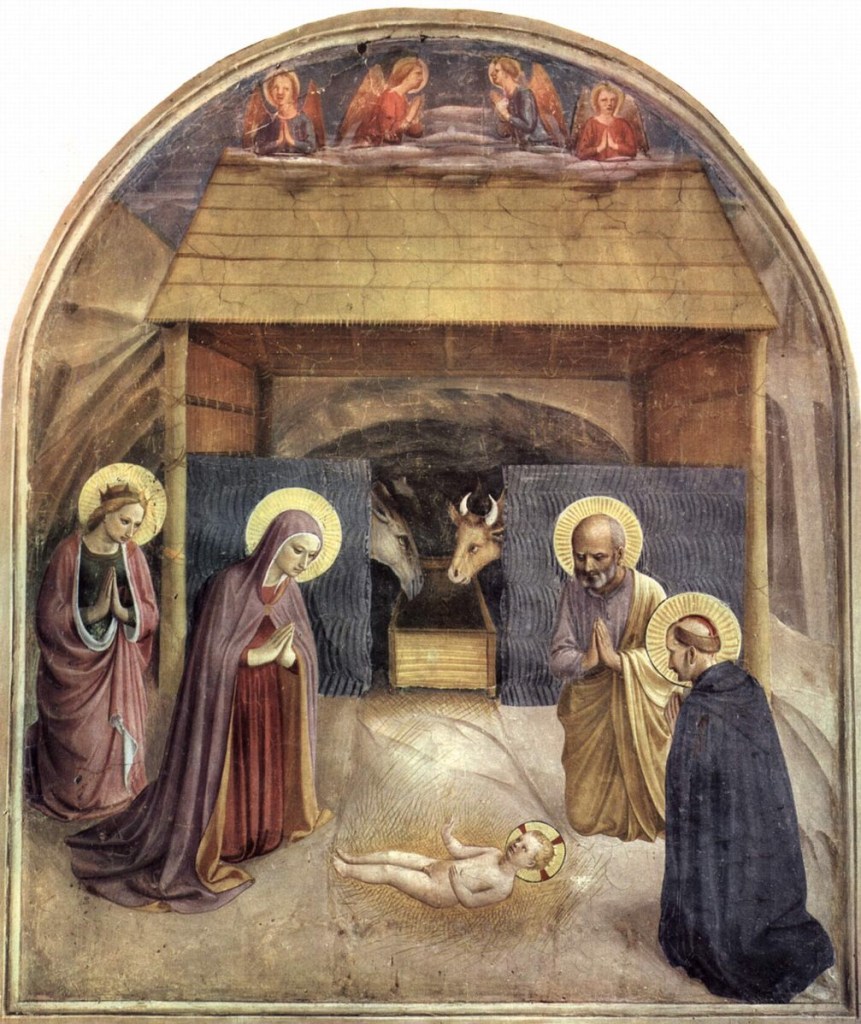
 The Argumentative Old Git