The story of Zeuxis is enough to make even the most hardened of sensitivity readers reach for the smelling salts. The artist Zeuxis, a historical figure (none of whose works, sadly, survive), is reputed to have suffocated to death while laughing at the ugliness and absurdity of an elderly lady he was painting. The story is about as unlikely as that of Aeschylus being killed by a bird dropping a turtle on his head, but, unlikely or not, it has now become so embedded in mythology that not even the most sensitive of readers can now prise it out. And, of course, it is a very cruel and unpleasant story. However, it is precisely this cruel and unpleasant story that inspired Rembrandt to paint one of his greatest masterpieces. In one of his late self-portraits, he depicted himself as Zeuxis, laughing heartlessly at the absurdity and ugliness of ageing human flesh.
Rembrandt’s series of self-portraits, especially the later ones, are some of the most enigmatic of artworks. We would be wrong, I think, to see them as autobiography: rather, he seemed to be using his own face as does an actor – presenting it in different ways to express different aspects, not necessarily of his own life, but of human life in general. Thus, in one of these self-portraits (currently in the Frick Collection, New York), he presents himself almost like an emperor, commander of all he surveys, even though it was painted immediately after he had been declared bankrupt. In his last self-portrait (currently in the Mauritshuis in The Hague), he presents himself with dull unglinting eyes, indicating a blankness behind; however, if Rembrandt really had been on the verge of senility, as this painting seems to suggest, he would not have been able to paint this. In these, and in his other self-portraits, he was using his own self to depict other matters. He was looking not into himself, I think, but, rather, out, into the wider world.
And he must have known that there was a particular irony in painting himself as Zeuxis. Obviously, he was not Zeuxis: throughout his career he had painted people not good-looking by any conventional standards, and in none of these paintings is there even the slightest hint of mockery. He frequently painted old people, but without any attempt either to idealise or to caricature. Indeed, his paintings of old people – old men, old women – display quite often a profound sense of sympathy, and, indeed, a sense of tenderness, a tenderness that, thanks to his refusal to beautify, never slips into sentimentality. He finds in these people what I can only describe as a sort of inner beauty – an inner beauty that is often at odds with their all-too-apparent failing human flesh. That Rembrandt, of all people, should depict himself as Zeuxis laughing merrily at the absurdity of this same failing human flesh is profoundly ironic, and it is an irony that would surely not have escaped him.
Self-portrait as Zeuxis by Rembrandt, courtesy of Wallraf_Richartz-Museum, Cologne
If we leave aside the story of Zeuxis, and look at the painting in purely visual terms, what is particularly noticeable is that Rembrandt hasn’t even made an attempt to depict flesh tones. The colour of the face is a sort of bronze, or, perhaps, of dark gold: it is the same colour as the magnificent collar, which appears to be reflecting light, almost as if it were metallic. The cap perched on his head, which one might have expected to be white (as it is, say, in the self-portrait currently in Kenwood House, London), is also of that same dark gold-bronze colour. It is almost as if the head, the cap, the collar, were all simultaneously transforming before our very eyes into something that is not, perhaps, quite human – into some kind of metallic artifice.
It is the kind of transformation that Yeats, some two hundred and fifty years later, fantasised about. He too, had fretted about the absurdity of failing flesh and of decrepitude:
What shall I do with this absurdity —
O heart, O troubled heart — this caricature,
Decrepit age that has been tied to me
As to a dog’s tail?
From “The Tower”
“An aged man is but a paltry thing”, he declares in “Sailing to Byzantium”, a poem contained in the same collection. In this poem, Yeats fantasises about being transformed into a metallic object – something that is not human, something that is not subject to decay and to decline into this terrible absurdity of decrepit age. His heart, he says, is
…. Sick with desire
And fastened to a dying animal.
What he longs for is to be gathered “into the artifice of eternity”:
Once out of nature I shall never take
My bodily form from any natural thing,
But such a form as Grecian goldsmiths make
Of hammered gold and gold enamelling
To keep a drowsy Emperor awake
Yes, this artifice is a trivial thing: it has been fabricated merely to keep a drowsy Emperor awake. But be that as it may, it is not subject to ageing, to decline, to death; and this fact alone makes it superior to the absurdity of our mortal state.
Of course, we may ask “What about all those things that make us human?” What about our loves, our passions, our desires, our very consciousness itself? But Yeats isn’t – or, at least, pretends he isn’t – moved by any of this: in the poem “Byzantium”, written some two years later and clearly linked to the earlier poem by its title, he dismisses all this with the striking expression “All mere complexities”:
A starlit or a moonlit dome disdains
All that man is,
All mere complexities
And these “mere complexities” don’t really amount to much: it is right to disdain them. The golden handiwork from the earlier poem returns, “planted on the starlit golden bough”, and it too scorns mere human complexities:
… scorn aloud
In glory of changeless metal
Common bird or petal
And all the complexities of mire or blood.
Better to be gathered into the artifice of eternity, in glory of changeless metal, and be free of all human emotions, of all these complexities of mire and blood, than to see oneself waste into old age, and absurdity. At the point of death, “all complexities of furies leave”.
We need not take this at face value. Indeed, we should not take this at face value. We should, I think, consider Yeats’ stated preference, and shudder at the thought of leaving behind all that makes us human, even if that is the price to be paid for eternity, for the glory of changelessness. But this is merely me putting a moralistic gloss on it all: it is a moralistic gloss that Yeats himself does not provide, leaving the issue open.
As, I think, does Rembrandt. In this deeply enigmatic self-portrait, he paints himself, it seems to me, as a figure leaving his humanity behind, and laughing at the absurdity of those of us who insist on clinging on to what are, after all, mere complexities. It is a very troubling painting, and is, I think, intended as such.
We are still, I think, wedded to an image of the great artist as someone who is single-minded, who is not prepared to compromise, who, with mind focused on visions beyond the merely worldly, is prepared to suffer for his art. He is a Michelangelo chiselling the rippling muscles and veins of Moses in a sort of divine fury; he is Beethoven struggling with the demons of fugual counterpoint; and so on, and so forth. We have trouble with those artists – especially if they are artists whose works are indisputably great – who are of a more down-to-earth and worldly nature; who are, indeed, businessmen. Shakespeare was probably one such. And Titian certainly was. His art studio was a successful business venture in that most commercial of cities, Venice, and, while he certainly created some very great works of art – some of the very greatest, indeed – he often seemed quite content to let works pass out of his studio that weren’t always up to the highest standards.
Take, for instance, his group portrait of the male members of the Vendramin family, now hanging in the National Gallery, London. It is a vast and imposing canvas: Titian had been working on it on and off for a few years, and he must have known that he was creating a masterpiece. And yet, he seemed perfectly happy to allow a studio assistant to paint three boys in the bottom left corner in such a way as to make nonsense of the painting’s spatial unity. Why would he allow this? Presumably, the request to paint in the boys was received late, and the customer had to be satisfied. But given that Titian had failed to meet his deadline anyway (and not for the first time either, nor the last), the obvious solution would have been to expand the canvas to the left to create a suitable space for the boys. But what we have instead is a clumsy blot on what is otherwise a breathtaking masterpiece. Somehow, one cannot imagine an artist of Michelangelo’s temperament allowing something like that.
The comparison with Michelangelo is bound to come up, firstly because Michelangelo and Titian were the two leading figures of the 16th century Italian High Renaissance (Raphael was of the same generation, but he died when still in his thirties, leaving the field open, as it were, to the other two; and Leonardo was a generation older); and secondly because they had such sharply contrasting artistic styles, and aims, and temperaments. Titian had seen Michelangelo’s work, and, while no direct quotes exist on the matter, it is clear he was deeply impressed; indeed, as Sheila Hale points out, the pose of the woman in the early Miracle of the Jealous Husband (in the Scuola del Santo in Padua) is the exact mirror image of the pose of Eve reaching for the forbidden fruit in the Sistine Chapel. It’s unlikely to be a coincidence.
Michelangelo, on his part, had seen Titian’s portrait of Alfonso d’Este in Ferrara, and, according to Vasari, looked at it in “stupefaction”. The only recorded meeting between the two was in 1545, when Titian was passing through Rome. According to Vasari, Michelangelo saw and expressed admiration for Titian’s painting of Danaë, but, on leaving, muttered that it was a shame that Venetians don’t learn how to draw. This story has now become famous, but it’s hard to discern how accurate it is: Vasari, after all, had his own biases on the matter. But this does lay out, albeit in crude terms, the very different aims of the Florentine and the Venetian schools, and, in particular, of Michelangelo and of Titian, the leading representatives of these two schools. Put crudely, the Florentines were interested in draughtsmanship, in accuracy of line, in the creation of space according to the law of perspective, in the sculptural solidity of figures and objects situated within that space; while the Venetians, on the other hand, were interested in light, in shadings, in textures, and, above all, in colour.
The two sets of interests are not mutually exclusive, of course. Sheila Hale insists that, no matter what Michelangelo may or may not have said, Titian was indeed a very fine draughtsman: there are too many examples in his work of very fine draughtsmanship to think otherwise. Take, for instance, that superbly drawn figure of Actaeon at the left of the painting of Actaeon and Diana (now jointly owned by the National Gallery of Scotland, Edinburgh, and the National Gallery, London). Here, Actaeon, out hunting, chances upon the private woodland bower of Diana, goddess of the hunt and of chastity, and sees what he, a mere mortal, shouldn’t. We see him moving away a hanging drapery as if it were a curtain on a stage, screening a tableau vivant behind. And the draughtsmanship here is quite exquisite.
“Diana and Actaeon”, courtesy National Gllery of Scotland, Edinburgh, and National Gallery, London
And yet, what are we to make of the very strange figure of Diana in the same painting? Her head appears too small. We appear simultaneously to be seeing her side profile and her back – which is anatomically impossible. Is his not indeed poor draughtsmanship? This had long troubled me: how could the artist who had created the rest of this miraculous painting with such breathtaking skill mess up so badly at this point? But, Sheila Hale tells us:
Titian took immense trouble with the figure of Diana, first painting her realistically from the side, and only at the end deciding on the anatomically impossible pose – a deliberate solecism that was unprecedented in European painting – that shows the breast in profile as well as the whole of her back. Her averted head, too small for her body, gives a snake-like venom to her pose.
In short, it wasn’t that he couldn’t: he didn’t. The distortions are deliberate. And it is for us to determine why Titian chose to distort in this manner.
I personally think it is because Titian wants us to see Diana as Actaeon sees her. He doesn’t see much of her head, as Diana very quickly hides it. Diana also turns away from him. So Actaeon, in the brief moment that he sees her, has a fleeting vision of her side profile, and of her back. It is this momentary view, startled and confused, that Titian chose to depict. As for showing both the side profile and the back at the same time, modern viewers, used to cubism, should have no problem with that: it’s the fact that we are seeing this in a sixteenth century Renaissance painting that, I think, throws us. (At least, that, I think, is what threw me.) There is much in Titian’s artistic vision, or, rather, in his artistic visions, that can still throw us.
But Titian was, nonetheless, a businessman, and a very successful one too. He was also a man widely respected and admired as an artist: no starving in the garret for him. His art was in demand by princes, by cardinals, by the wealthiest of families, and even by Emperor Charles V himself. (And, after Charles’ death, by his son, Philip II, who was something of a connoisseur.) The famous anecdote about Emperor Charles V picking up a paintbrush for him that he had accidentally dropped is, most likely, apocryphal, but the very existence of such an anecdote reveals the extent to which he was esteemed by even the most mighty and the most powerful. However, although we know much of the history of the times – political social, cultural – there doesn’t really seem to be much about Titian the man. What letters remain by Titian are mainly business letters. (Titian, like most artists, was apprenticed to a studio at an early age, and was not the most well lettered of people: he would often ask his friend, the flamboyant and larger-than-life figure Pietro Aretino, to draft formal letters he sometimes had to send to princes and clerics). We know nothing about what Titian thought on politics, on religion, on social matters, or even on art. Indeed, we find more biographical details in Hale’s book of Titian’s friend Pietro Aretino than we do of Titian himself: Aretino’s life is far better recorded. We may infer from all this that Titian, despite his social stature, and despite his closeness with some of the most powerful men of his time (including the Holy Roman Emperor himself), kept, by and large, a low profile. However, his close and long-lasting friendship with a man as erudite and intellectual as Aretino does suggest that Titian’s was not a dull personality; and his closeness with the highest and the mightiest indicates a man possessed of tact and of courtly manners. Further, the success not merely of his studio, but also of his interventions in the family business, suggest a man who was commercially shrewd. And that’s about as much as we know of his personality.
We know also of his repeated attempts to find an ecclesiastical livelihood for his elder son Pomponio, and also of Pomponio’s reluctance to lead such a life; we know also of the eventual estrangement between father and son. But beyond this, there isn’t really much to tell.
This means that Hale has to focus not so much on the details of Titian’s life, but more on the times – on the various wars and political upheavals, on the social and cultural aspects, on the various religious disputes, and so on. These were momentous times. Of course, any period in history will have its fair share of wars and conflicts, and of various political manoeuvrings, but the sixteenth century saw also the beginnings of Protestantism. In 1517, Martin Luther famously nailed the text of his “95 Theses” to the castle church door in Wittenberg. It was not as dramatic an act as it might now seem: nailing theological theses to the church door was quite common practice. Luther himself was unlikely to have anticipated what this seemingly simple act would eventually lead to, but to describe the aftermath of his act as “seismic” doesn’t seem an overstatement.
The era of the Reformation, and also of the counter-Reformation that followed, is among the most crucial periods of European history, and scholars may spend entire lifetimes studying it. I am not a historian, and my understanding of this era may with justice have been described as “sketchy”. However, while great works of art may well transcend their times (and I, for one, believe that they do), they are also, paradoxically, products of their time; and so, to come to even an adequate understanding Titian’s works, we must have some understanding, at least, of the times in which they were created. This Hale gives us: not an in-depth picture of the Reformation and the counter-Reformation (that is not what this book is about), nor an in-depth analysis of the various political power struggles, the various wars, the various territorial and trade disputes, and all the rest of it; but as much of it as is needed for a layman like myself to make at least some sense of the era in which these masterpieces were created.
But of Titian the Person, who lived through it all, we don’t really know much more than we do, say, of Shakespeare the Person. Except that, despite the picture we may still have of what great geniuses ought, at least, to be, they were both shrewd and successful businessmen.
Which leaves, of course, the art.
For any artist whose creative life spans so many years (and Titian’s spans over 60), the nature of the art has to keep renewing itself; otherwise, it becomes stagnant and the fire dies. Titian’s art did most certainly renew itself over the years: the early masterpieces are very different from the later ones. There was a period, when Titian was around 50 or so, when he seemed content merely painting portraits of rich and powerful people – although, perhaps, I shouldn’t use the term “merely”: these portraits are, without exception, magnificent: Titian ranks with the likes of Holbein or Rembrandt as among the greatest of portrait painters. However, he could easily have continued his thriving business painting merely these portraits. But one does not become a great artist without having some sort of artistic vision burning inside, no matter how shrewd a businessman one may be, and Titian, no less than his contemporary Michelangelo, had such fires burning inside. But the essence of these fires is not easy to apprehend, let alone describe.
“The Assumption of the Virgin”, courtesy Santa Maria Gloriosa dei Frari
What strikes one immediately about Titian’s paintings – and especially, I think, his early paintings – is the brilliance and vibrancy of his colours. While Luther was preparing those ninety-five theses that he famously nailed to the church door, Titian, then in his late twenties, was at work on one of the monumental masterpieces of Catholic art – The Assumption of the Virgin for the Santa Maria Gloriosa dei Frari church in Venice, where it still hangs. It is a vast work, almost 7 metres in height, and depicts the moment when the Virgin Mary is taken up into Heaven. It is a subject that had been treated before by other artists, but never like this. Raphael had painted the subject some fifteen or so years earlier, and the contrast between the two is instructive. Raphael’s is a calm and serene affair, with the disciples in the lower half of he painting standing in an orderly line, looking up reverently into a heavenly world that is distinctly different from their own earthly world. In this heavenly world, the Virgin Mary, eyes demurely downcast in worship, is being crowned. Titian’s vision, though, is very different. The first thing one notices – at least, the first thing I noticed – was the colour. Instead of casting the scene in the sober and muted hues of Raphael, Titian chose a much warmer palate, and saturated the canvas with the most vivid of colours. Particularly striking is the flame-like red in which he chose to dress the Virgin (rather than in the more traditional blue), and the repetition of that same shade of red in the gowns worn by two of the disciples below: these three figures form an isosceles triangle, with Mary at the apex. And behind Mary is the most extraordinary golden light, which dazzles the viewer as much as it appears to dazzle Mary. Now, how one can paint an unearthly light using what are, after all, merely earthly paints, I do not know, but I cannot think of any light in any other painting I have seen that seems so insistently to belong to another world.
And, again in contrast to Raphael’s painting, there is a sense of drama. The figures here are not idealised representations: these are real, natural people, albeit witnessing a seemingly unreal and supernatural event. Of course, they are in turmoil. Most of the disciples are in the shade: the few whose faces we can see look up in bewilderment. The postures of the others suggest disorientation and confusion. What they are witnessing maybe an other-worldly vision, but it is here – right here, on earth. The heavenly world may be different from the earthly one, but the boundary is not as strictly defined as it is in Raphael’s more ordered vision: here, the muscular arm of one of the disciples seems almost to touch that other world.
And neither is there anything calm and collected about Mary’s reaction: her posture, with her hands raised, may be seen as one of religious ecstasy, but it is also, I think, the posture of an earthly creature startled by the sudden revelation of the Eternal. Caravaggio is the artist often credited with placing people from the real world into his religious scenes, but, on the basis of this painting, I’d say Titian had got there almost a century earlier.
Masterpiece followed masterpiece: religious scenes, mythological scenes, genre scenes, portraits, group portraits, small canvases, large canvases, monumental canvases – all painted with a mastery that seemed able to adapt itself to whatever was required. The tragic, the joyful, the everyday – nothing seemed beyond his scope. Even the erotic. Perhaps, in seeking to distance the sacred calling of Art from mere fleshly lust, we have tried to downplay this aspect of Titian’s art, or, maybe, sublimate it into something that may be thought of as nobler and loftier; but Titian clearly loved the nude female form, and was quite unabashed by it. When Mark Twain described Venus of Urbino as “the foulest, the vilest, the obscenest picture the world possesses”, I think he had a pretty good idea of what Titian was depicting. Indeed, I find it hard to see Titian’s nudes, in poses that often anticipate those of Playboy, and miss the delight he took in the female body. From the agony of Christ’s Passion to the voluptuous delights of the female nude: nothing in life was too sacred or too profane for his art.
Titian’s depictions of light, of various types of lights, are still as breathtaking now as they must have seemed back then; his figures are endowed with tremendous life and with vitality, his textures are exquisite, and his colours are like nothing seen before. Of course, other artists have also used vivid colours, but Titian, to a greater extent, I think, than just about any other artist I can think of, seemed to depict a world in which the vividness of the colours seems to define the dynamism and the radiance of life itself.
When an artist’s work ranges so widely, it becomes difficult to identify, let alone describe, the nature of his artistry, or of his artistic vision. The very range of Titian’s work is dazzling: it seems hard to imagine an artist less single-minded. But it is quite sobering to realise that much of what Titian had painted, including many regarded as among his greatest masterpieces, is now lost. The Assassination of St Peter Martyr, for instance, was regarded by many as Titian’s greatest masterpiece: it was destroyed completely by fire in 1867, and what hangs now in its place is a copy made in 1691 by a Johann Carl Loth. How well or otherwise this copy communicates what the original painting had communicated can only be a matter of conjecture.
But looking through the astonishing treasures that remain, I really don’t know that it is possible to pick a single painting as the “greatest” masterpiece. And, contrary to the myth of great artists being recognised only after their deaths, the art of Titian (as of Michelangelo) was recognised in his own times.
Titian was patronised even by the Emperor Charles V, and, after his death, by his son Philip II, both of whom liberally commissioned works from him – portraits of themselves and of their families, and subjects both religious and mythological. It was for Philip that, in the mid-1550s, Titian painted a set of six paintings, now collectively known as “Poesie”, based on episodes from Ovid’s epic poem Metamorphoses. Hale describes them as:
… first and foremost about erotic passion (or in the case of the Diana pictures about its negation) which for better or worse changes us and determines our destiny. And just as Ovid edited the much older and more detailed Greek myths in order to dramatize that underlying theme, so Titian took liberties with Ovid to convey, in a way that would be rivalled only by Shakespeare, the many manifestations of the most primitive and overwhelming of human emotions: the sadness of anticipated loss, the suspense, danger, cruelty and unfairness, and the sheer anarchic fun. It was in these paintings that Titian … showed himself to be the dispenser of all emotions and the plenipotentiary of the senses.
The series consists of; Danaë (the version currently in Apsley House, London, is now believed to be the one presented to Philip); Venus and Adonis (Prado, Madrid); Perseus and Andromeda (Wallace Collection, London); Rape of Europa (Isabella Stewart Gardner Collection, Boston); and two paintings featuring Diana, now shown in rotation in the National Gallery of Scotland, Edinburgh, and the National Gallery, London – Diana and Actaeon, and Diana and Callisto. Lucian Freud once described these two Diana paintings as simply “the most beautiful paintings in the world”.
Though now scattered around different galleries, in 2020, somewhat delayed by the pandemic, they were they brought together and exhibited in a single room. This exhibition toured the world, and I saw it when it came to the National Gallery, London. The exhibition was titled, perhaps rather cheesily, Love, Desire, Death. Big themes, certainly, and perhaps themes that all major artists have to address. But there was no sense of portentiousness. I felt little sense of awe or of reverence that one often feels in the presence of art of this stature. Rather, what I felt was a sense of exhilaration, of elation; a sense of being in the midst of the most extraordinary whirl of colours and of movement. Or, as Sheila Hale puts it, a sense of “sheer anarchic fun”.
But, along with the anarchic fun, there is also cruelty. And it seems to me that as Titian entered into his old age, this element of cruelty started becoming an increasingly salient feature in his work. Not that Titian hadn’t depicted tragic themes before, but the vibrancy of his colours and the exuberance of his compositions communicated in those earlier works an intoxicated sense of elation, of exhilaration, that seemed somehow to counteract the tragic. But in his later paintings, the tone seems to me to become darker, both literally and metaphorically. The palette becomes more restrained, the brushwork rougher, the finish less glossy; and there seems less radiance in the light. At times, indeed, he seems to be depicting wat Milton later famously referred to as “darkness visible”: rather than a brilliant or a gracious light bathing the world, we seem at times, in his very late work, to be enveloped in some profound murk lit only fitfully by spots of light spontaneously bursting and dying in the air.
“The Crowning of Thorns”, courtesy Louvre, Paris
To see the contrast most clearly, one may compare two paintings of his on the same subject – The Crowning of Thorns. The earlier version, now hanging in the Louvre in Paris, dates from around 1540, when Titian was around 50 or so (his exact date of birth is uncertain); the later, now hanging in the Alte Pinakothek in Munich, was painted some thirty-five years later in extreme old age. The composition is much the same in both, but where, in the earlier painting, the vibrancy of the colours and of the light involves us in the sense of movement, there is no mistaking the terror and the despondency of the later vision, painted with brushstrokes that are far less smooth, and seen seemingly through broken shards of light. The vision has, without doubt, darkened.
“The Crowning of Thorns”, courtesy Alte Pinakothek, Munich
Not that the turn was sudden, of course. Even in the “Poesie”, we had had more than a few hints of the tragic. Take, say, the painting of Diana and Callisto: In Ovid’s poem, Callisto was one of Diana’s handmaiden, but was banished after she was judged to have broken her vow of chastity. (Never mind that she had been raped by Jupiter.) In Titian’s painting, against a dramatically darkening sky, the pregnant Callisto is dragged before Diana by the other handmaidens, and right at the very centre of the composition is Diana’s imperiously outstretched finger, condemning without sympathy. If the mood isn’t quite tragic, it isn’t, perhaps, too far off.
“Diana and Callisto”, courtesy National Gallery of Scotland, Edinburgh, & National Gallery, London
But this was not the last painting by Titian about Diana, and neither is this the last time Diana passes her divine and inhuman judgement on an uncomprehending humanity. In one of the paintings in the “Poesie” he had painted for Philip, he had shown Actaeon stumbling upon Diana’s bower; The Death of Actaeon, now hanging in the National Gallery, London, shows its terrible aftermath. Actaeon is transformed into a stag, and is torn to pieces by his own hounds.
“Death of Actaeon”, courtesy National Gallery, London
Whether Titian had intended this as an addition to the series is not known. My guess is that it isn’t, as its tone, far from projecting a sense of dizzying intoxication, is now grim. The palette is far more restricted than it had been – even though a forest scene, there’s barely any trace of greenery – and the whole thing seems oppressive and airless. The goddess, faceless (her facial features are not seen) delivers a terrible judgement on humanity that can make no sense to human sensibilities.
This was one of the paintings still in the studio at the time of Titian’s death, and there is some controversy about whether it is finished, but I am not sure it matters. Over his last two decades or so, Titan had moved away from the highly finished works of his earlier years to something much newer and much more innovative: in a great many paintings now, not only are the individual brush-strokes not hidden, they’re not meant to be hidden: we’re supposed to see the internal workings, as it were; the very textures of the brush-strokes is part of the effect these pictures are intended to create. I am no art historian, but I think this was new, and was taken up afterwards by entire generations of artists.
Titian had painted tragic subjects before, but comparing his earlier tragic works to his later is a bit like comparing Romeo and Juliet to King Lear. The exuberance has gone; in its stead has descended a profound gloom, as mankind suffers dumbly under divine judgements that, to human standards, can make no sense. The Flaying of Marsyas, now in the State Museum of Kroměříž in the Czech Republic, was also one of the paintings still in Titian’s studio at the time of his death, and depicts the story from Ovid’s Metamorphoses of the satyr, Marsyas, who had challenged the god Apollo to a contest of musical skill. Marsyas had lost, of course, and the punishment divinely deemed suitable for his transgression was for him to be skinned alive. In this painting, right down the central vertical axis, we have the startling and rather grotesque image of the satyr Marsyas hung upside down, his goat’s legs prominent. The hideous act is skinning alive has already begun, and a puppy sniffs at the blood that is soaking the ground. To the left, a musician, possibly Apollo himself, plays a stringed instrument (a lira di braccio), gazing upward, and seemingly oblivious to the atrocity carried out right under his nose. And to the right, King Midas looks down upon the skinning: there is no trace of horror either in his posture or in his expression. These figures are all painted close to the plane of the canvas, taking up the foreground; and what little space there is between these figures is painted with textures so thick as to appear airless. The colours are bright, but not really in harmony: they appear garish. And the light is dense and murky. I saw this painting when it was exhibited in London nearly twenty years ago, and it seemed to me then, and seems to me still, as grotesque and as disturbing as anything I’ve seen. It projects a sense of terror that I have experienced only one other time in the presence of art – when I stood before the Black Paintings of Goya in the Prado.
“The Flaying of Marsyas”, courtesy State Museum of Kroměříž
There’s a late Nymph and Shepherd hanging in the Kunsthistorisches Museum in Vienna, but we’re far from a pastoral idyll here: the shepherd holds his pipe, and the nymph smiles at him, but the landscape these two traditional lovers inhabit, far from evoking the pastoral, seems to speak of some apocalyptic devastation. It’s as if Titian had deliberately seized upon the traditional images of pastoral grace precisely in order to subvert them. But to what purpose he subverts them in such a manner, it is for us to decide.
“Pietà“, courtesy Gallerie dell’Academia, Venice
And there is the enigmatic and terrifying Pietà, which Titian, seemingly, had intended to be placed over his own tomb. There seems a sort of nostalgic glance back at the graceful and radiant paintings of Giovanni Bellini, who had been active in Venice when Titian had been starting out: Bellini had often set his figures within a niche, with an arch overhead. (The San Zaccaria Alterpiece is a very beautiful example of Bellini’s art.) In Titian’s painting, we have, once again, the arch and the niche, but there is nothing graceful or radiant about this. The arch itself seems constructed of large, ugly stone, roughly put together. The light, once again, is unreal, but it is no heavenly light; we seem, rather, in some unearthly region, as far as can be imagined from the light of Paradise that had greeted Mary on her assumption in that painting from over fifty years earlier. The paintwork here is rough: the paint on the chest of the dead Christ seems to have been applied with the fingers rather than with a brush. Mary looks upon her dead son in quiet contemplation, but, towering over her and forming the apex of an assymetrical triangle, is the gigantic figure of Mary Magdalene, screaming into the dark. Standing before this extraordinary painting in the Gallerie dell’Academia in Venice is a chilling experience: one feels in the presence of death itself. One feels the need immediately afterwards to go over to the Frari church to see again The Assumption of the Virgin to remind oneself of what Titian’s vision once had been.
It is hard to say why Titian’s vision darkened. From the evidence of his paintings, it was a gradual rather than a sudden change. But I don’t know that biographical reasons, even assuming they exist, could take us any closer to the heart of this vast and magnificent body of work. Great artists will always look beyond what is immediately in front of them: studying what is immediately in front of them can be instructive, but we mustn’t expect that to unlock the mysteries that all great art contains.
It is hard to see how Sheila Hale’s biography of Titian could possibly be bettered. She tells us what little we know of him as a person, without passing judgement on any aspect of it; and, more importantly, she gives us, with great scholarly rigour, a fascinating picture of the historic and cultural background against which Titian created these magnificent works. Reading this book, we come to understand these works in the context of their times; but if we are to understand how these works – from the profound sensuality and exuberance of his earlier paintings to the dark and comfortless vision of the later – we must, as ever, look for ourselves. The miracles are right there, before us: all we need to do is to look. Look, and wonder.
There’s something about the mid-19th century that fascinates me. Or rather, to be more precise, there’s something about the arts and the culture of the western world of the mid-19th century that fascinates me. But that’s too cumbersome for an opening line.
Pick just about any decade or two any time in history, and it would be easy to reel off the great writers, painters and composers who were active at the time, and the great works that were produced; and the mid-19th century is no exception in that regard. But what makes this period exceptional for me is that there were so many works of that era that mean so much to me personally. Let us, for instance, consider the single decade, the 1860s. It was Dickens’ last decade, and saw the publication of his last two complete novels – Great Expectations, and Our Mutual Friend; George Eliot weighed in with The Mill on the Floss, Lewis Carroll published the first of his two Alice novels, Robert Browning published Dramatis Personae and The Ring and the Book, while Elizabeth Barrett Browning’s last poems were published posthumously after her death in 1861; Tennyson wrote Enoch Arden, and Trollope … well, a quick glance at the reference books indicates that he was, as usual, scribbling away like no man’s business. Across the channel, there was the publication of the final edition of Baudelaire’s Les Fleurs du Mal, Flaubert published Salammbô and L’Education Sentimentale, and Zola made his mark with the wonderfully lurid Thérèse Raquin. From Russia, we have Turgenev’s Fathers and Sons and Leskov’s Lady Macbeth of Mtsensk, while Dostoevsky was keeping himself busy with From the House of the Dead, Notes from Underground, Crime and Punishment, and The Idiot. Tolstoy only wrote one major work in that decade, but that major work was War and Peace. And in the meantime, Ibsen, after many years churning out plays that are now only remembered because he went on to write better stuff, got off the mark as an artist with Brand and Peer Gynt, possibly the last great plays written in verse. And all this time, across the Atlantic, the two great American poets of the 19th century, Emily Dickinson and Walt Whitman, were writing some of their finest works.
And this is just literature. There were revolutions happening in the other arts too. Music could not be the same again after Wagner’s Tristan und Isolde: composers who came afterwards were either influenced by Wagner, or reacted against him, but they could not ignore him. Die Meistersinger von Nürnberg was also composed in that decade, as were Mussorgsky’s Boris Godunov, Verdi’s La Forza del Destino and Don Carlos, some of the later works of Berlioz and some of the earlier works of Brahms … and so on, and so forth.
Meanwhile, in the visual arts, the two giant canvases exhibited by Manet – Olympia and Le Déjeunersur l’Herbe – were arguably as revolutionary in painting as Tristan und Isolde was in music. The artists now known collectively as the Impressionists (rather misleadingly, since they were all very different from each other) – Manet, Degas, Monet, Pissarro, Renoir – were all establishing their distinctive styles and artistic visions.
Even acknowledging that we can find significant artistic activity in just about any decade we may care to look at, this seems to me quite exceptional. And if we look at the decades before and after the 1860s (don’t worry – I won’t be providing more boring lists!) we can find similar flowerings of artistry, in all areas. It could well be that I find this era particularly fascinating merely because I am personally attached to so many of its artistic creations, but I do find it hard to escape the conclusion that there was something in the air – something special was happening. But it’s hard to put one’s finger on it without making crude generalisations.
It seems to me that, around the mid-century – 1850, say – Europe, culturally, was between, as it were, two “-isms”. Romanticism wasn’t quite dead – indeed, I don’t think it ever died – but the writers who flourished in the latter half of the century cannot really be described as “Romantic”: indeed, many, such as, say, Flaubert, may rightly be described as rebelling against Romanticism. Similarly in art: the label “Romantic” may easily be applied to Turner, say, or to Delacroix, but not to the artists now known as the Impressionists, nor to the next generation who are labelled (not too imaginatively) as the post-Impressionists. Like the writers of that era, they were neither Romantic, nor Modernist. The composers who flourished in the latter part of the century are still known as Romantic – Wagner, Verdi, Brahms, Tchaikovsky, etc. – but many of the earlier generation of romantics (Mendelssohn, Weber, Chopin) were already dead by 1850, and Schumann died shortly afterwards in 1856 (although his productivity had been tragically cut off towards the end by severe mental illness). Although some of the old-timers did continue into the latter half of the century (Berlioz, Liszt, Wagner, Verdi), styles, inevitably, had moved on from the early days of Romanticism: Berlioz had already done much of his best work (Les Troyens excepted), while the best work of Wagner and of Verdi was yet to come. In short, whether they had labels or not, artists of the later half of the 19th century, despite the lack of an “-ism” to characterise them, were, I think, producing works that were significantly different from what had come before. And it is this period – this “inbetweenism”, in between the first wave of Romanticism and the emergence of modernism – that fascinates me. While there are, of course, many artists from outside this era whom I revere – Shakespeare, Rembrandt, Beethoven, and various others who carry that terrible stigma of being “dead white men” – it is this in-between era to which I most feel drawn.
And so, when a trusted friend recommended me to read The Europeans by Orlando Figes, I had little hesitation. It is, ostensibly, the story of Russian novelist Ivan Turgenev, and the somewhat curious ménage à trois he had with famous opera singer Pauline Garcia-Viardot, and her husband, the art critic and translator Louis Viardot; but Figes hangs on this narrative line a fascinating cultural history of Europe in that period. He considers all kinds of factors that shaped the direction of the arts – political, economic, social, technological, even legal: the establishment of copyright laws, for instance, and the various bilateral agreements between nations, transformed the direction not only of literature, but also of music publishing. The greater ease of transport not only made travelling between countries easier, it increased the catchment areas of opera houses, and an increased potential pool for their audience meant a decreased requirement for a constant supply of new works. And so on. Within a few decades, the world changed in all sorts of very important ways, and the arts, to survive, and, quite often, to flourish, had to adapt and change along the way.
The narrative of Figes’ book begins in 1843, when Turgenev and Pauline Viardot first met, and continues till 1883, with the deaths of Louis Viardot and of Turgenev. An early chapter fills us in on the events before, and a concluding chapter on events afterwards – focussing, naturally, on Pauline Viardot who lost the two men in her life within a few months of each other. Their story, fascinating in itself (all three were remarkable figures) is particularly appropriate for a book that is essentially about European culture, since they were the most cosmopolitan of people. Turgenev was Russian, Louis Viardot was French, and Pauline Garcia was Spanish, but they all seemed most at home in Germany, and travelled and lived extensively around Europe. Pauline Garcia wasn’t, to judge from her portraits, particularly beautiful, but she possessed, apparently, an extraordinary personal charisma, and her singing was, from all accounts, mesmeric. At one point, we are told of Turgenev observing Dickens in the stalls, listening to Pauline singing Orfeo in a revival of Gluck’s opera (the revival was organised by some chap called Hector Berlioz) with tears streaming down his eyes. Turgenev met briefly with Dickens on the way out, and Dickens was sufficiently moved by the performance to write what is effectively a fan letter to Pauline Garcia-Viardot.
Throughout, one gets what could be called “cultural name-dropping”: there goes Manet, there’s Wagner, there’s Tolstoy – and look over there! – there’s Brahms, there’s Flaubert. The entire book, apart from anything else, is a veritable Who’s Who of major cultural figures of the time. There are some, admittedly, who remain on the fringes: Turgenev appears never to have met with Verdi, for instance, despite Verdi’s immense stature, even at the time. Although we are told Pauline Viardot had performed in Verdi’s Macbeth and Il Trovatore, we are also told of her antipathy to Verdi’s music; and Turgenev himself had been a bit rude about La Traviata in his novel On the Eve. The tastes of Turgenev and of the Viardots tended to run more towards the Germanic rather than the Italianate: Pauline Viardot was, like many others, entranced by the music of Wagner, though she was (much to her credit) outraged when Wagner reprinted his notorious pamphlet “Judaism in Music”. Another of my great cultural heroes of that era, Ibsen, doesn’t really get much of a look in either, despite having spent most of his best productive years in Europe.
The two events that most shook the lives of Turgenev and the Viardots were the revolutions of 1848, and the Franco-Prussian War of 1870. (The unification of Italy doesn’t appear to have touched them much, as their focus was more on the north than on the south.) For the latter Turgenev and the Viardots sided strongly with the Prussians, despite Louis Viardot’s French nationality: this was partly because they were living in Baden at the time, but also because they felt this war would help bring down the hated monarchy of Napoleon III.
Interestingly, Verdi, another great artist with liberal leanings, sided with France in this conflict, saying in a private letter that whatever the Italians knew about freedom and liberty, “we have learnt from the French”, and expressing great unease about growing Germanic nationalism. It has long seemed quite curious to me that, despite his own position as a sort of cultural representative of Italian nationalism, he chose for his next opera, Aida, a storyline that was very explicitly anti-nationalist. It is of course wishful thinking on my part that so great a cultural hero of mine should share my own political biases, and I think I should read up a bit more to see if this was indeed the case. But I continue to think it remarkable, nonetheless, that at a time when various types of nationalism around Europe were on the rise, Verdi should compose a work that so eloquently depicts human love overcoming the barriers of nationhood that separate and divide us.
For, while this era was an era of greater cosmopolitanism, it was an era also of increased nationalism: perhaps one cannot have one without the other. People became increasingly worried that with nations coming closer together, local traditions would be erased, and all different cultures homogenised. Perhaps the most notorious expression of this was the monologue Hans Sachs is given towards the end of Die Meistersinger von Nürnberg, where German artists are encouraged to keep German art “pure”. This feeling was echoed by all other nationalities – the Czechs, the Russians, and the citizens of the newly united Italy. (Even Verdi urged that Italian composers should be true to the spirit and the traditions of Italian music.) There seemed to be a genuine fear that individual national characteristics will be swallowed up by the international whole – a fear that is still, incidentally, very much with us. This feeling was particularly acute in Russia, where Slavophiles and those who looked to western liberalism were virtually at each other’s throats. This conflict was very apparent in relations between Turgenev and Dostoyevsky. They met when Dostoyevsky, in Baden, visited Turgenev: he had not wanted to, but the two had met accidentally in the street, and, since Dostoyevsky owed Turgenev money, he did not want Turgenev to think that he was deliberately avoiding his creditor. There are conflicting reports on what exactly passed between the two men, but it was certainly most acrimonious, with Dostoyevsky angrily denouncing Turgenev’s last novel Smoke, and Turgenev (according to Dostoyevsky) claiming that he was proud to regard himself as a German rather than as a Russian. Turgenev later denied he had ever said such a thing. And Dostoyevsky’s debt to Turgenev never did get paid.
Like many others at the time of the Franco-Prussian War, Turgenev and the Viardots found themselves refugees in England, and the picture that emerges of England at the time reads almost like a catalogue of every single stereotype about the coutry: bad food, a highly polluted foggy and dismal London, and the like. Prices in England were much higher than elsewhere in Europe: despite the shocking levels of poverty, there was clearly much more money circulating in England than there was elsewhere in the continent. (Although Figes doesn’t mention it, one suspects that the rather extensive British Empire may have had something to do with that.) And there was the cultural insularity. The British book trade depended far less on translations than did the book trades of other countries, and when Turgenev spent a few days as a guest of Tennyson’s (yes, he pops up as well), he was surprised to find that not only did this eminent man of letters know nothing of any literature written in any of the countries across the channel, he wasn’t much interested in finding out about it either.
Turgenev had his personal flaws, as does anyone, but he does emerge as a very kind and decent person. So, indeed, does Louis Viardot. Pauline Viardot, in many ways, does appear to be a stereotypically temperamental prima donna, but Figes captures the immense personal charisma that drew so many people to her. Both Louis Viardot and Ivan Turgenev died in 1884: Viardot was some twenty years older, so his demise was perhaps not so unexpected; Turgenev died after a very painful and distressing illness. Among other things, he wrote on his deathbed a touching reconciliatory letter to Tolstoy (with whom he hadn’t always been on good terms), telling him that he considered it a privilege to have lived at the same time. Turgenev, his great friend Flaubert, Wagner, Distoyevsky, Manet and Liszt all died within about five years of each other: culturally, it did seem like the end of an era. And of course, a new one was just around the corner. But what an extraordinary few decades these were! We could see this era, of course, as a sort of bridge between Romanticism and Modernism, but really, beyond a point, labels are pretty meaningless: they may help us see patterns amid all the chaos, but sometimes, these labels create patterns don’t really exist. This Inbetweenism that existed in the years covered by this book – roughly, 1843 to 1874 – remains, for me, one of the most wonderful periods of artistic and cultural activity, and The Europeans I found a quite enthralling guide. Among other things, it makes me want to revisit the works of Turgenev (“the novelist’s novelist” according to Henry James), and of his friend Flaubert. On the whole, this is the cultural era in which I feel most at home.
It is difficult to be in Florence and not have one’s head full of lofty thoughts: it’s the city of Dante and Michelangelo, after all. And it is equally difficult to be in Florence and not get fleeced, for it is also, traditionally, a banking city, a city for making money. You have paid to see the Medici Chapel at San Lorenzo? Yes, of course you have. You don’t come all the way to Florence without seeing some of Michelangelo’s most astounding sculptures. But if you think that ticket entitles you to walk into the basilica, then think again. Well, I thought again, and, since I was there, I figured I might as well pay a bit more to enter the basilica. That library in the San Lorenzo is of Michelangelo’s design, and is reputed to be very beautiful, and naturally, I was keen to see that. So I bought my ticket, and headed for the library. But no – my ticket is for the basilica only: you need to get another ticket for the library, sir. And so on.
Sorry, I didn’t mean to carp about the money. Although, I do admit I couldn’t help thinking of Rome which we had visited about three years ago, and where entry to all the various churches, even the St Peter’s, was actually free. Admittedly, you paid to see the Sistine Chapel, but if you wanted to see Michelangelo’s Pietà, say, or the great Caravaggio paintings in the San Luigi dei Francesi, you just walked in. Perhaps I should be praising Roman generosity rather than moaning about Florentine commerce. For, after all, those extra euros did not inhibit the loftiness of thought to which the rightly fabled Florentine art all too easily gives rise. Well, perhaps they did a little, but only a little: I like to think, at least, that I am not as mean and as petty as my opening paragraph may perhaps have suggested.
For how can one stand before Michelangelo’s statue of David, graceful and noble and suffused with what I can only describe as a sort of radiance, and not have Hamlet’s paean to mankind going round one’s head? What a piece of work is Man, indeed! How noble in reason, how infinite in faculty, and all the rest of it. In action how like an angel, in apprehension how like a God. But then, afterwards, intoxicated with such lofty thoughts, I find myself in one of the many tourist tat shops (which, despite my loftiness, I love), and spy a postcard picturing a close-up of the genitals of this same noble David, with dark glasses sketched in at the base of the penis, and the upturned mouth of a smiley face drawn across the scrotum. I doubt that even as a sniggering dirty-minded schoolboy I would have found this particularly funny. All that loftiness seemed suddenly deflated, and not in a manner I found myself comfortable with – although, I suppose, those of a more cynical frame of mind than mine may perhaps differ on this point. How was it Hamlet’s speech ended again? Ah yes – Man delights not me. No, nor woman neither.
That afternoon, I was sitting outside a café, reading a book. (Yes, it was Dante, since you ask.) A middle-aged man and an elderly lady walked up to the café, and he asked her, in English, if she would like to sit outside. “No,” I heard her reply, “it smells too much of people.” I am sure I didn’t mishear her. There was no reason to think the remark was directed specifically at me: I was not the only one sitting outside, and neither was I the one nearest them, so there was no reason to take offence personally. Naturally, I tried to construct a story to go with this lady’s rather extraordinary comment. Of course, she could simply have been very eccentric and very rude. But I pictured to myself a much younger lady, with a formidable mind and a keen aesthetic sense; she had loved art, and had always promised herself a visit to Italy, to see some of the great masterpieces of the Italian Renaissance; but the years passed by, as they do, and now, in what is merely early old age – her mid-sixties, perhaps, only a few years older than I am now – she has been diagnosed with an early onset of dementia. And, in the shadow of this impending tragedy, her dutiful son is fulfilling her lifetime’s dream, showing her around Florence while her weakening mind is still capable of taking it in.
Of course, I could have got a few details wrong. Indeed, my entire story could be utter nonsense. I do not insist on it. But I was, I admit, rather moved by my own construction. And that strange line she spoke – “it smells too much of people” – kept resonating in my mind. Let me kiss that hand: let me wipe it first, it smells of mortality.
The next day, we were at the Medici Chapel. I wasn’t thinking about the expense, honestly: I was grateful just to be there. At the altar of this chapel was a Madonna and child, with the upper part of the child’s torso turned towards the Madonna – contrapposto, as I believe such twisting of the body is known – and the Madonna herself wearing an expression of infinite sadness. This Madonna seems already to be anticipating her part in the Pietà, when the twisting baby now upon her knee would become so cruelly transformed. Of course, foreknowledge of tragedy in depictions of Madonna and child is fairly commonplace, but this sculpture seems drenched in a sorrow that appears to overwhelm everything else. To my eyes, anyway. But maybe that lady I had encountered the previous day was still in my mind.
On two opposite walls of the chapel, facing each other, are the two Medici tombs, for Lorenzo and Giuliano, two relatively minor figures (historically speaking, that is) of that famous family. In niches on the wall above the two tombs are highly stylised and idealised sculptures of Lorenzo and Giuliano. But it’s the monumental figures immediately on top of the tombs that take one’s breath away. On Giuliano’s tomb, there are figures representing Night and Day; on Lorenzo’s, there are similarly two figures, this time representing Dawn and Dusk. Four times of the day, four phases of our existence: birth, life, old age, death. There is about Michelangelo’s work an intense ingrained seriousness. In his younger days, he had sculpted a Bacchus (now in the Bargello Museum in Florence), depicting a young man holding a cup of wine, with a glazed, vacant expression on his face, and, quite clearly, unsteady on his feet. It remains a quite delightful celebration of inebriation, one with which, I admit, I can readily identify. But such youthful frivolity was far behind Michelangelo now (as I fear it also is with me): his mind had now moved on to other regions – regions that ordinary mortals such as I cannot perhaps inhabit too long without feeling a bit giddy.
Night is a sleeping woman – but whether she is sleeping serenely or uneasily, it is hard to say. On the one hand, she leans her head rather precariously upon her hand; but then again, the expression on her face appears undisturbed. Her body is not that of the fresh and young maiden: this is the body of someone who has borne children. And yet, there is also a certain beauty to the body – not the untouched beauty of youth and its vacancy of expectation, but the beauty of one who has lived, of one who has experienced life’s fitful fever.
Day is frankly terrifying. He is a giant, titanic in strength. The legs are crossed, the upper part of his torso turned away from us towards his left, and the head turned back again to his right over his shoulder – the entire form twisted in a sort of double contrapposto. (I don’t know if that is a proper term, but since I have now written it, it might as well stay.) The head is unfinished, whether deliberately or otherwise I do not know, and its rough, inchoate texture seems to heighten a sense of menace. And throughout that body, the muscles are taut, tense, stretched to the utmost, straining at the very limits of what is possible. His left arm is folded behind his back, with veins on his forearm bulging prominently. There is nothing here of the grace and the radiance of David: what we have instead is a sense of raw concentrated strength, and also, I think, a fury – a fury at having reached the limits of the physical, and of striving vainly but defiantly to transcend them.
All passion seems spent in Dusk. This is a man who had once been as strong and as powerful as Day, but those muscles are now sagging. As with Day, the legs are crossed, but now, there is a sense of resignation in the posture. His flaccid penis lies almost apologetically upon his thigh, and the head, also in a somewhat unfinished state, seems held up with effort. The battle has been fought and lost, and there is little dignity in defeat, except, perhaps, what dignity there is in a weary acceptance.
And there’s Dawn, a nude woman, graceful in posture, but with an expression of intense sorrow upon her hauntingly beautiful face, recalling the sorrow on the face of the Madonna with the infant Christ upon her knee. This is Dawn born with the foreknowledge of what is to come: vain gaiety, vain battle, vain repose – themes of an embittered heart, or so it seems.
But I don’t know that Michelangelo’s heart was embittered, as such. Certainly the Michelangelo who sculpted these figures was a very different Michelangelo from the young man who had sculpted David, and who, in the Vatican Pietà, had found a transcendent beauty even in death and in grief. These astounding figures in the Medici Chapel seem to me the work of a deeply troubled man, a man disturbed by the smell of mortality, but not a man who turns away from that smell in disgust.
In his old age, Michelangelo turned back to the theme of his first great triumph – the Pietà. There are three late Pietàs, all unfinished, one disfigured (by himself, in a fit of divine dissatisfaction), and another of doubtful provenance. This last, known as The PalestrinaPietà, is in the Accademia in Florence, and, whoever the sculptor may have been, it is a moving work: in contrast to the youthful Pietà in the Vatican, Christ’s body here is vertical, and Mary, standing behind him, is striving to hold up the weighty, inert mass. The very last Pietà, known as The RondaniniPietà, is in Milan, and I have only seen it in reproduction: once again, the thrust is vertical, with Mary standing behind Christ, striving to hold up the body. But individual features are removed, and the two bodies seem almost to merge into one. Michelangelo here seems intent upon removing anything that is not essential, leaving behind only the essence, a sort of abstraction, of those themes of death and of grief that appear to have haunted him so. Seemingly, he was working on this right up to the day of his death, aged 89.
And there is a there is a third unfinished Pietà, known as The BandiniPietà, in the Museo del Opera del Duomo in Florence. Michelangelo had worked on this for some eight years in his 70s, but, for reasons still subject to scholarly debate, in 1555, aged 80, he took a hammer to it. Much of it has been reconstructed from the broken fragments, but Christ’s left leg, presumably beyond repair, is missing. And the figure of the Magdalene, under Christ’s right arm, was finished by another hand. It shows: competent though the Magdalene is, compared to the intense expressivity of the rest of the group, it is, frankly, rather bland.
Here, once again, the figure of Christ is vertical, and Mary, here crouching, is trying desperately to hold up the inert mass of his body. Her face is close to his, and the propinquity is more than merely physical. Christ’s right leg zigzags across the lower part of the group, while his left arm, reconstructed from the broken fragments, hangs loose and twisted, its once powerful muscles now incapable. Above these two figures is the hooded figure of Nicodemus (possibly a self-portrait of the artist), leaning forward, and looking down upon this desolate scene with the utmost compassion. I do not think I have seen a visual depiction of mortality and of mourning that is quite so powerfully affecting as this.
One cannot, as I say, remain on these heights for any length of time without beginning to feel giddy. This may have been an emotional world that Michelangelo no doubt inhabited every day, but ordinary mortals like myself need to climb down after a while to the lower slopes. Maybe go into a café, and not mind that it smells too much of people.
Of course, there is much, much more to see in Florence. We were there for five days, but that’s hardly adequate. Merely looking at a painting or a sculpture for a few seconds, or even for a minute or two, and then passing on, is like listening to music in the background while doing something else: it’s not quite taking it in. One really needs a lifetime to truly absorb all the riches. But we all have our lives to get on with: one takes in what one can in the time one has, and is grateful for the opportunity of doing so. Yes, I had my head filled with lofty thoughts; and some very troubling ones too. But then, I need that glass of Chianti. And – I won’t hide it – something a bit lighter, perhaps, than Dante.
There are, next to each other, two fridge magnets, on our fridge (as one might expect), of Rembrandt’s painting “The Jewish Bride”, and of Velazquez’ painting “Las Meninas”. And I used to say that one was the greatest painting I have seen, and the other the greatest painting I haven’t. Well, I have finally remedied that. Heaven knows why it has taken so long. We finally made that trip to Madrid, and spent a day at the Prado – one day was never going to be enough, but it will have to do for now – and so, yes, I have now seen “Las Meninas” as well.
Visiting the Prado is a dizzying experience. There is far too much to take in in a single visit. After a while, one finds oneself walking past paintings one knows to be masterpieces, but feeling too saturated with what one has already seen to try to absorb anything more. And what about all those other paintings that deserve the time I did not have, and the attention that had already drained away? Well, another visit, perhaps, some other time. Maybe a longer stay in Madrid, and more than a mere day. My mind these days is too small to absorb too many things within so short a space of time. (This, incidentally, applies to my reading also, but let us not get side-tracked.)
Not that I responded to everything. I can make nothing at all of Hieronymus Bosch for instance, and “The Garden of Earthly Delights”, so often cited as one of the gallery’s highlights, left me cold. And what is one to make of Rubens? Now, there are a great many paintings by Rubens that I admire – some immensely – but he did churn them out, didn’t he? And yes, I love flamboyance: if anything, my tastes run towards the flamboyant rather than towards the restrained. But there were times I stood in front of some of those canvases, and thought to myself, “This is just silly!” Standing in front of “The Adoration of the Magi”, I actually found myself laughing: not quite, perhaps, the most appropriate response. And yes, this is a comment on me, not on Rubens. But, much though I love the dramatic and the colourful, certain things are beyond even my threshold.
And El Greco. There was a strange one. There was a time when the paintings of El Greco fascinated me, with those colours, at once vibrant and austere, and those forms curiously elongated, but I can see little in them these days except a sort of mystic terror. I don’t think I am so earthbound as to reject anything that may be termed “spiritual” (I use inverted commas there as an admission of defeat: “spiritual” seems far too vague a term to describe what I would like to convey, but neither can I think of a suitable alternative). But, whatever “spirituality” I may profess, an artistic vision that appears to me to offer little other than terror is not one that speaks to me. Not these days, at least: perhaps my receptivity had been broader in my younger days.
But let us not dwell on all that I failed to respond to. What is the point, when there was so much that transported me? Merely to list all the paintings that I loved would be tedious, certainly for myself, and even more certainly, I think, for the reader. So let me highlight just a few paintings that made a particular impression on me. Please indulge me as I choose my personal choices – five paintings that I would take with me from this gallery for my own imaginary private collection.
But choosing merely a few highlights is not very easy in a gallery such as this, where, after having been held transfixed for God knows how long by Velazquez’ “Las Meninas”, I turned round to see through an open doorway Titian’s magnificent equestrian portrait of Carlos V. And this would be my first choice.
“Carlos V” by Titian, courtesy Prado Museum
Of course, I suppose I should pick “Las Meninas” too – perhaps the most famous painting in a gallery bursting at the seams with famous paintings. But no – for Velazquez, I will pick his portrait of Sebastian de Morra. He was a dwarf, and was in the court merely to amuse the courtiers with his short stature. But Velazquez paints him as a he would an emperor. He doesn’t hide his physique – quite the opposite – but gives this man, the purpose of whose very existence was merely to provoke mirth, a dignity and a nobility that is nothing short of majestic.
“Sebastian de Morra” by Velazquez, courtesy Prado Museum
My next choice is not so well-known. It is a still life by Francisco de Zurbarán, and at first glance, it is simplicity itself: four vessels, one of metal, the other three of earthenware, arranged in a straight line parallel to the plane of vision, none of them touching or overlapping with each other. Other than these vessels, and the ledge on which they are placed, all is dark. What could be simpler, or, one might think, less remarkable? And yet, the painting projects a sense of stillness, of utter silence, that seems almost sacred. I had said earlier that I do not reject the “spiritual”, and, given my sensibilities, I must say that I find greater spirituality here than in all the mystic visions of El Greco. (Once again, this is not a comment on El Greco … etc. etc. …)
“Four Vessels” by Zurbaran, courtesy Prado Museum
It was towards the end of my visit of the gallery, after many hours’ wandering, and as I was nearing the end of my attention span, that I found myself face to face with Rogier van der Weiden’s “Descent from the Cross”. And it’s one of those occasions where I wish I were more skilled at this ekpharsis business. I wish I could explain why it is that I find myself so unutterably moved by the fact of Christ’s right hand and the Virgin’s left hand being parallel to each other. But I can’t. I can’t explain anything at all about this wondrous painting. Perhaps I had best resort to that old cliché of certain matters transcending analysis, and leave it there.
“Descent from the Cross” by Rogier van der Weiden, courtesy Prado Museum
My last choice is a Goya. Not one of those horrific “black paintings” – but one he painted at the end of that series: “The Milkmaid of Bordeaux”. I may be completely wrong in this, but standing in front of that painting, I get a sense of serenity. Through that web of silvers and blues and greens, there seems, to me at least, a sense of having, as it were, come through: after all the horrors, after a journey through Hell itself, Goya presents us with a vision of radiance in a simple figure of a milkmaid. But it is also the vision of someone who knows what he has gone through, and hasn’t forgotten. It is a vision of serenity despite all the terrors. All this is no doubt very fanciful, and I do not possess the skill to explain why I feel this way. I can only report on that fact that I do.
“The Milkmaid” by Goya, courtesy Prado, Madrid
Another trip beckons. I don’t know when: it has taken many, many years just to make my first visit. But I know I have to return. I can’t just leave it here.
About a year or so ago, after visiting the Musée d’Orsay in Paris – a gallery crammed to the brim with masterpieces – I found myself writing, despite my lack of anything resembling qualification or expertise on the matter, on Manet’s L’Olympia. The post turned out to be quite a jokey one. There was another post I wanted to write on another of the masterpieces in that gallery, but, after the first few drafts, I gave up on it: the nature of this painting is such that it demands from the viewer, and from the commentator, a serious engagement with the deepest and the most unvarnished of human emotions, and I felt I wasn’t up to it. Jokey posts are fairly easy to write, but serious writing on intense, naked emotions I find far more difficult: when I read over my early drafts, they appeared to me merely mawkish, and insincere. However, a year later, I thought it was time for another attempt. So if this post too, dear reader, appears mawkish or insincere, do please put it down to my lack of skill as a writer, and to nothing else.
The painting in question is Monet’s painting of his wife, Camille, on her deathbed. It was painted in 1879, when he was 39, and his dying wife merely 32. Monet painted it even as his beloved wife lay there, breathing her last. Many years later, Monet himself had wondered how he could have done it. How could he have been so callous? How could he have focussed on colours, on light, on composition, on brush-strokes, on all those things that artists concern themselves with, when his beloved wife was dying right in front of him?
“Camille Monet on her deathbed”, by Claude Monet, 1879, courtesy Musée d’Orsay in Paris
And yet he wasn’t callous. For people like me, lacking all artistic talent, it is impossible to know just what goes on in those minds possessed not merely of talent, but of genius. But I would hazard a guess that Monet painted his dying wife because he had to. It is merely the dilettante who first feels, and then sets out to give expression to what they had felt: for someone like Monet, I’d conjecture that the distance between the feeling and the expression of that feeling is much shorter: possibly, it doesn’t exist at all.
There are other examples of this sort of thing – the sort of thing that to the rest of us may well appear callous and unfeeling. Bach, I gather, composed the aria “Schlummert Ein” (from the cantata Ich Habe Genug) while the corpse of his son was lying cold in the next room. Janáček, who has claims to being the finest composer of operas of the 20th century, was fascinated by speech patterns and intonations, and had developed his own means of notating these; and, when his beloved daughter was dying, he found himself at her bedside, notating her groans and her cries of pain. All these examples sound callous, but I wonder whether they are. I have heard it said, for instance, that Tchaikovsky couldn’t have been tearing his hair out when he composed his emotionally distraught 6th symphony, as he wouldn’t be able to work out the harmonies and the counterpoint while tearing his hair out; but maybe, just maybe, working out these harmonies and counterpoint was his way of tearing his hair out. And so, Bach’s aria, Janáček’s notations, Monet’s painting, are not, for these artists, expressions of their grief so much as the thing itself: this is how these people tore their hair out.
All this is, I appreciate, conjecture. I will never be privileged enough to know what it is exactly that goes on in the mind of a genius.
Monet’s painting of his dying wife, even if we did not know the circumstances in which it was painted, is heart-rending. It is a painting of a parting, a final parting. The face, now seemingly unaware even of the presence of the viewer, seems already beyond human reach, disappearing fast into an ever-thickening, impenetrable mist. “Il y a un moment, dans les séparations, où la personne aimée n’est déjà plus avec nous,” Flaubert had written in L’Education Sentimentale (“There comes a moment in parting when the person we love is no longer with us”). Monet has captured here this very moment. The face is becoming at this moment a mere lifeless object, like the pillow upon which her head rests, and which Monet has painted as if it were a snow-covered hill.
This is certainly not the “emotion recollected in tranquillity” of Wordsworth’s formulation. It is, however, worth considering these well-known words in their proper context:
I have said that poetry is the spontaneous overflow of powerful feelings: it takes its origin from emotion recollected in tranquillity: the emotion is contemplated till, by a species of reaction, the tranquillity gradually disappears, and an emotion, kindred to that which was before the subject of contemplation, is gradually produced, and does itself actually exist in the mind. In this mood successful composition generally begins, and in a mood similar to this it is carried on…
William Wordsworth, from the preface to the 1800 edition of Lyrical Ballads
Wordsworth is clearly not suggesting that poetry should be created while in a state of tranquillity: quite the contrary – he says that it should be created when the poet in an emotional state similar to (“kindred to”) the emotions being depicted. The point of recollecting “in tranquillity” is to produce again in the poet’s mind emotions similar to those the poet is setting out to depict. For only then can the overflow of powerful feelings, which Wordsworth contends is the very essence of poetry, be spontaneous. So if Tchaikovsky, say, is depicting emotional states of mind that are tormented and turbulent, he must, even while composing it, even while working out the harmonies and the counterpoint, be feeling something that is at least kindred to that torment and that turbulence. Otherwise, how can that overflow of powerful feelings be spontaneous?
Wordsworth does, however, qualify his formulation with the word “generally”: “In this mood successful composition generally begins…” (my italics). And I wonder, in view of Bach’s aria, in view of Monet’s painting, whether, in some cases, that spontaneous overflow of powerful feelings can occur not as a consequence of recollecting afterwards in tranquillity emotions previously felt, but even at the very moment the artist is feeling these emotions for the first time.
I don’t know. These are merely conjectures on my part, as the workings of creative minds remain a mystery to me. But, given that Monet himself had wondered how he could have painted his dying wife even as she lay dying, it could be that these things are mysteries to artists also.
Michelangelo’s Pieta, courtesy of the Duomo Museum Florence
Even those who claim not to be Christian, or not to be religious, often find themselves listening to Bach’s passion music on Good Friday. And, further, find themselves moved by it. I am among them. I do not profess to be religious; I do not identify myself by any religious affiliation; and indeed, I was not even born into a Christian family (my parents were Hindus, though not practising Hindus). And yet, I shall shortly be putting on CDs of Bach’s Matthew Passion, and fully expect to be in tears by the end.
I make shamefaced excuses for this. It’s the quality of the music, I say. Well, yes, it is. But it is not entirely the abstract nature of the music that moves me so. It is the story itself that the music narrates
This, for many, is what is known as a “gotcha!” moment. “Gotcha!” they say. “So you are religious after all! And a sentimentalist to boot!” And sometimes I think, well, maybe I am. But so what? And then, I think a bit more and realise that I find myself moved by Othello and King Lear also, and don’t for a minute believe in the literal truth of Desdemona or of Cordelia. So my militant agnostic status, I submit m’lud, remains on solid ground.
Of course, in speaking of the undoubted sublimity of the story of the Passion, we shouldn’t overlook its occasionally less savoury aspects. A Jewish friend of mine jokes that, much though he loves Bach, every time the Evangelist sings of “Das Juden”, he can’t help thinking to himself “‘Ere, ‘old on, mate! It warn’t me wot killed yer Messiah!” But even he concedes the power of the story.
Artists, composers, and poets have all been drawn to this story – not necessarily because the churches were among the major patrons of the arts and demanded works on religious themes, but because they found in this story a focus for some of their most profound thoughts and feelings about everything that matters most – betrayal, guilt, atonement, evil, cruelty, suffering, grief, love, compassion, and, of course, death. And, for the believers, resurrection. Or, even for those of us who do not believe, that tantalising promise. In the final scene of The Winter’s Tale, Shakespeare dramatises this promise of the Resurrection, and I have never been quite able to work out quite why, despite my not believing, I find that scene so ineffably moving.
But I am not speculating on the matter any further: I am quite happy leaving my unanswerable questions unanswered. It is true I was born into an Indian Hindu family, but Christianity is so deeply imbued into Western culture that it is simply not possible to absorb one without also absorbing the other.
Nearly thirty years ago now, when I knew so little of Renaissance art (even less than I do now), I remember standing in front of Michelangelo’s Pietà that is now in the Cathedral Museum in Florence, and I gasped. I felt that same sense of solemn wonder as I do when faced with the mystery that is Bach’s Matthew Passion. This Pietà is a late work: Michelangelo had been working on it till the very end of his long life. He had left it in a vandalised state: in some divine fit of dissatisfaction, he had taken a hammer to it, and had smashed Christ’s left arm, and his left leg. (The arm has been reconstructed from the fragments, but the left leg is still missing.) The sculpture is also unfinished: the figure under Christ’s right arm was sculpted after Michelangelo’s death, and it shows. Though undoubtedly competent, it’s the only part of the entire group that, as even my inexpert eyes could tell, is lacking in expression. And this figure throws into relief the almost unbearably intense and profound expression of the rest of the group.
There is much that may legitimately be said against religious belief. And yes, I know well the vast sufferings that have been caused, and continue to be caused, in the name of religion. But I must confess I find it hard to regret a culture that has given us a meditation so profound as this on suffering, on death, on grief and on compassion, and on love. On everything, in short, that most matters.
It is hardly indicative of any great insight or perspicacity to describe Goya’s paintings as “disturbing”. It is hard to think of any other artist with a darker, more harrowing vision.
Sadly, I have not yet visited Madrid, and have yet to see most of Goya’s output, but what I have seen in reproduction is striking enough. And, about two years ago, I saw an exhibition in the National Gallery, London, of Goya’s portraits. And in that exhibition there was this quite extraordinary self-portrait, loaned from the Minneapolis Institute of Art where it normally hangs.
Self-portrait with Dr Arrieta by Francisco Goya, courtesy of Minneapolis Institute of Art
Goya presents himself here as severely ill, somewhere close to that vague borderline between this world and the next, his head rolled back, clutching on to his bedsheets as if for his very life. By his side is Dr Arietta, to whom Goya presented this painting in gratitude. Dr Arrieta is shown here as a reassuring presence, holding up his patient gently but firmly, and urging him to drink from his glass of medicine – urging him, indeed, to return, as it were, to life itself.
It is a striking image, but what fascinates me most are the other faces on the canvas – shadowy faces, as if vaguely glimpsed, behind the dominating figures of the doctor and his patient. Who are they? The Wikipedia article on this painting suggests they are “perhaps [Goya’s] servants and a priest”. Well, yes: perhaps. The article goes on to further suggest, I think plausibly, that they may be “portents of doom”. I remember standing in front of this canvas, looking at those faces looming menacingly in the murk, and experiencing a certain frisson, a vague sense of something fearful. These figures, lurking in the dark, the level of their heads considerably lower than that either of the doctor or of Goya, may indeed be real people – servants and a priest, as the Wikipedia article suggests. But – and maybe this reflects only on my own cast of mind, and nothing else – I could not help sensing something demonic about them. Like some horrific spirits glimpsed in the throes of a vivid nightmare – or, perhaps, sensed in the delirious wanderings of a sick mind dangerously close to death.
If we do indeed accept these faces as demons, we could certainly interpret them as but demons of the mind, of Goya’s sick mind, false creations proceeding from the heat-oppressed brain; and that Dr Arrieta, a man of science, as the representative of Enlightenment rationality, banishing these creatures of the dark.
But there is, it seems to me, another possible explanation: it could be that though our rationality refuses to admit their reality, these demons are real enough, and that not all our science and reason could ever drive these monsters out from our minds.
The Apu Trilogy, directed by Satyajit Ray, consists of the films Pather Panchali (a.k.a. The Song of the Road, 1955), Aparajito (a.k.a. The Unvanquished, 1956), and Apur Sansar (a.k.a. The World of Apu, 1959)
It’s always difficult writing about things you feel personally close to. For one thing, it becomes virtually impossible to keep an objective distance, or even the pretence of one, and the whole thing ends up being the kind of gushing that puts off the very readers one wishes to enthuse. And for another thing, it becomes very difficult to keep autobiography out of it.
Looking back on what I had previously written in this blog on these three films, I see I hadn’t quite managed to keep autobiography out of it. But it was not as bad as I had feared. I see also that while I had focussed on the themes of the work, I had spoken also on what happens – i.e. the plot. But that previous post had been written over six years ago. I try not to say much about plot in my posts these days, since, in any major work of art – whether a film, or a novel, or a play, or an opera, or whatever – the plot is usually the least interesting aspect, and doesn’t, I think, merit much discussion. And after all, a summary of the plot is always a bit boring: if you know the work in question, it becomes merely an account of what you already know; and I fail to see what possible interest it can have for those who don’t know the work. So, I promise, in this post at least, to keep off the plot as far as I can. I promise also not to get autobiographical.
(No, on second thoughts, I retract that second promise, for once I start talking about these films, who knows where my ramblings may lead me! The first promise, though I intend to keep.)
But I do feel I need to talk about these films again. (And here I make another promise: I shall do my utmost best not to repeat anything I had said in my previous post.) This last Sunday, I was at the British Film Institute on the South Bank in London, seeing all three films one after the other, on the big screen, in newly restored prints; and, since then, I am finding it difficult to think about anything else.
I have known these films since my teenage days, and have seen them heaven knows how many times over the years – first on VHS tape, later on DVD, and, occasionally, in the cinema. For reasons given above, I’ll resist the temptation to gush about them, and overload this piece with superlatives: let me just restrict myself to saying that what I experienced at the BFI on Sunday, I feel I need to share.
First of all, the restorations themselves. I didn’t think they would make much difference – after all, how could I love those films even more than I already did? – but they do. Those passages where I remember the picture shaking now emerge as they were meant to be seen; and the extraordinary beauty Ray and his cameraman Subrata Mitra capture – in the Bengali countryside, in the faces of people, even in the scenes of urban squalor – emerges as if freshly minted. I realised, as I frankly hadn’t done before, just how visually gorgeous these films are.
And the soundtrack too has been restored. The music for Pather Panchali was composed by a then relatively unknown Ravi Shankar during a single session on a single day (Ravi Shankar later composed the music for the other two films also), and it emerges here resplendent. And what music! With the restoration of the soundtrack to such pristine quality, I realised all the better how much thought Ray had put into the placing of the music. There are musical themes – leitmotifs, I suppose I should call them – associated with certain dramatic themes, with certain characters, and with certain dramatic situations; and their reprises, often in subtly altered form, tell us much about the nature of the drama. For instance, in Apur Sansar, the third of these films, we hear, on the night of Apu’s bizarre wedding, the soulful strains of the boatman’s bhatiali song; we hear this music again much later when Apu returns, and sees his son for the first time. The effect of linking those two scenes together with this music is heart-rending. And we get this kind of thing throughout – scenes and situations linked together, often unexpectedly, by the music. For this trilogy of films seems to me a musical as well as a dramatic masterpiece.
Most striking of all, for me, was the return at the very end of the last film of that hysterical death music we had heard near the end of Pather Panchali. I never quite understood why the reprise of this music at this particular moment should be so striking. I suppose an explanation of sorts can be offered: at its first appearance, a father loses a child; at its reprise, a father reclaims his child. The wheel has, in a sense, come round full circle. But this is a contrived explanation, and it doesn’t really satisfy. In the end, one has to put it down – as with so much in these three films – as one of those pieces of magic that defy rational analysis. It works, it resonates, it takes our minds and our souls to some rarefied plane to which only the greatest of art can take us: we might as well just leave it there, and not even try to account for it.
When I try to convey my overall impressions of these films, I often find myself speaking of its emotional intensity, and I think I give the impression of a tearful wallow, a weepie. I suppose this is, in a sense, inevitable. Everyone I know, or know of, who has responded to these films, speaks of its very direct – often disconcertingly direct – emotional impact. Saul Bellow, in Herzog, describes his titular character watching Pather Panchali in a New York cinema, and weeping with the mother when the hysterical death music begins. Indeed, only now, writing that last sentence, do I realise that the words “hysterical death music” that I have used both in this paragraph and in the previous are taken from Bellow’s novel. In the previous paragraph, the borrowing had been unconscious: Bellow’s words had obviously lodged in my mind, and they had surfaced unbidden. But since I have already written it, it might as well stay: Bellow’s words do, after all, describe the nature of the music, the expressive ardour and ferocity of which convey more powerfully than any other music I am aware of an utterly uninhibited abandon in the face of that greatest and most devastatingly final of all losses.
In my earlier years, I remember, I used to try my best not to weep as Moses Herzog had done in that New York cinema. For I was a man. A young man at that. And men don’t cry. At the end of the film, I would try to compose myself as best I could before walking out of the cinema. What’s that in my eye? Yes, that’s right, something had gone into my eye, and I was just scratching it, that’s all. But this time, my worry was quite the opposite: I was afraid that, as Hopkins puts it, “as the heart grows older, it will come to such sights colder”: I was afraid that I wouldn’t be so emotionally affected by these scenes; that, with age, my heart, along with my arteries, will have hardened. And I am genuinely happy to report that such was not the case. I was as emotionally affected as ever I have been.
But although there is much loss in the course of these three films, loss is not the central theme. Rather, at the centre of these films is the ability to grow with experience, to engage with the world and all that it has to offer. In this, I think, Ray’s trilogy is somewhat different from those two magnificent novels by Bibhuti Bhushan Banerji (Pather Panchali and Aparajito) on which they are based. Bibhuti Bhushan (it is customary in Bengali to refer to people by their forenames rather than by their surnames) had been primarily interested, it seems to me, on the continuity between past and present – on those events of childhood, apparently trivial though many may be, which shape the person that is to emerge; and also on the re-creation through memory of the past that helps nourish the present. But Satyajit had picked up, I think, on another aspect of Bibhuti Bhushan’s novels, and this is Apu’s desire, his hunger, to engage with the world, and all that it has to offer. And to do this, he has to live through loss. He has to learn – not so much to overcome grief (for such grief cannot be overcome), but to live with the grief, and not turn away. But turning away, despite all, is precisely what he does in Apur Sansar: here, even Apu buckles, and chooses to turn his back on life, and live instead with the memory of the dead. Only in the final section of the film does he re-emerge; or, rather, it is only in the final section that he begins to re-emerge: there is no closure, no finality, for such things cannot exist while we go on living. But even in this beginning to re-emerge, there is joy. For all the pain and grief that run through these three films, ultimately, what is conveyed is a sense of joy – a joy that is all the more precious for being so precarious, and for having been so painfully won.
I suppose this is the point, as I am approaching the end of this post, where I should recap and summarise, but I must be careful once again not to appear gushing. Before I went to the British Film Institute last Sunday, I was wondering whether I could take so long an emotional marathon. And it’s fair to say, I think, that the six or so hours I experienced was not exactly light entertainment. But I am glad I went. Sometimes, one feels one knows certain works so well, that one doesn’t bother revisiting them: they’re in one’s mind anyway, so what’s the point? But even when something is imprinted in one’s mind as firmly as these three films are in mine, it is worthwhile revisiting them. Especially when, as in this instance, they have been returned to their pristine glory by such loving and meticulous restoration.
Manet’s Olympia predictably scandalised the public when it was first exhibited in 1863, and it’s not hard to see why. Even now, in our more enlightened times, there’s something about that painting I find curiously disconcerting. I always find myself uncomfortable standing before it, or even when I see it in reproduction. And, when I stood before it again last week at the Musée d’Orsay in Paris, I found myself disconcerted all over again.
“Olympia” by Edouard Manet, courtesy Musée d’Orsay, Paris
It is not the nudity that is disconcerting. Art lovers are hardly unused to nudity: they were familiar with it even in the mid nineteenth century. The same year that Manet exhibited Olympia, Alexandre Cabanel, a respected and respectable artist, exhibited The Birth of Venus, in which Venus is forced into a tortuous pose so as to reveal as much of her nude female form as is possible. It is a painting that seems almost to salivate over the female form in a most lascivious manner. And yet, it created no shock, no scandal: indeed the painting was actually bought by Napoleon III himself. And yet, the same society that had no difficulty with the flagrant titillation of Cabanel’s painting found itself shocked by Manet’s. Whatever the reason for the shock, it was not the nudity.
“The Birth of Venus” by Alexandre Cabanel, courtesy Musée de Louvre, Paris
Of course, as any basic primer will tell you, Manet and various other artists of his generation, known collectively (though not really very helpfully) as the “Impressionists”, rebelled against the accepted norms of the time, and changed the face of Western art. (Or something like that.) It is also fairly well-known that these artists only challenged the norms of the time, but were fully aware of, and, indeed, respected, the older traditions of Western art. Manet’s outrageous Olympia, for instance, clearly references Titian’s Venus of Urbino, in the Uffizi Gallery in Florence, and the comparisons between the two masterpieces are fascinating.
“Venus of Urbino” by Titian, courtesy Uffizi Gallery, Florence
The title of Titian’s painting refers to the goddess Venus, but the person we see is clearly a courtesan. Or, more plainly, a prostitute, though, admittedly, a high-class one. The two ladies adopt almost an identical pose, but with some significant variations. While Titian’s courtesan slightly inclines her head, Manet’s holds her head up straight. They both look directly at the viewer, but the expression on the face of Titian’s courtesan is gentle, and welcoming: the expression in Manet’s painting is bold, direct, even, perhaps, confrontational. The flower in the hair and the ribbon round the neck are clearly intended to be seductive, but there’s nothing seductive about the utterly unembarrassed and challenging look she directs at the viewer. If anything, it is we who wither in the spotlight of her gaze. (Cabanel’s Venus, in contrast, does not show her face at all: she is merely a body, and nothing more.)
And the left hand. Titian’s courtesan places her left hand gently upon her pudenda, pretending coyly to hide the very part of her body she is drawing attention to. In Manet’s painting, the left hand is placed upon her privates palm downwards, as if it has been slapped down. Titian’s courtesan is long-limbed and graceful: Manet’s is short-limbed; indeed, were it not for the fully developed breasts, she could easily be mistaken for a child.
It is no wonder Manet’s painting shocked. And I find myself shocked still. Well, if not perhaps shocked – for it is very bad form these days to admit to being shocked by mere works of art – I find myself feeling very uncomfortable. For Manet’s painting does, indeed, speak to me. That brazen figure, so unashamed of her nudity, is saying something. And what she seems to be saying is:


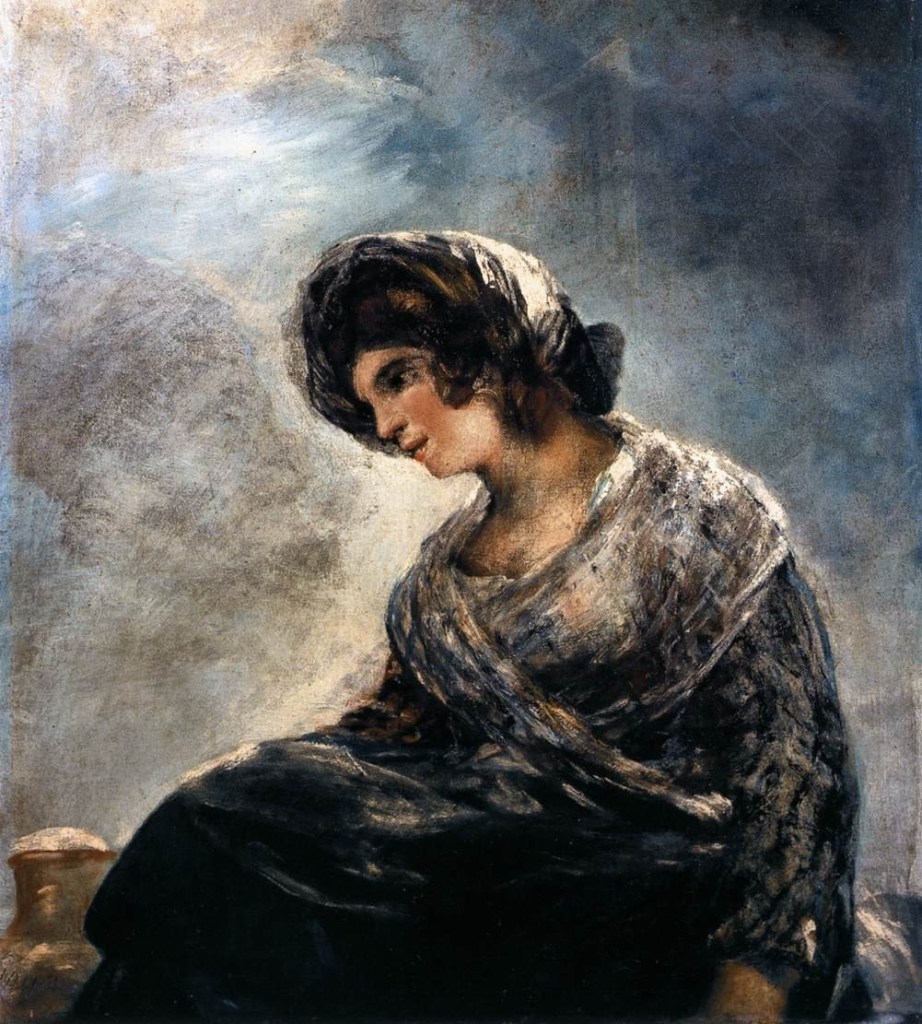


 The Argumentative Old Git
