
NBI or NBI Incorporated was a computer company based out of the state of Colorado that went out of business in 1991. They seemed to have mostly focused on word processing but they did release IBM-compatible computers, one of which we will be looking at today.
The NBI 4200 is a 10MHz 286-based PC. The case is a beige desktop and pretty standard-looking for the era with three 5 1/4 drive bays on the far right.

On the left and below the case label we have a keylock system as well as a reset button and lights for power and hard disk activity. The reset button seems to use a dome switch and only requires a light press to activate, overall it’s pretty unsatisfying. The power LED is a bit interesting as it has the default CPU speed listed under it. There is no turbo button on this case so I assume there is some keyboard key press combo that will downclock the system speed and presumably change the LED light color. There is a jumper (JP 11) which does control startup CPU speed (10 or 6MHz) so a switch could conceivably be hooked up.
I also have the matching keyboard that goes with this machine. It’s a standard AT keyboard but it does have four LED lights on it instead of the usual three, with one being a power indicator LED.


Let’s take a look at the back of the case.

On the back, we have a power switch along with a three-prong connector for attaching a power cable as well as a connector for hooking up a monitor directly to the PC’s power supply. Other than that we have an AT keyboard connector and eight expansion slots conveniently labeled, no built-in I/O at all.
On the label, we do have MPF-PC/900 listed as the model number but if you Google NBI 4200 you can find a jumper manual for the motherboard
Taking the top off the case we can see inside.

There are two cards currently installed. One is the floppy drive/hard drive controller card and the second being a parallel port/MDA video combo card. There is a bay for a hard drive located to the left of the 1.2MB 5 1/4 floppy drive. Unfortunately, I removed the drive before documenting it so I’m not sure what model it was but I believe it was either a 10 or 21MB Seagate MFM drive.

The floppy/hard drive controller card is a 16-bit ISA Western Digital WD-1003-WA2. This card can support high-density 1.44 and 1.2MB floppy drives as well as MFM and RLL hard drives.

The video card installed is a Multitech MGA-PC PB85005-7F. This is a combination of parallel port and monochrome MDA video card. This card is interesting being that Multitech from what I gather was the company that eventually became Acer. This card also supposedly supports Hercules video mode though I was unable to confirm this.


The motherboard is also a Multitech branded board with the model designation MPF-PC/900-2. It also appears other branded PCs use this board as well in the same case but with different branding such as the Accel 900. The motherboard itself is also very large with a high chip count which is typical of earlier 286 motherboards. The board features a typical eight ISA slots, six being 16-bit and two 8-bit.

*Note that I was unable to access any type of BIOS or setup for this motherboard nor could I find any directions from the scant information online. It may use an uncommon key press combo to access it OR this machine may require a setup disk much like early IBM and some early Compaq systems.
1 ) CPU – the CPU, although unmarked here is a ceramic 10MHz 286. This puts it in the mid-range of power for a 286 and should still be able to acceptably play all your CGA and EGA titles as well as some early VGA ones as well. The 10MHz 286 is a bit of an uncommon sight as I’m more used to seeing its 12MHz big brother. The chip and socket are also in the LCC form factor. There are no pins on the relatively flat chip which is kept in place with a latch mechanism. This latch presses the CPU down on contact plates to create a connection to the board.

2) RAM – currently there is 512K of memory soldered onto the motherboard directly with sockets to add an additional 512k for a 1MB total. 1MB is enough for most 286-oriented tasks as well as enough for most games this machine would run acceptably. Unfortunately having the first 512K soldered onto the board can create issues when RAM goes bad as it necessitates removing the board itself and desoldering bad RAM and either preferably soldering on a socket or simply soldering on good RAM in its place.

Unfortunately with this particular PC, some of the initial 512k RAM has gone bad resulting in random lockups when in use.
3) NPU – There is a socket which I strongly suspect is for adding a 80287 math co-processor but was unable to confirm this. I also could not locate any jumper for either enabling a math-co processor chip or for setting synchronous/asynchronous speed with one. The jumper manual on Statson does indicate a 287 as an option for this board.
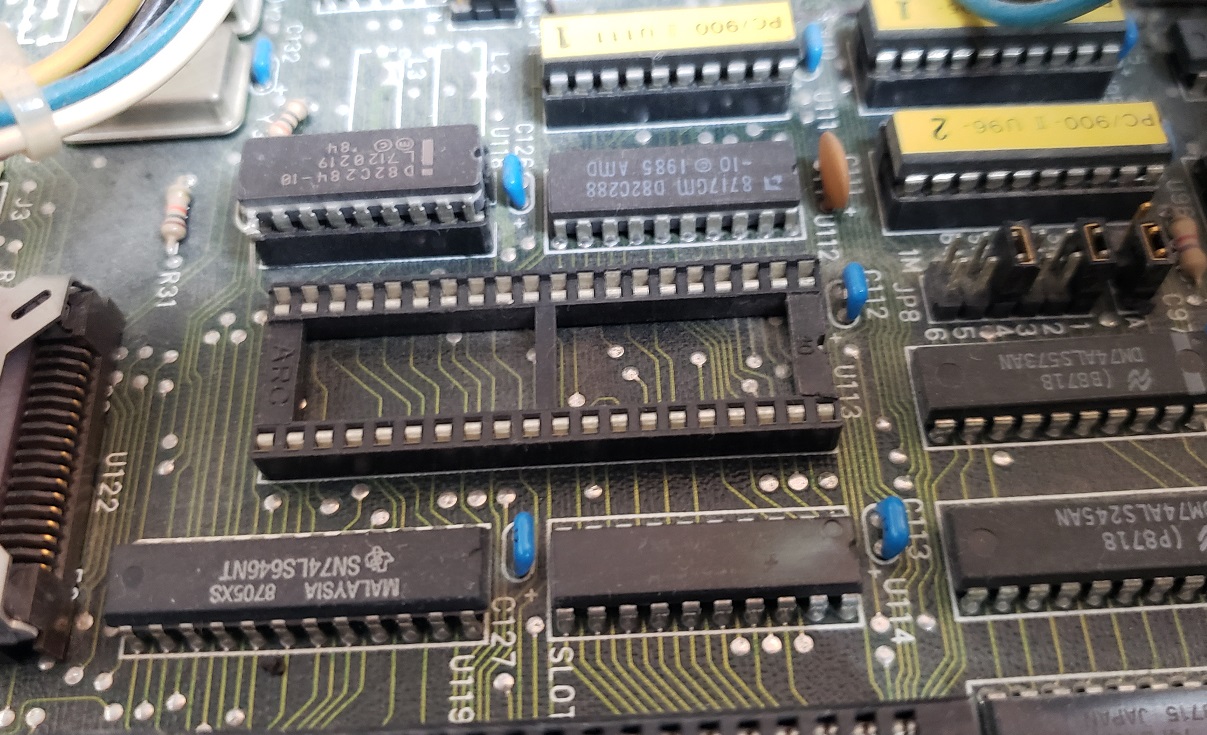
4) There is a large switch block located at the edge of the motherboard. It seems to mostly be used to set settings for “BIOS selection” between 27128 and 27256. My guess is this has something to do with ROM size. Switch 4 does select between if you’re using a monochrome or color monitor.

5) Piezo speaker
6) AT power connector

The NBI 4200 is an interesting example of an 80s mid-tier 286 and could make a capable retro DOS machine for primarily earlier CGA and EGA titles. It could be made more powerful with the addition of a modern hard drive solution, an ISA VGA card, and perhaps a memory expansion add-on card. The case is also nice and large with solid construction. There are better solutions though such as any of Tandy’s offerings from the era or a slightly later and more integrated 286 motherboards featuring a 12MHz CPU and higher reliability, the NBI doesn’t really offer any unique features besides its case with a little 10MHz label and a power LED on the keyboard. The soldered-on memory is a big negative since it is prone to fail and leaves the user with no simple solution to easily replace it.


 ancientelectronics