

Firecrawl (firecrawl.dev) is a managed web data API built specifically for AI agents and LLM applications, converting any URL, whole site, or live web query into clean, tokenizer-friendly markdown or structured JSON. Instead of standing up Playwright or Puppeteer and writing custom parsing logic for every target site, a developer sends a single API call and gets back content with navigation, ads, and boilerplate already stripped out.
AI and ML engineers building retrieval-augmented generation pipelines, autonomous agents, and LLM training datasets make up the core of Firecrawl's user base, since the API is designed around what a language model actually needs from web content rather than raw HTML. The project is open source with more than 130,000 GitHub stars, and it also ships pre-built integrations for AI coding assistants like Claude Code, Cursor, and Windsurf so agents can fetch and use it directly.
How Firecrawl Works
At the center of Firecrawl is a family of endpoints covering the full find-extract-clean-use workflow: Search runs live web queries and returns full page content rather than just links, Scrape converts a single URL's HTML and JavaScript-rendered content into clean markdown or structured JSON, Crawl performs depth-first traversal of an entire domain while respecting robots.txt and rate limits, and Map quickly discovers a site's structure before a larger crawl begins. A separate Extract endpoint pulls structured data out of a page based on a prompt or schema, which matters because LLMs generally work better with organized fields than a wall of raw text. For content behind logins or dynamic interactions, the Interact endpoint manages a full browser session automatically, and a Parse endpoint handles document formats like PDFs and DOCX files alongside standard web pages.
Key Features
- Scrape endpoint: converts any URL into clean, LLM-ready markdown, structured JSON, or screenshots, handling JavaScript rendering automatically
- Crawl endpoint: discovers and scrapes every subpage on a domain, with path regex, depth limits, and subdomain rules to scope the crawl
- Map endpoint: generates a fast overview of a site's structure and pages before committing to a full crawl
- Extract endpoint: pulls structured data from a page based on a prompt or JSON schema rather than requiring manual parsing
- Search endpoint: returns full page content for live web queries, not just a list of links or snippets
- Interact endpoint: managed browser automation for dynamic pages and authenticated, multi-step flows
- Boilerplate removal: automatically strips navigation, footers, and ad containers, cutting typical page content from tens of thousands of tokens down to a few thousand
- Agent onboarding and MCP support: pre-built setup for Claude Code, Cursor, Windsurf, and other AI coding assistants via Skills, CLI, or MCP
- Open source core: the underlying engine is open source and self-hostable in addition to the managed API
Firecrawl Pricing
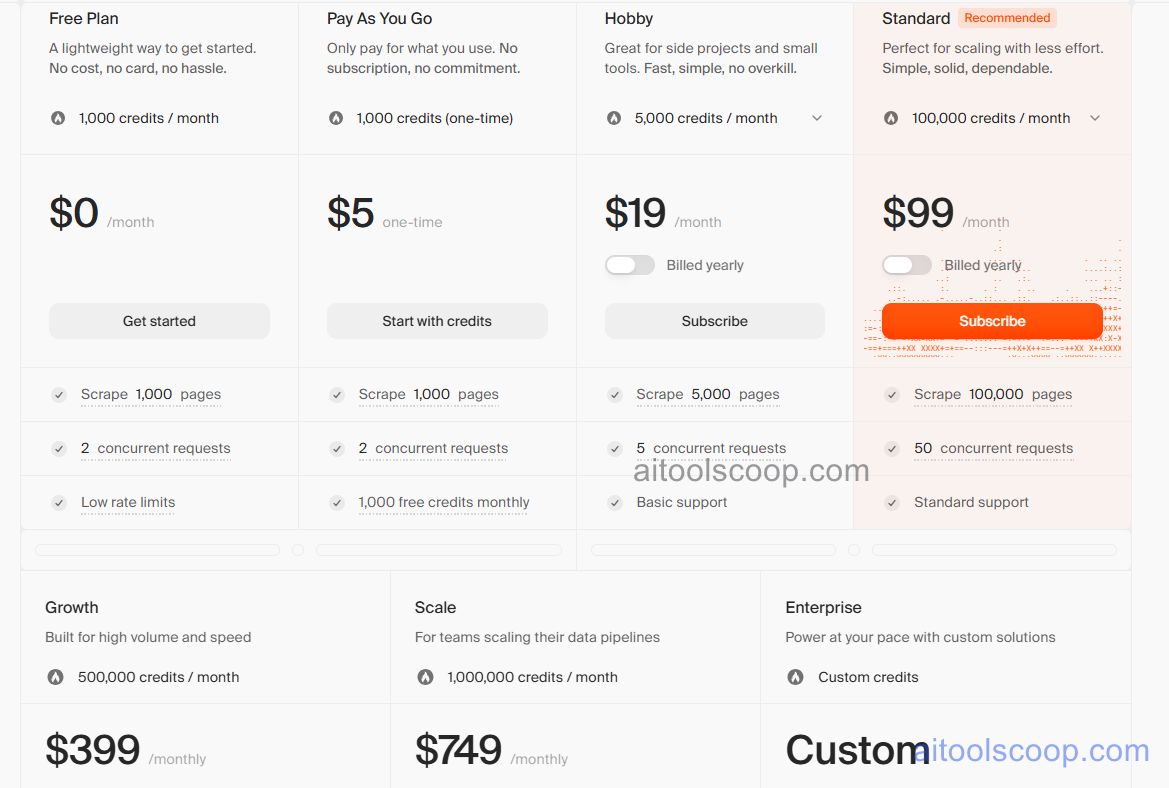
- Free — $0/month — 1,000 credits/month, roughly 1,000 pages scraped, 2 concurrent requests, and low rate limits, with no card required to start.
- Pay As You Go — $5 one-time — 1,000 credits with no subscription or ongoing commitment, roughly 1,000 pages scraped, 2 concurrent requests, and 1,000 free credits monthly on top.
- Hobby — $19/month (from $16/month billed annually) — 5,000 credits/month, roughly 5,000 pages scraped, 5 concurrent requests, and basic support, built for side projects and small tools.
- Standard — $99/month (from $83/month billed annually) — 100,000 credits/month, roughly 100,000 pages scraped, 50 concurrent requests, and standard support, recommended for scaling with less manual effort.
- Growth — $399/month (from $333/month billed annually) — 500,000 credits/month for high-volume, high-speed scraping needs.
- Scale — $749/month (from $599/month billed annually) — 1,000,000 credits/month for teams scaling large data pipelines.
- Enterprise — Custom credits and pricing — for teams needing volume and terms beyond the published tiers, priced individually.
Credit usage varies by endpoint and page complexity; a standard scrape typically costs 1 credit while JavaScript-heavy or Extract calls can cost more. Annual billing lowers the effective monthly rate on every subscription tier. Pricing verified from firecrawl.dev; rates may change — always confirm current pricing at firecrawl.dev.
Who Should Use Firecrawl?
Developers building any kind of AI application that needs live web data — a RAG pipeline, a research agent, a competitive-intelligence tool — are the clearest fit for Firecrawl, since it removes the usual overhead of maintaining a custom scraping and cleaning stack. The Free plan and $5 Pay As You Go option are enough to prototype an integration or handle a small, one-off project without any ongoing commitment. Hobby suits individual developers and small side projects with modest, regular scraping needs, while Standard is where most production applications land once they need meaningfully higher volume and concurrency without managing infrastructure themselves. Growth and Scale exist for teams running large-scale data pipelines or training data collection at real volume, and Enterprise covers custom requirements beyond the published tiers. Teams that need only a handful of scrapes a month, or that already have a mature in-house scraping stack, may not see enough marginal benefit to justify moving off what they've already built.
Frequently Asked Questions
What does Firecrawl actually return from a URL?
Firecrawl converts a URL's content into clean markdown, structured JSON, or screenshots, stripping out navigation, ads, and other boilerplate so the output is ready for direct use in an LLM prompt or a RAG pipeline, rather than requiring separate HTML parsing.
Is there a free way to try Firecrawl?
Yes, the Free plan includes 1,000 credits per month with no credit card required, covering roughly 1,000 scraped pages at 2 concurrent requests. A $5 one-time Pay As You Go option is also available for testing without any ongoing subscription.
Does Firecrawl require running my own browser or Playwright setup?
No. Firecrawl is a managed API service, so it doesn't require a local browser, Playwright, or Puppeteer installation to operate — JavaScript rendering, proxies, and rate limiting are all handled on Firecrawl's side of the API call.
What's the difference between Scrape, Crawl, and Map?
Scrape handles a single URL and returns its cleaned content. Crawl performs depth-first traversal to discover and scrape every subpage across a domain. Map generates a fast overview of a site's structure and pages, useful for understanding a domain before committing to a full crawl.
Can Firecrawl connect directly to AI coding assistants like Cursor?
Yes. Firecrawl provides agent onboarding support and MCP (Model Context Protocol) integration for AI coding assistants including Claude Code, Cursor, and Windsurf, letting an agent set up an API key and start scraping directly from its own workflow.


