

Fibery (fibery.io) takes a different starting point than most work management tools: instead of shipping with a fixed set of views for tasks, docs, or roadmaps, it gives teams custom databases they can shape around their actual process, then connects those databases to each other so information flows between teams instead of living in disconnected apps. A product team can link customer feedback to features, features to releases, and releases to company goals, all inside one workspace, rather than maintaining that connective tissue manually across a CRM, a roadmap tool, and a docs app. Founded in 2017 by the team behind Targetprocess, Fibery serves product teams, software companies, and operations-heavy organizations that have outgrown rigid, single-purpose tools.
What distinguishes Fibery from a Notion-style flexible workspace is its relational structure: databases aren't just pages with properties, they're proper entities that can be linked across the workspace, queried, and visualized through formulas, charts, and dashboards. Automations handle repeatable steps — creating a task at the start of a sprint, assigning a reviewer when a story is marked done — and Fibery AI can summarize notes, polish written content, and generate ideas directly inside the workspace. A free plan supporting up to 10 users, with no credit card required, makes it accessible for smaller teams to build out their own structure before committing to a paid tier.
How Fibery Works
A workspace starts by choosing between a pre-built template or a custom setup based on the team's existing process, then building out the core databases that matter most — features, customers, tasks, insights, campaigns, or support requests, depending on the team's focus. Each database supports a full range of custom field types, from simple text and number fields to powerful formulas, and databases can be connected to each other in any direction to reflect real work relationships, such as linking a customer insight to the feature it inspired and that feature to the release it eventually ships in. Automations can be layered on top of these connections to handle repeatable steps automatically, and Fibery AI is available throughout the workspace to summarize long documents, refine written content, or help brainstorm ideas without leaving the platform. Dashboards and reports — including velocity charts, burn-up/down charts, and cumulative flow diagrams — pull data across connected databases to visualize progress in a way a single-purpose tool typically can't.
Key Features
- Custom databases: builds entities for any kind of information — features, customers, bugs, campaigns, research — with fully customizable fields
- Connected relationships: links records across different databases in any direction to reflect real work and data relationships
- Documents and whiteboards: combines rich-text docs and visual whiteboards with structured data inside the same workspace
- Fibery AI: summarizes notes, polishes written content, and generates ideas directly within the platform
- Automations: triggers repeatable actions automatically, such as creating tasks at sprint start or assigning reviewers when work is marked done
- Custom apps and JS automations (Pro/Enterprise): extends the platform further with scripting and custom application logic for advanced workflows
- Dev tool integrations: syncs pull requests, branches, and commits from GitHub or GitLab, linking them automatically to related stories and bugs
- Dashboards and reports: builds velocity, burn-up/down, cumulative flow diagrams, and other visualizations pulling from connected databases
- Version history: tracks changes across documents and work entities, with the ability to restore earlier versions
- Advanced permissions and SSO (Enterprise): supports SAML SSO, SCIM provisioning, and granular access control for larger organizations
Fibery Pricing
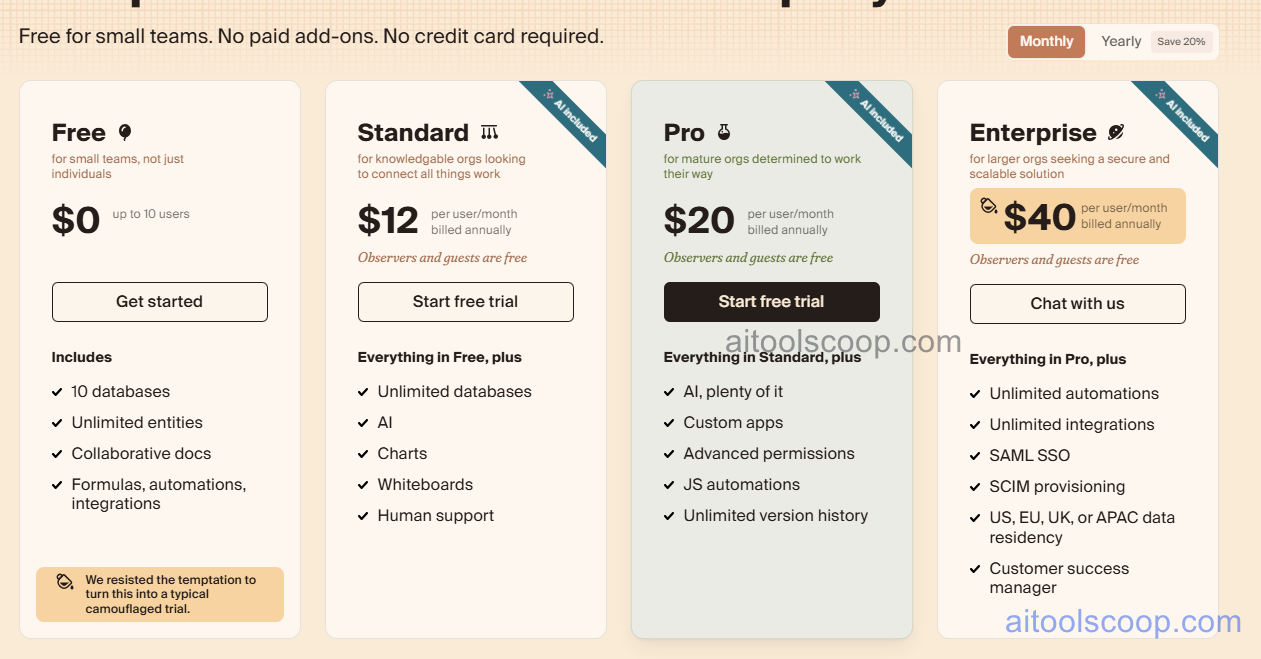
- Free — $0, up to 10 users — 10 databases, unlimited entities, collaborative docs, and formulas, automations, and integrations. Free for small teams, no paid add-ons, no credit card required.
- Standard — $15/month per user (from $12/month per user billed annually) — everything in Free, plus unlimited databases, AI, charts, whiteboards, and human support. Observers and guests are free. Aimed at knowledgeable orgs looking to connect all things work.
- Pro — $24/month per user (from $20/month per user billed annually) — everything in Standard, plus more AI capacity, custom apps, advanced permissions, JS automations, and unlimited version history. Observers and guests are free. Built for mature orgs determined to work their own way.
- Enterprise — $50/month per user (from $40/month per user billed annually) — everything in Pro, plus unlimited automations, unlimited integrations, SAML SSO, SCIM provisioning, US/EU/UK/APAC data residency, and a dedicated customer success manager. Observers and guests are free.
All paid plans start with a free trial. Annual billing saves 20% compared to paying monthly. Discounted custom pricing is available for startups and non-profits. Pricing verified from fibery.io; rates may change — always confirm current pricing at fibery.io.
Who Should Use Fibery?
Small teams just starting to outgrow simple task lists or spreadsheets, and wanting to connect docs, tasks, and structured data without paying anything upfront, can genuinely run day-to-day operations on the free plan for up to 10 users. Growing organizations that need every team on the same connected workspace — product, support, and marketing all referencing the same underlying data — are the clearest fit for Standard, where unlimited databases and AI unlock the platform's core relational advantage. Established product and engineering teams building custom internal apps, needing advanced permissions, or wanting JS-level automation control should look at Pro. Larger enterprises with compliance and security requirements — SSO, SCIM provisioning, specific data residency — will need Enterprise, given that those capabilities aren't available on the lower tiers. Teams wanting a rigid, opinionated tool built for one specific workflow (like a pure Kanban board or a simple to-do list) may find Fibery's flexibility is more setup than they actually need.
Frequently Asked Questions
Is Fibery's free plan really free, or a disguised trial?
Fibery's own pricing page states they "resisted the temptation to turn this into a typical camouflaged trial." The free plan supports up to 10 users with 10 databases, unlimited entities, collaborative docs, and core automations and integrations, with no credit card required.
What makes Fibery different from a typical project management tool?
Rather than shipping with fixed views for tasks or docs, Fibery lets teams build custom databases for any kind of information and connect those databases to each other, so data like customer feedback, features, and releases can be linked and queried across the whole workspace instead of staying siloed.
What's the difference between the Standard, Pro, and Enterprise plans?
Standard unlocks unlimited databases, AI, charts, and whiteboards. Pro adds more AI capacity, custom apps, advanced permissions, and JS automations. Enterprise adds unlimited automations and integrations, SAML SSO, SCIM provisioning, regional data residency, and a dedicated customer success manager.
Does Fibery include AI features across all plans?
Basic AI is included starting on the Standard plan, with expanded AI capacity ("AI, plenty of it") available on Pro and above. The free plan does not include AI features.
Are guest and observer accounts included in the per-user pricing?
No. Observers and guests are free on Standard, Pro, and Enterprise, so organizations only pay per active editing user rather than for everyone who needs read-only or limited access to the workspace.


