

ERP.AI (erp.ai) positions itself less as a traditional ERP and more as an enterprise AI agent platform that sits on top of a company's data and processes. Instead of shipping a fixed set of finance, HR, or supply chain modules, it offers what the company calls an Enterprise AI App Store — a way to generate department-specific applications from a written description and hand routine work off to autonomous agents that keep running after setup. The platform is built for mid-size and larger organizations juggling scattered systems across finance, sales, operations, and HR.
What separates ERP.AI's approach to enterprise automation from most SaaS competitors is its emphasis on data sovereignty. Every tier can run in a private cloud or fully on-premises, so a company's records and intellectual property never have to leave its own environment to get AI-driven insight. That matters most to organizations in regulated industries or anyone who has been reluctant to route sensitive operational data through third-party AI infrastructure just to automate a workflow.
How ERP.AI Works
Underneath the app-generation layer sits a knowledge graph built on graph neural network research, which the platform uses to map how records, people, and processes across a business actually relate to one another rather than treating each department's data as a separate silo. A written prompt against the Enterprise AI App Store turns into a working CRM, HR tracker, or procurement tool in minutes, complete with the fields and logic implied by the request. Autonomous agents then operate against that same knowledge graph continuously, executing multi-step processes — reconciling records, flagging anomalies, routing approvals — without needing to be re-triggered for each run. A separate Deep Research capability lets users query the unified graph directly for answers that would otherwise require pulling reports from several disconnected systems.
Key Features
- Enterprise AI App Store: generates CRM, HR, finance, procurement, and other department tools from a plain-text description, without requiring a development queue
- Autonomous AI agents: run assigned business processes continuously in the background rather than waiting on manual triggers each time
- Knowledge graph architecture: built on graph neural network research to model how enterprise data connects across departments and return context-aware answers quickly
- Deep Research: a dedicated module for pulling structured answers directly out of the unified knowledge graph
- On-premises and private cloud deployment: keeps data inside the customer's own environment instead of external AI infrastructure
- Agent credits and record limits: usage-based caps that scale with each plan and determine how much automation and data volume it supports
- Custom branding and APIs & Sandbox (Business and up): white-labeling plus a sandbox for testing integrations before going live
- Multi-org and cross-entity reporting (Enterprise): consolidated reporting across multiple business units or subsidiaries
- Custom integrations and dedicated support (Enterprise): tailored connections to existing systems backed by direct vendor support
ERP.AI Pricing
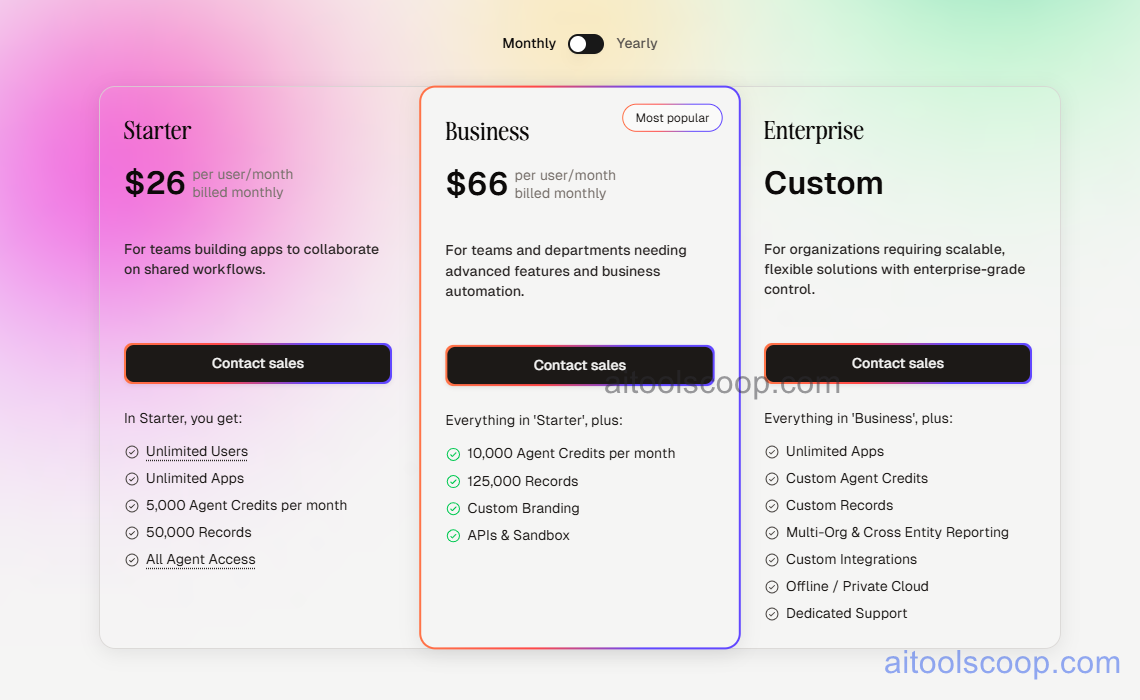
- Starter — $26/user/month (from $19/user/month billed annually) — unlimited users and apps, 5,000 agent credits per month, 50,000 records, and access to all agents. Covers a team standing up its first set of shared workflows.
- Business — $66/user/month (from $49/user/month billed annually) — everything in Starter, plus 10,000 agent credits per month, 125,000 records, custom branding, and APIs & Sandbox. Built for departments running heavier automation.
- Enterprise — Custom pricing — everything in Business, plus unlimited apps, custom agent credits and records, multi-org and cross-entity reporting, custom integrations, offline/private cloud deployment, and dedicated support.
All tiers require contacting sales rather than self-serve checkout; there is no permanent free plan. Annual billing lowers the effective monthly rate on both published tiers. Pricing verified from erp.ai; rates may change — always confirm current pricing at erp.ai/pricing.
Who Should Use ERP.AI?
Organizations already running several disconnected systems for finance, sales, HR, and operations are the clearest fit for ERP.AI, particularly if IT can't keep up with requests for new internal tools. Starter suits a single team piloting shared workflows and app generation; Business fits departments that need custom branding and API access for deeper integration work; Enterprise makes sense for multi-entity organizations that need cross-org reporting and a private or offline deployment. Companies in regulated industries, or anyone who has held off on AI automation specifically because of data-residency concerns, get the most out of the on-premises option. Smaller teams without a sales conversation's worth of budget, or anyone wanting to self-serve sign up and start immediately, will likely find the contact-sales-only model slower than a typical SaaS trial.
Frequently Asked Questions
What does ERP.AI actually do?
ERP.AI is an enterprise automation platform that generates AI-powered business applications from text descriptions and runs autonomous agents against a company's unified data. Rather than shipping fixed ERP modules, it lets teams build CRM, HR, finance, or procurement tools on demand and hand recurring processes off to agents that operate continuously.
How much does ERP.AI cost?
Starter is $26/user/month billed monthly, or from $19/user/month billed annually. Business is $66/user/month billed monthly, or from $49/user/month billed annually. Enterprise is custom-priced. All plans require contacting sales rather than a self-serve checkout.
Is there a free version of ERP.AI?
No. ERP.AI does not offer a permanent free tier; every plan, including Starter, goes through a sales conversation before access is granted.
Can ERP.AI run entirely on our own infrastructure?
Yes. On-premises and private cloud deployment are available, which keeps data and processing inside the customer's own environment instead of relying on external AI infrastructure. This option is highlighted specifically for organizations with strict data-residency or compliance requirements.
Who is ERP.AI built for?
ERP.AI targets mid-size to large organizations managing multiple disconnected business systems across departments. Starter fits a single team getting started with shared workflows, Business suits departments needing deeper API access and branding, and Enterprise is aimed at multi-entity organizations needing custom integrations and cross-org reporting.


