

Albato (albato.com) positions itself as a lower-cost, no-code alternative to Zapier and Make, connecting more than 800 SaaS applications — CRMs, e-commerce platforms, communication tools, and AI models like ChatGPT and Gemini — through a trigger-and-action automation builder. Rather than manually copying data between disconnected tools, users define a trigger event in one app (a new lead in a CRM, a new row in a spreadsheet) and one or more resulting actions in another (a Slack message, a Mailchimp contact), and Albato handles the rest in the background. Small and medium businesses on tighter software budgets, along with SaaS companies wanting to offer white-labeled integrations inside their own product, make up the platform's two main audiences.
Founded in Lisbon in 2018, Albato has built out a feature set that goes beyond basic linear automations: routers, iterators, aggregators, delay steps, and error handling give workflows real branching logic rather than a single straight path from trigger to action, and a built-in Albato AI feature can pick the right action automatically within a workflow. For apps not covered by Albato's existing library, the no-code App Integrator lets users build a custom connection themselves rather than waiting on the vendor to add support. An embedded, white-label version of the platform is also available for SaaS companies wanting to offer native-feeling integrations to their own customers under their own brand.
How Albato Works
Building an automation starts by selecting a trigger app and the specific event that should kick off the workflow — a new form submission, a new deal stage, an incoming email — then choosing one or more connected apps to receive an action once that trigger fires. Data can be filtered, transformed, or routed conditionally between the trigger and the final action using Albato's built-in tools: a router to send data down different paths based on conditions, an iterator to loop through multiple items, an aggregator to combine data from several steps, and error handling to manage failures gracefully. Once configured, the automation runs continuously in the cloud, executing in near real-time as trigger events occur, with logs retained so past runs can be reviewed if something doesn't behave as expected. For apps Albato doesn't already support, the App Integrator provides a no-code way to build a custom connection to that app's API without needing developer resources.
Key Features
- 800+ app integrations: connects CRMs, e-commerce platforms, marketing tools, communication apps, and AI models like ChatGPT and Gemini
- No-code trigger-action builder: creates automated workflows between apps without writing code, using a visual builder
- App Integrator: builds custom connections to apps not already in Albato's library, without developer involvement
- Advanced workflow tools: includes routers, iterators, aggregators, delay steps, and error handling for branching, looping automation logic
- Albato AI: automatically selects the right action within a workflow step rather than requiring it to be manually specified every time
- Data migration and auto replay: re-runs failed automation steps and migrates historical data into new workflows (Pro and above)
- Unlimited automations and steps (Pro and above): removes the automation and step-count caps present on the free plan
- Embedded, white-label integration: lets SaaS companies offer Albato's integration capabilities natively inside their own product under their own branding
- Log storage and automation update speed: retains automation run logs and reduces the delay before an automation reflects a triggering event, scaling by plan
- Team collaboration (Teams plan): supports shared workspaces, projects, role-based invitations, and multiple team seats
Albato Pricing
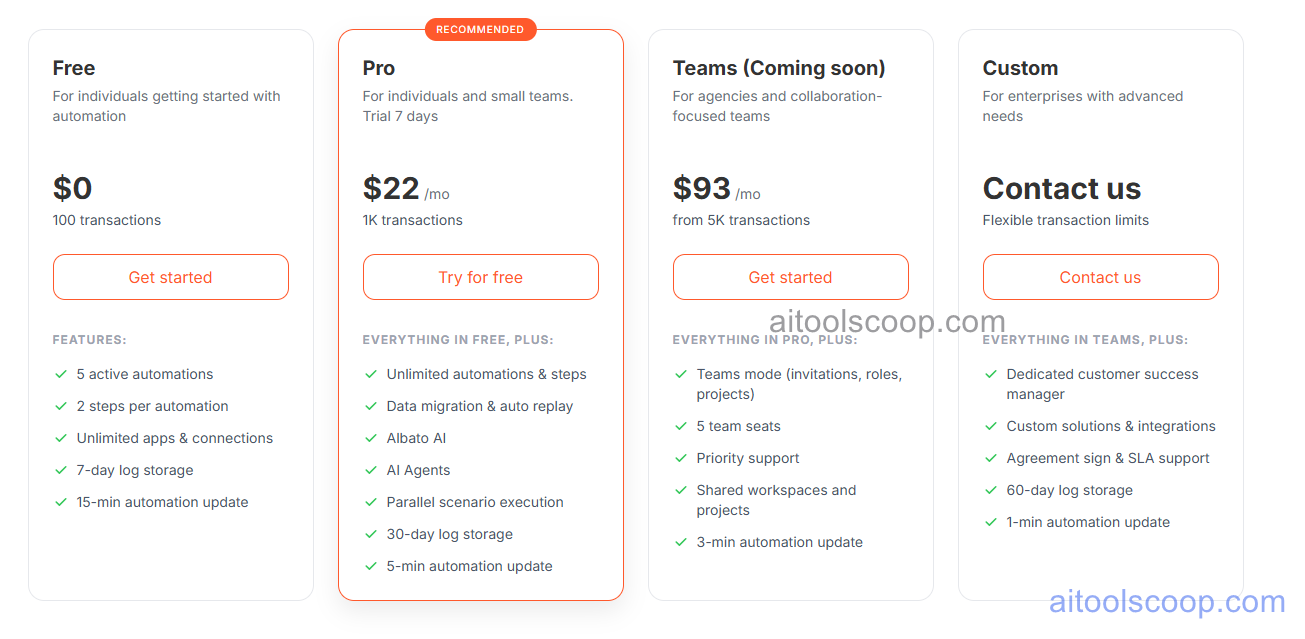
- Free — $0, 100 transactions — 5 active automations, 2 steps per automation, unlimited apps and connections, 7-day log storage, and 15-minute automation update speed. Built for individuals getting started with automation.
- Pro — $22/month, 1K transactions (from $15/month billed annually) — everything in Free, plus unlimited automations and steps, data migration and auto replay, Albato AI, AI Agents, parallel scenario execution, 30-day log storage, and 5-minute automation update speed. A 7-day free trial is available. Built for individuals and small teams.
- Teams — $93/month, from 5K transactions (Coming soon; from $65/month billed annually) — everything in Pro, plus Teams mode with invitations, roles, and projects, 5 team seats, priority support, shared workspaces and projects, and 3-minute automation update speed. Built for agencies and collaboration-focused teams.
- Custom — contact for pricing, flexible transaction limits — everything in Teams, plus a dedicated customer success manager, custom solutions and integrations, agreement sign and SLA support, 60-day log storage, and 1-minute automation update speed.
Plans are priced by monthly transaction volume, which scales up the pricing tier as usage grows. Pricing verified from albato.com; rates may change — always confirm current pricing at albato.com.
Who Should Use Albato?
Individuals and very small businesses just getting started with automation can genuinely run a handful of useful workflows — syncing a form to a spreadsheet, posting a Slack alert on a new lead — entirely on the free plan's 5 active automations. Small businesses and solo operators ready to remove the automation and step-count caps, and who want AI-assisted action selection and faster update speeds, are the clearest fit for Pro, particularly given its lower price point relative to Zapier at comparable usage levels. Agencies and collaboration-focused teams managing automations across multiple clients or projects should watch for the Teams plan once it launches, given its dedicated team seats, shared workspaces, and priority support. Larger organizations or SaaS companies wanting to embed Albato's integration capabilities directly into their own product under their own brand, or needing custom SLAs and dedicated support, should reach out for Custom pricing rather than trying to make the standard tiers work at that scale.
Frequently Asked Questions
How many apps does Albato integrate with?
Albato connects to more than 800 SaaS applications, including CRMs, e-commerce platforms, marketing and communication tools, and AI models like ChatGPT and Gemini. For apps not already supported, the no-code App Integrator can build a custom connection.
Does Albato have a free plan?
Yes. The free plan includes 100 transactions, 5 active automations with up to 2 steps each, unlimited app connections, and 7-day log storage, enough to automate a handful of simple recurring tasks at no cost.
How is Albato priced compared to a fixed monthly fee?
Albato's paid plans are priced according to monthly transaction volume, starting at 1K transactions on Pro and scaling from 5K transactions on Teams, so the cost tracks how much automation activity a business actually runs each month.
What happens if an app isn't already supported by Albato?
Albato's App Integrator lets users build a no-code connection to an app's API themselves, without waiting for the vendor to add official support or requiring developer resources to build a custom integration from scratch.
Can Albato be embedded into another company's product?
Yes. Albato offers an embedded, white-label version of its integration platform, letting SaaS companies present Albato's connection and automation capabilities as a fully native part of their own product under their own branding.


